
Electrical Engineering
GATE EE concept:no-load PYQs
Build your understanding with focused practice from past exam papers.
How to practice concept:no-load
Attempt a question, record the concept and assumptions, then check the available answer. Rework mistakes after revising the relevant concepts. Topic tags can overlap; review the question context.
Questions 1–10 of 12. Imported answers require independent review unless marked reviewed.
Question 31
Open questionEEMSQ1 markNeeds review
A 220V/12V single-phase transformer is designed for use in India and rated 100 VA at 50 Hz. Later, this unit is shipped to the USA where it is used as a 110V/6V transformer at 60 Hz.
Which of the following statements is/are correct?
Your answerSelect all correct options. You can choose more than one.
Log in to check the answer
You can attempt this question now. Sign in to view the answer key, explanations and discussion.Log in to check answerQuestion 35
Open questionEENAT1 markNeeds review
The induced emf in a 3 kV, 4 pole, 3-phase star connected synchronous motor is considered to be equal and in phase with the terminal voltage under no load condition. On application of a mechanical load, the induced emf phasor is deflected by an angle of 2° mechanical with respect to the terminal voltage phasor. If the synchronous reactance is
, and stator resistance is negligible, then the motor armature current magnitude, in ampere, during loaded condition is closest to, __________ (round off to two decimal places).Log in to check the answer
You can attempt this question now. Sign in to view the answer key, explanations and discussion.Log in to check answerQuestion 55
Open questionEENAT2 marksNeeds review
A 5 kW, 220 V DC shunt motor has 0.5
armature resistance including brushes. The motor draws a no-load current of 3 A. The field current is constant at 1 A. Assuming that the core and rotational losses are constant and independent of the load, the current (in amperes) drawn by the motor while delivering the rated load, for the best possible efficiency, is ________ (rounded off to 2 decimal places).Log in to check the answer
You can attempt this question now. Sign in to view the answer key, explanations and discussion.Log in to check answerQuestion 65
Open questionEENAT2 marksNeeds review
A 3-phase, 415 V, 4-pole, 50 Hz induction motor draws 5 times the rated current at rated voltage at starting. It is required to bring down the starting current from the supply to 2 times of the rated current using a 3-phase autotransformer. If the magnetizing impedance of the induction motor and no load current of the autotransformer is neglected, then the transformation ratio of the autotransformer is given by ____________. (round off to two decimal places).
Log in to check the answer
You can attempt this question now. Sign in to view the answer key, explanations and discussion.Log in to check answerQuestion 17
Open questionEENAT1 markNeeds review
A three-phase, 50 Hz, 4-pole induction motor runs at no-load with a slip of 1 %. With full load, the slip increases to 5 %. The % speed regulation of the motor (rounded off to 2 decimal places) is ____________.
Log in to check the answer
You can attempt this question now. Sign in to view the answer key, explanations and discussion.Log in to check answerQuestion 21
Open questionEENAT1 markNeeds review
A single-phase, 4 kVA, 200 V/100 V, 50 Hz transformer with laminated CRGO steel core has rated no-load loss of 450 W. When the high-voltage winding is excited with 160 V, 40 Hz sinusoidal ac supply, the no-load losses are found to be 320 W. When the high-voltage winding of the same transformer is supplied from a 100 V, 25 Hz sinusoidal ac source, the no-load losses will be ________ W (rounded off to 2 decimal places).
Log in to check the answer
You can attempt this question now. Sign in to view the answer key, explanations and discussion.Log in to check answerQuestion 28
Open questionEEMCQ2 marksNeeds review
A 250 V dc shunt motor has an armature resistance of 0.2
and a field resistance of 100
. When the motor is operated on no-load at rated voltage, it draws an armature current of 5 A and runs at 1200 rpm. When a load is coupled to the motor, it draws total line current of 50 A at rated voltage, with a 5 % reduction in the air-gap flux due to armature reaction. Voltage drop across the brushes can be taken as 1 V per brush under all operating conditions. The speed of the motor, in rpm, under this load condition, is closest to:Your answerChoose one option.
Log in to check the answer
You can attempt this question now. Sign in to view the answer key, explanations and discussion.Log in to check answerQuestion 48
Open questionEENAT2 marksNeeds review
Windings ‘A’, ‘B’ and ‘C’ have 20 turns each and are wound on the same iron core as shown, along with winding ‘X’ which has 2 turns. The figure shows the sense (clockwise/anti-clockwise) of each of the windings only and does not reflect the exact number of turns. If windings ‘A’, ‘B’ and ‘C’ are supplied with balanced 3-phase voltages at 50 Hz and there is no core saturation, the no-load RMS voltage (in V, rounded off to 2 decimal places) across winding ‘X’ is ______.
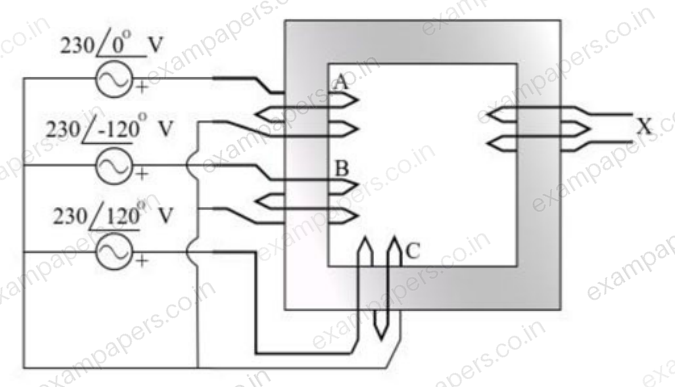
Log in to check the answer
You can attempt this question now. Sign in to view the answer key, explanations and discussion.Log in to check answerQuestion 46
Open questionEENAT2 marksNeeds review
A 220 V DC shunt motor takes 3 A at no-load. It draws 25 A when running at full-load at 1500 rpm. The armature and shunt resistances are 0.5 Ω and 220 Ω, respectively. The no-load speed in rpm (round off to two decimal places) is __________.
Log in to check the answer
You can attempt this question now. Sign in to view the answer key, explanations and discussion.Log in to check answerQuestion 24
Open questionEENAT1 markNeeds review
A separately excited dc motor has an armature resistance
. The field excitation is kept constant. At an armature voltage of 100 V, the motor produces a torque of 500 Nm at zero speed. Neglecting all mechanical losses, the no-load speed of the motor (in radians/s) for an armature voltage of 150 V is ____ (up to 2 decimal places).Log in to check the answer
You can attempt this question now. Sign in to view the answer key, explanations and discussion.Log in to check answer