
Electrical Engineering
GATE EE discipline:electrical-electronics-and-instrumentation PYQs
Build your understanding with focused practice from past exam papers.
Questions 81–90 of 715. Imported answers require independent review unless marked reviewed.
Question 16
Open questionEEMCQ1 markNeeds review
Which one of the following statements is true about the small signal voltage gain of a MOSFET based single stage amplifier?
Your answerChoose one option.
Log in to check the answer
You can attempt this question now. Sign in to view the answer key, explanations and discussion.Log in to check answerQuestion 17
Open questionEEMCQ1 markNeeds review
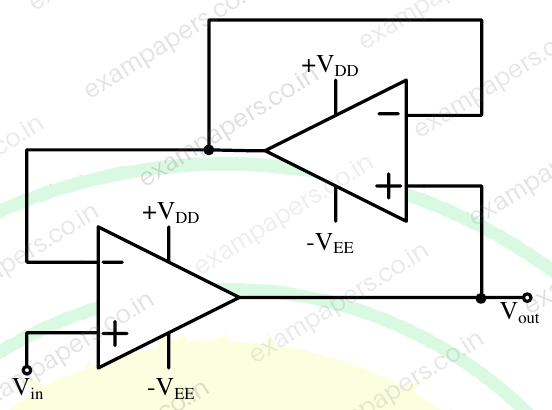
Assuming ideal op-amps, the circuit represents a
Your answerChoose one option.
Log in to check the answer
You can attempt this question now. Sign in to view the answer key, explanations and discussion.Log in to check answerQuestion 18
Open questionEEMCQ1 markNeeds review
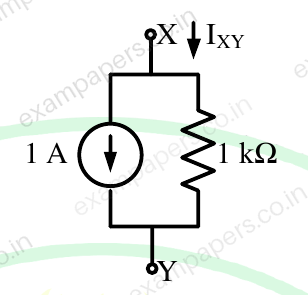
The I-V characteristics of the element between the nodes X and Y is best depicted by
Your answerChoose one option.
Log in to check the answer
You can attempt this question now. Sign in to view the answer key, explanations and discussion.Log in to check answerQuestion 19
Open questionEEMCQ1 markNeeds review
A nullator is defined as a circuit element where the voltage across the device and the current through the device are both zero. A series combination of a nullator and a resistor of value, R, will behave as a
Your answerChoose one option.
Log in to check the answer
You can attempt this question now. Sign in to view the answer key, explanations and discussion.Log in to check answerQuestion 20
Open questionEEMCQ1 markNeeds review
Consider a discrete-time linear time-invariant (LTI) system
, where
where
is the discrete-time unit impulse function. For an input signal
, the output
isYour answerChoose one option.
Log in to check the answer
You can attempt this question now. Sign in to view the answer key, explanations and discussion.Log in to check answerQuestion 21
Open questionEEMCQ1 markNeeds review
Consider a continuous-time signal
where
is the continuous-time unit step function. Let
be the continuous-time unit impulse function. The value of
isYour answerChoose one option.
Log in to check the answer
You can attempt this question now. Sign in to view the answer key, explanations and discussion.Log in to check answerQuestion 22
Open questionEEMCQ1 markNeeds review
Selected data points of the step response of a stable first-order linear time-invariant (LTI) system are given below. The closest value of the time-constant, in sec, of the system is
Time (sec) | 0.6 | 1.6 | 2.6 | 10 | |
|---|---|---|---|---|---|
Output | 0.78 | 1.65 | 2.18 | 2.98 | 3 |
Your answerChoose one option.
Log in to check the answer
You can attempt this question now. Sign in to view the answer key, explanations and discussion.Log in to check answerQuestion 23
Open questionEEMCQ1 markNeeds review
The Nyquist plot of a strictly stable
having the numerator polynomial as
encircles the critical point
once in the anti-clockwise direction. Which one of the following statements on the closed-loop system shown in figure, is correct?
Your answerChoose one option.
Log in to check the answer
You can attempt this question now. Sign in to view the answer key, explanations and discussion.Log in to check answerQuestion 24
Open questionEEMCQ1 markNeeds review
During a power failure, a domestic household uninterruptible power supply (UPS) supplies AC power to a limited number of lights and fans in various rooms. As per a Newton-Raphson load-flow formulation, the UPS would be represented as a
Your answerChoose one option.
Log in to check the answer
You can attempt this question now. Sign in to view the answer key, explanations and discussion.Log in to check answerQuestion 25
Open questionEEMCQ1 markNeeds review
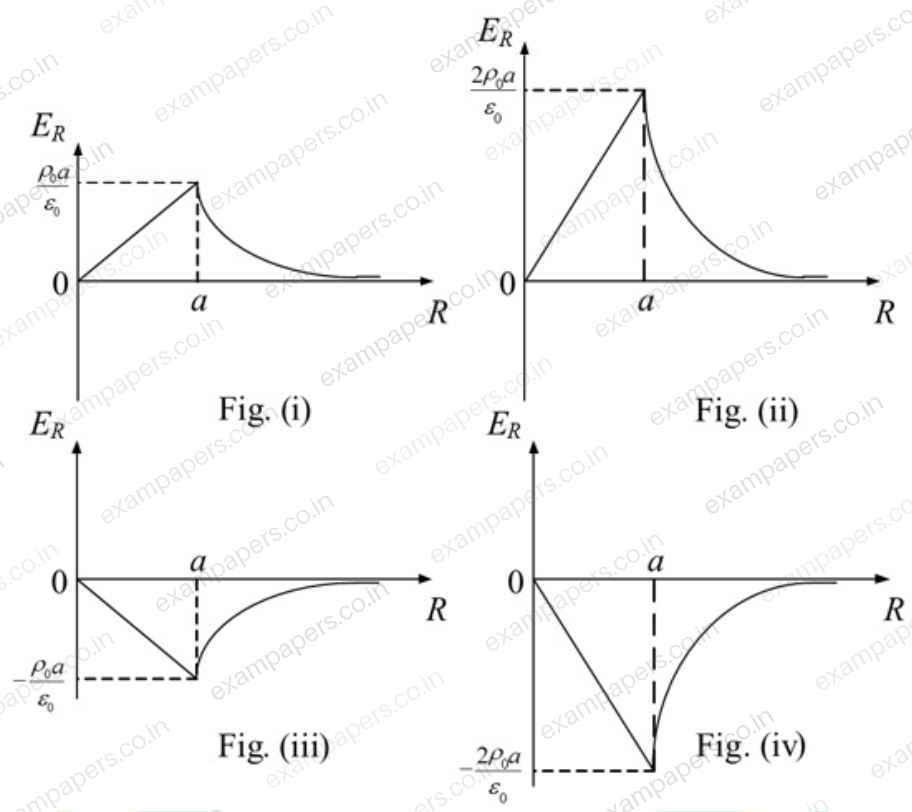
Which one of the following figures represents the radial electric field distribution
caused by a spherical cloud of electrons with a volume charge density,
for
(both
are positive and
is the radial distance) and
for
? 
Your answerChoose one option.
Log in to check the answer
You can attempt this question now. Sign in to view the answer key, explanations and discussion.Log in to check answer