
Electrical Engineering
GATE EE Electrical Machines PYQs
Build your understanding with focused practice from past exam papers.
Questions 41–50 of 79. Imported answers require independent review unless marked reviewed.
Question 44
Open questionEENAT2 marksNeeds review
A belt-driven DC shunt generator running at 300 RPM delivers 100 kW to a 200 V DC grid. It continues to run as a motor when the belt breaks, taking 10 kW from the DC grid. The armature resistance is 0.025
, field resistance is 50
, and brush drop is 2 V. Ignoring armature reaction, the speed of the motor is __________ RPM. (Round off to 2 decimal places.)Log in to check the answer
You can attempt this question now. Sign in to view the answer key, explanations and discussion.Log in to check answerQuestion 45
Open questionEENAT2 marksNeeds review
An 8-pole, 50 Hz, three-phase, slip-ring induction motor has an effective rotor resistance of 0.08 Ω per phase. Its speed at maximum torque is 650 RPM. The additional resistance per phase that must be inserted in the rotor to achieve maximum torque at start is ______ Ω. (Round off to 2 decimal places.) Neglect magnetizing current and stator leakage impedance. Consider equivalent circuit parameters referred to stator.
Log in to check the answer
You can attempt this question now. Sign in to view the answer key, explanations and discussion.Log in to check answerQuestion 7
Open questionEEMCQ1 markNeeds review
A three-phase cylindrical rotor synchronous generator has a synchronous reactance
and a negligible armature resistance. The magnitude of per phase terminal voltage is
and the magnitude of per phase induced emf is
. Considering the following two statements, P and Q, P: For any three-phase balanced leading load connected across the terminals of this synchronous generator,
is always more than
. Q: For any three-phase balanced lagging load connected across the terminals of this synchronous generator,
is always less than
. Which of the following options is correct?Your answerChoose one option.
Log in to check the answer
You can attempt this question now. Sign in to view the answer key, explanations and discussion.Log in to check answerQuestion 17
Open questionEENAT1 markNeeds review
A three-phase, 50 Hz, 4-pole induction motor runs at no-load with a slip of 1 %. With full load, the slip increases to 5 %. The % speed regulation of the motor (rounded off to 2 decimal places) is ____________.
Log in to check the answer
You can attempt this question now. Sign in to view the answer key, explanations and discussion.Log in to check answerQuestion 21
Open questionEENAT1 markNeeds review
A single-phase, 4 kVA, 200 V/100 V, 50 Hz transformer with laminated CRGO steel core has rated no-load loss of 450 W. When the high-voltage winding is excited with 160 V, 40 Hz sinusoidal ac supply, the no-load losses are found to be 320 W. When the high-voltage winding of the same transformer is supplied from a 100 V, 25 Hz sinusoidal ac source, the no-load losses will be ________ W (rounded off to 2 decimal places).
Log in to check the answer
You can attempt this question now. Sign in to view the answer key, explanations and discussion.Log in to check answerQuestion 28
Open questionEEMCQ2 marksNeeds review
A 250 V dc shunt motor has an armature resistance of 0.2
and a field resistance of 100
. When the motor is operated on no-load at rated voltage, it draws an armature current of 5 A and runs at 1200 rpm. When a load is coupled to the motor, it draws total line current of 50 A at rated voltage, with a 5 % reduction in the air-gap flux due to armature reaction. Voltage drop across the brushes can be taken as 1 V per brush under all operating conditions. The speed of the motor, in rpm, under this load condition, is closest to:Your answerChoose one option.
Log in to check the answer
You can attempt this question now. Sign in to view the answer key, explanations and discussion.Log in to check answerQuestion 34
Open questionEEMCQ2 marksNeeds review
Consider a permanent magnet dc (PMDC) motor which is initially at rest. At
, a dc voltage of 5 V is applied to the motor. Its speed monotonically increases from 0 rad/s to 6.32 rad/s in 0.5 s and finally settles to 10 rad/s. Assuming that the armature inductance of the motor is negligible, the transfer function for the motor isYour answerChoose one option.
Log in to check the answer
You can attempt this question now. Sign in to view the answer key, explanations and discussion.Log in to check answerQuestion 43
Open questionEEMCQ2 marksNeeds review
The figure below shows the per-phase Open Circuit Characteristics (measured in V) and Short Circuit Characteristics (measured in A) of a 14 kVA, 400 V, 50 Hz, 4-pole, 3-phase, delta connected alternator, driven at 1500 rpm. The field current,
is measured in A. Readings taken are marked as respective
coordinates in the figure. Ratio of the unsaturated and saturated synchronous impedances (
) of the alternator is closest to: 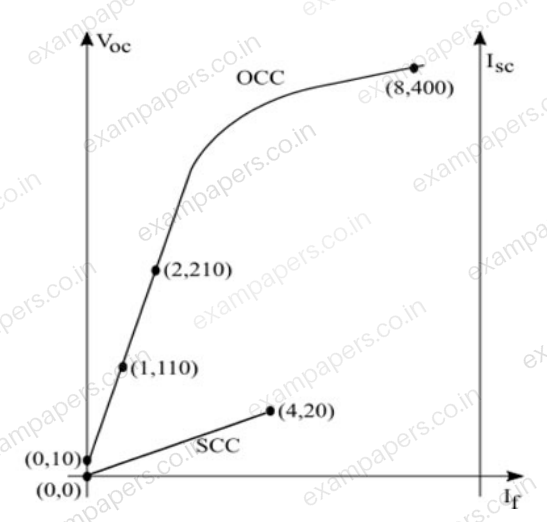
Your answerChoose one option.
Log in to check the answer
You can attempt this question now. Sign in to view the answer key, explanations and discussion.Log in to check answerQuestion 46
Open questionEENAT2 marksNeeds review
A cylindrical rotor synchronous generator with constant real power output and constant terminal voltage is supplying 100 A current to a 0.9 lagging power factor load. An ideal reactor is now connected in parallel with the load, as a result of which the total lagging reactive power requirement of the load is twice the previous value while the real power remains unchanged. The armature current is now ______ A (rounded off to 2 decimal places).
Log in to check the answer
You can attempt this question now. Sign in to view the answer key, explanations and discussion.Log in to check answerQuestion 48
Open questionEENAT2 marksNeeds review
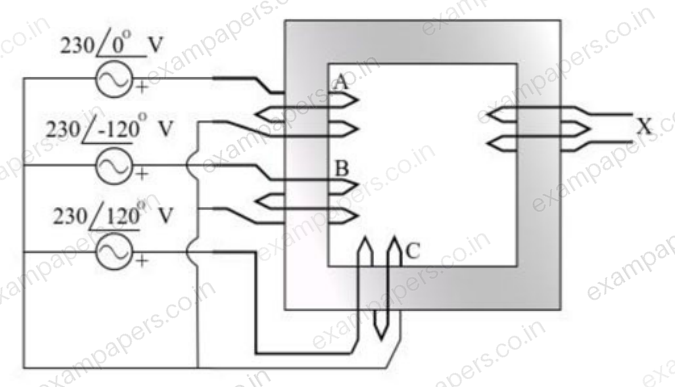
Windings ‘A’, ‘B’ and ‘C’ have 20 turns each and are wound on the same iron core as shown, along with winding ‘X’ which has 2 turns. The figure shows the sense (clockwise/anti-clockwise) of each of the windings only and does not reflect the exact number of turns. If windings ‘A’, ‘B’ and ‘C’ are supplied with balanced 3-phase voltages at 50 Hz and there is no core saturation, the no-load RMS voltage (in V, rounded off to 2 decimal places) across winding ‘X’ is ______.
Log in to check the answer
You can attempt this question now. Sign in to view the answer key, explanations and discussion.Log in to check answer