
Electrical Engineering
GATE EE Power Systems PYQs
Build your understanding with focused practice from past exam papers.
How to practice Power Systems
Attempt a question, record the concept and assumptions, then check the available answer. Rework mistakes after revising the relevant concepts. Topic tags can overlap; review the question context.
Questions 1–10 of 64. Imported answers require independent review unless marked reviewed.
Question 18
Open questionEEMCQ1 markNeeds review
Consider a power system with
buses, of which
are generator buses and the remaining
are load buses (where there is no generation).Assume that there are no reactive power-limit violations at the generator buses.
What is the size of the Jacobian matrix in the Newton-Raphson load flow method?
Your answerChoose one option.
Log in to check the answer
You can attempt this question now. Sign in to view the answer key, explanations and discussion.Log in to check answerQuestion 19
Open questionEEMCQ1 markNeeds review
The initial three-phase voltage phasors (
,
, and
) at a bus of a power network are as shown in Case-1. Due to a disturbance, the bus voltage phasors changed in phase by a small angle
, and the magnitudes remained the same as depicted in Case-2. 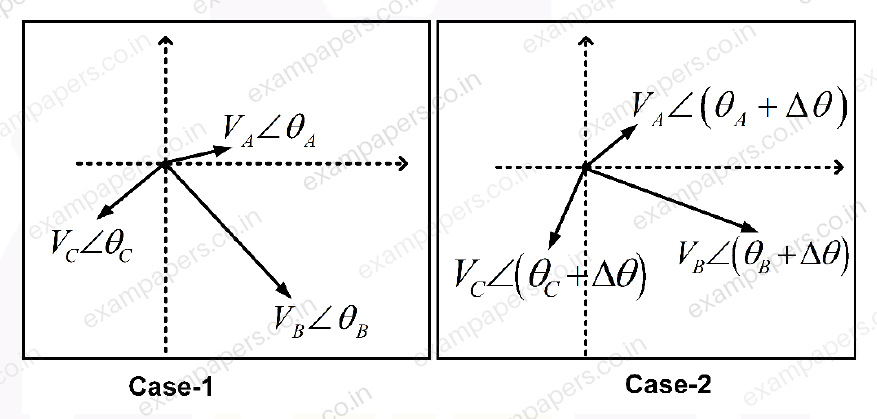
Which one of the following statements is correct about the zero sequence components?
Your answerChoose one option.
Log in to check the answer
You can attempt this question now. Sign in to view the answer key, explanations and discussion.Log in to check answerQuestion 39
Open questionEEMCQ2 marksNeeds review
In the circuit shown, the phase currents are
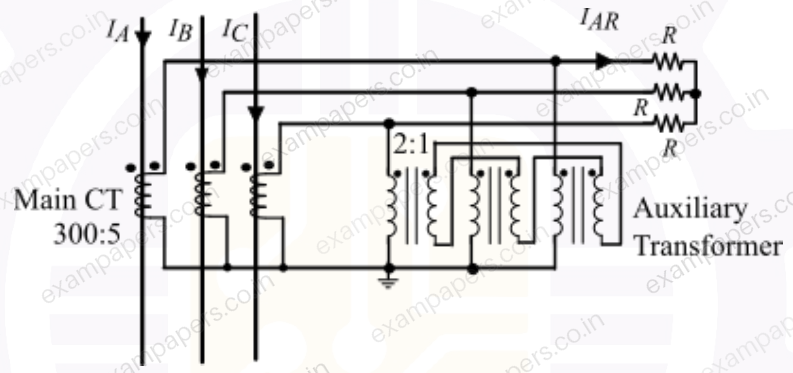
Given that the CTs are ideal with no saturation, and the turns ratio of the Main CT is 300:5 and that of the Auxiliary Transformer (YₙΔ) is 2:1 on every phase, the value of
, rounded off to three decimal places, is:Your answerChoose one option.
Log in to check the answer
You can attempt this question now. Sign in to view the answer key, explanations and discussion.Log in to check answerQuestion 40
Open questionEEMCQ2 marksNeeds review
The operating characteristic of a reactance relay is given by
, where
is the reactance calculated by the relay. Its operating characteristic in the admittance plane (G-B plane, where G and B denote conductance and susceptance, respectively, expressed in
) is given by:Your answerChoose one option.
Log in to check the answer
You can attempt this question now. Sign in to view the answer key, explanations and discussion.Log in to check answerQuestion 41
Open questionEEMCQ2 marksNeeds review
A three-phase two-winding transformer has a voltage transformation ratio
, where
is the primary side voltage in p.u., and
is the secondary side voltage in p.u.
and
represent the currents injected into the primary and secondary sides of the transformer, respectively. The admittance corresponding to the leakage impedance of the transformer referred to the secondary is
p.u. Neglect the magnetizing branch. 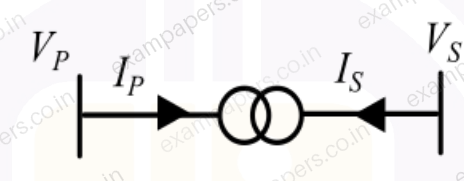
The Y bus representation of this transformer is:
Your answerChoose one option.
Log in to check the answer
You can attempt this question now. Sign in to view the answer key, explanations and discussion.Log in to check answerQuestion 54
Open questionEEMSQ2 marksNeeds review
For the balanced 3-phase transmission line shown, consider the following cases:
Case-1:
and
Case-2:
and
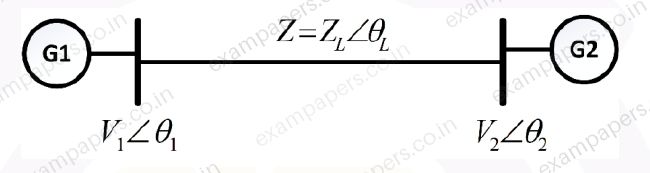
Which of the following statements is/are correct about real power loss and reactive power loss in the line?
Your answerSelect all correct options. You can choose more than one.
Log in to check the answer
You can attempt this question now. Sign in to view the answer key, explanations and discussion.Log in to check answerQuestion 58
Open questionEENAT2 marksNeeds review
A system with two generators G1 and G2 (without generator limits) is shown.
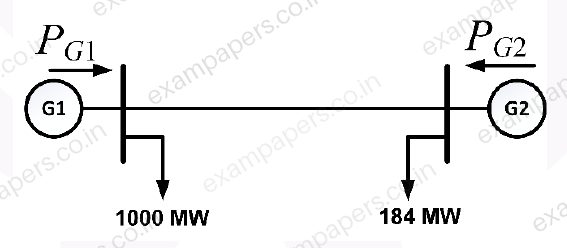
The total load on the system is 1184 MW. The expressions for the cost of generation (C₁ and C₂) and real power loss (Pₗₒₛ) are as follows:
C₁(P_G₁) = 1000 + 50P_G₁ + 0.01(P_G₁)² Rs/MWh
C₂(P_G₂) = 2000 + 50P_G₂ + 0.001(P_G₂)² Rs/MWh
Pₗₒₛ = 0.001(P_G₂ − 50)² MW
When the generators are operating at their optimal generation, meeting the total load requirement, the real power loss in the system is ______ MW (Round off to one decimal place)
Consider the Lagrange multiplier λ = 70.25 for optimal generation.
Log in to check the answer
You can attempt this question now. Sign in to view the answer key, explanations and discussion.Log in to check answerQuestion 24
Open questionEEMCQ1 markNeeds review
During a power failure, a domestic household uninterruptible power supply (UPS) supplies AC power to a limited number of lights and fans in various rooms. As per a Newton-Raphson load-flow formulation, the UPS would be represented as a
Your answerChoose one option.
Log in to check the answer
You can attempt this question now. Sign in to view the answer key, explanations and discussion.Log in to check answerQuestion 32
Open questionEENAT1 markNeeds review
Consider a distribution feeder, with
ratio of 5. At the receiving end, a 350 kVA load is connected. The maximum voltage drop will occur from the sending end to the receiving end, when the power factor of the load is __________ (round off to three decimal places).Log in to check the answer
You can attempt this question now. Sign in to view the answer key, explanations and discussion.Log in to check answerQuestion 33
Open questionEENAT1 markNeeds review
The bus impedance matrix of a 3-bus system (in pu) is
. A symmetrical fault (through a fault impedance of
pu) occurs at bus 2. Neglecting pre-fault loading conditions, the voltage at bus 1, during the fault is ______ pu (round off to three decimal places).Log in to check the answer
You can attempt this question now. Sign in to view the answer key, explanations and discussion.Log in to check answer