
Electrical Engineering
GATE EE Power Systems PYQs
Build your understanding with focused practice from past exam papers.
Questions 21–30 of 64. Imported answers require independent review unless marked reviewed.
Question 28
Open questionEEMSQ1 markNeeds review
The bus admittance (
) matrix of a 3-bus power system is given below.
Considering that there is no shunt inductor connected to any of the buses, which of the following can NOT be true?
Your answerSelect all correct options. You can choose more than one.
Log in to check the answer
You can attempt this question now. Sign in to view the answer key, explanations and discussion.Log in to check answerQuestion 33
Open questionEENAT1 markNeeds review
A 50 Hz, 275 kV line of length 400 km has the following parameters:
Resistance, R = 0.035 Ω/km;
Inductance, L = 1 mH/km;
Capacitance, C = 0.01 μF/km;
The line is represented by the nominal-π model. With the magnitudes of the sending end and the receiving end voltages of the line (denoted by
and
, respectively) maintained at 275 kV, the phase angle difference (
) between
and
required for maximum possible active power to be delivered to the receiving end, in degree is __________ (Round off to 2 decimal places).Log in to check the answer
You can attempt this question now. Sign in to view the answer key, explanations and discussion.Log in to check answerQuestion 41
Open questionEEMCQ2 marksNeeds review
The three-bus power system shown in the figure has one alternator connected to bus 2 which supplies 200 MW and 40 MVAr power. Bus 3 is infinite bus having a voltage of magnitude
p.u. and angle of
. A variable current source,
is connected at bus 1 and controlled such that the magnitude of the bus 1 voltage is maintained at 1.05 p.u. and the phase angle of the source current,
, where
is the phase angle of the bus 1 voltage. The three buses can be categorized for load flow analysis as 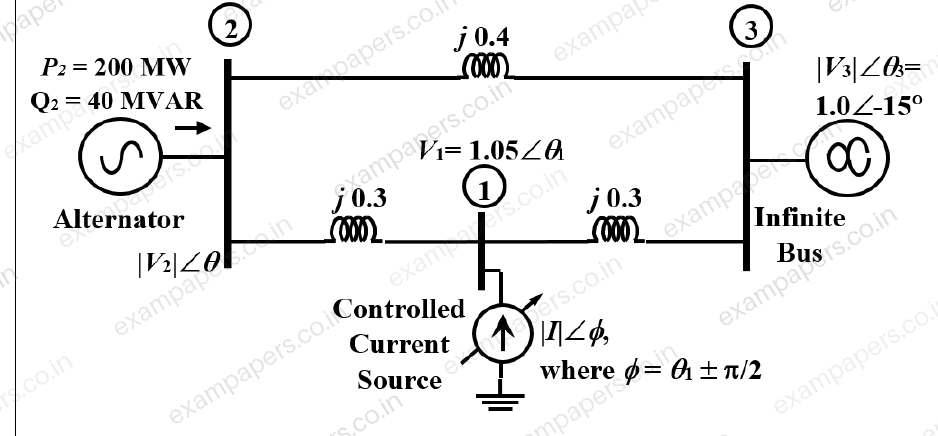
Your answerChoose one option.
Log in to check the answer
You can attempt this question now. Sign in to view the answer key, explanations and discussion.Log in to check answerQuestion 60
Open questionEENAT2 marksNeeds review
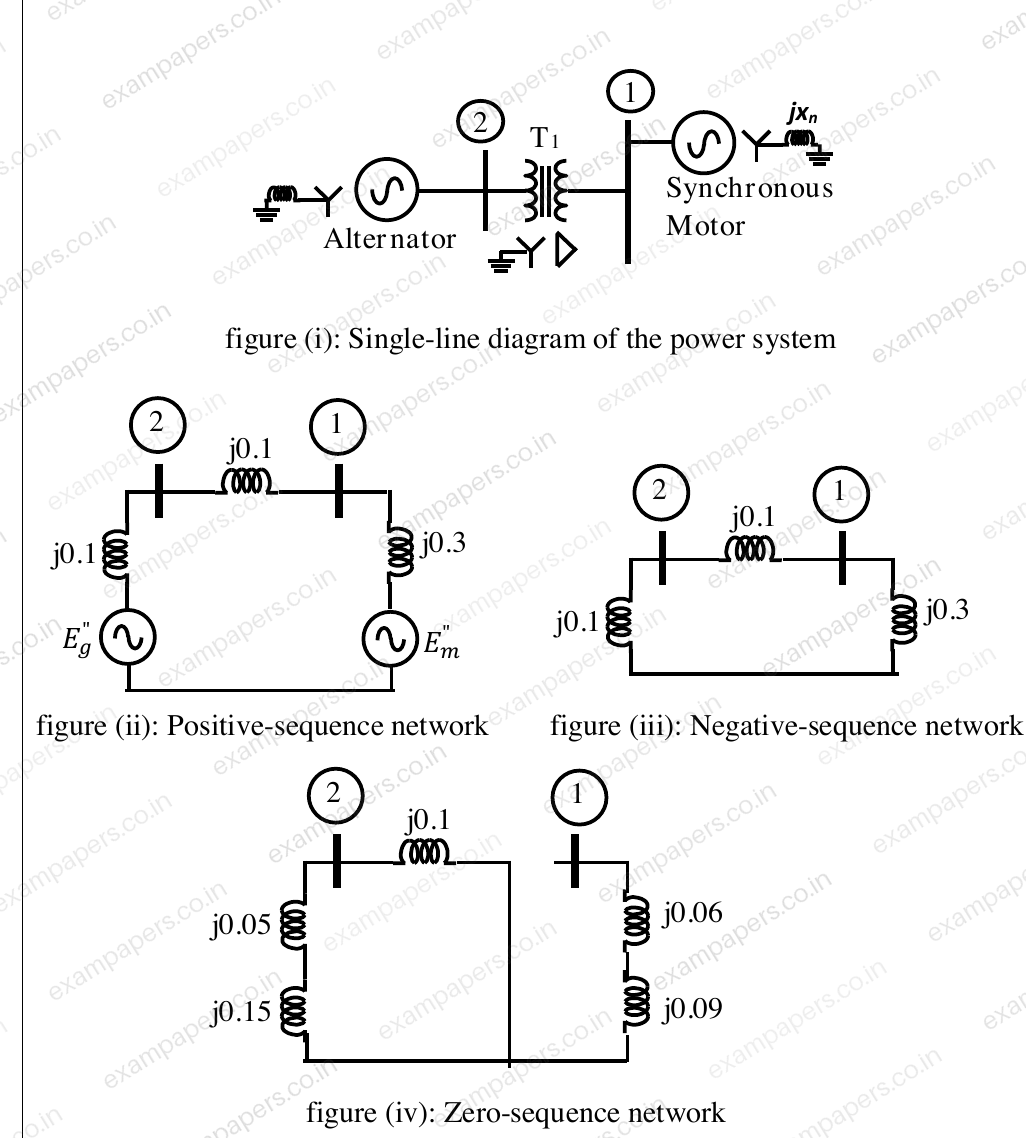
The two-bus power system shown in figure (i) has one alternator supplying a synchronous motor load through a Y-Δ transformer. The positive, negative and zero-sequence diagrams of the system are shown in figures (ii), (iii) and (iv), respectively. All reactances in the sequence diagrams are in p.u. For a bolted line-to-line fault (fault impedance = zero) between phases ‘b’ and ‘c’ at bus 1, neglecting all pre-fault currents, the magnitude of the fault current (from phase ‘b’ to ‘c’) in p.u. is __________ (Round off to 2 decimal places).
Log in to check the answer
You can attempt this question now. Sign in to view the answer key, explanations and discussion.Log in to check answerQuestion 14
Open questionEEMCQ1 markNeeds review
The geometric mean radius of a conductor, having four equal strands with each strand of radius
, as shown in the figure below,
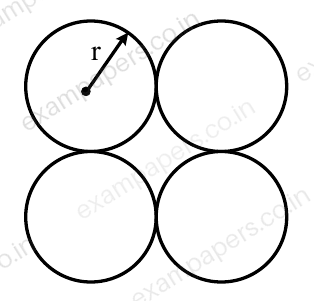
is
Your answerChoose one option.
Log in to check the answer
You can attempt this question now. Sign in to view the answer key, explanations and discussion.Log in to check answerQuestion 15
Open questionEEMCQ1 markNeeds review
The valid positive, negative and zero sequence impedances (in p.u.), respectively, for a 220 kV, fully transposed three-phase transmission line, from the given choices are
Your answerChoose one option.
Log in to check the answer
You can attempt this question now. Sign in to view the answer key, explanations and discussion.Log in to check answerQuestion 43
Open questionEEMCQ2 marksNeeds review
The fuel cost functions in rupees/hour for two 600 MW thermal power plants are given by
Plant 1:
Plant 2:
where
and
are power generated by plant 1 and plant 2, respectively, in MW and
is constant. The incremental cost of power (
) is 8 rupees per MWh. The two thermal power plants together meet a total power demand of 550 MW. The optimal generation of plant 1 and plant 2 in MW, respectively, areYour answerChoose one option.
Log in to check the answer
You can attempt this question now. Sign in to view the answer key, explanations and discussion.Log in to check answerQuestion 56
Open questionEENAT2 marksNeeds review
Two generating units rated for 250 MW and 400 MW have governor speed regulations of 6% and 6.4%, respectively, from no load to full load. Both the generating units are operating in parallel to share a load of 500 MW. Assuming free governor action, the load shared in MW, by the 250 MW generating unit is ________. (round off to nearest integer)
Log in to check the answer
You can attempt this question now. Sign in to view the answer key, explanations and discussion.Log in to check answerQuestion 9
Open questionEEMCQ1 markNeeds review
Consider a power system consisting of
number of buses. Buses in this power system are categorized into slack bus, PV buses and PQ buses for load flow study. The number of PQ buses is
. The balanced Newton-Raphson method is used to carry out load flow study in polar form,
,
,
and
are sub-matrices of the Jacobian matrix
as shown below:
The dimension of the sub-matrix
isYour answerChoose one option.
Log in to check the answer
You can attempt this question now. Sign in to view the answer key, explanations and discussion.Log in to check answerQuestion 10
Open questionEEMCQ1 markNeeds review
Two generators have cost functions
and
. Their incremental-cost characteristics are
They need to deliver a combined load of 260 MW. Ignoring the network losses, for economic operation, the generations
and
(in MW) areYour answerChoose one option.
Log in to check the answer
You can attempt this question now. Sign in to view the answer key, explanations and discussion.Log in to check answer