
Electrical Engineering
GATE EE topic:power-systems PYQs
Build your understanding with focused practice from past exam papers.
Questions 11–20 of 64. Imported answers require independent review unless marked reviewed.
Question 49
Open questionEEMCQ2 marksNeeds review
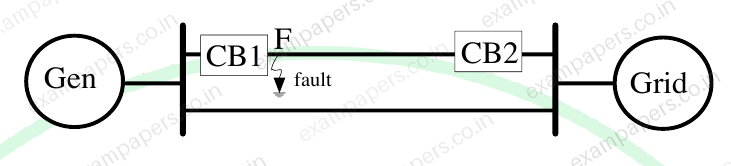
In the system shown below, the generator was initially supplying power to the grid. A temporary LLLG bolted fault occurs at F very close to circuit breaker 1. The circuit breakers open to isolate the line. The fault self-clears. The circuit breakers reclose and restore the line. Which one of the following diagrams best indicates the rotor accelerating and decelerating areas?
Your answerChoose one option.
Log in to check the answer
You can attempt this question now. Sign in to view the answer key, explanations and discussion.Log in to check answerQuestion 64
Open questionEENAT2 marksNeeds review
Two units, rated at 100 MW and 150 MW, are enabled for economic load dispatch. When the overall incremental cost is 10,000 Rs./MWh, the units are dispatched to 50 MW and 80 MW respectively. At an overall incremental cost of 10,600 Rs./MWh, the power outputs of the units are 80 MW and 92 MW, respectively. The total plant MW-output (without overloading any unit) at an overall incremental cost of 11,800 Rs./MWh is ____________ (round off to the nearest integer).
Log in to check the answer
You can attempt this question now. Sign in to view the answer key, explanations and discussion.Log in to check answerQuestion 19
Open questionEEMCQ1 markNeeds review
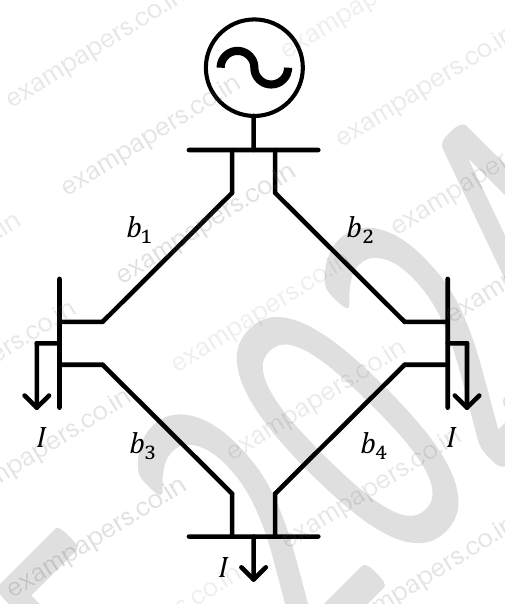
The figure shows the single line diagram of a 4-bus power network. Branches
,
,
, and
have impedances
,
,
, and
per-unit (pu), respectively, where
, with
and
. The current drawn from each load (marked as arrows) is equal to
pu, where
. If the network is to operate with minimum loss, the branch that should be opened is
Your answerChoose one option.
Log in to check the answer
You can attempt this question now. Sign in to view the answer key, explanations and discussion.Log in to check answerQuestion 34
Open questionEENAT1 markNeeds review
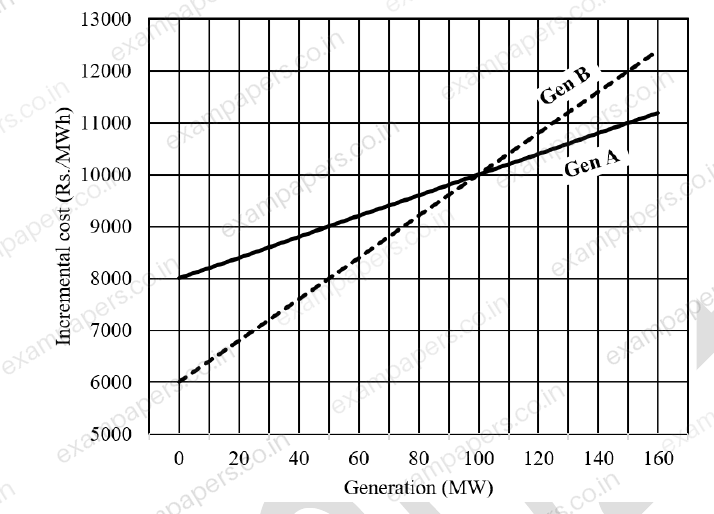
The incremental cost curves of two generators (Gen A and Gen B) in a plant supplying a common load are shown in the figure. If the incremental cost of supplying the common load is Rs. 7400 per MWh, then the common load in MW is ______ (rounded off to the nearest integer).
Log in to check the answer
You can attempt this question now. Sign in to view the answer key, explanations and discussion.Log in to check answerQuestion 41
Open questionEEMCQ2 marksNeeds review
For the three-bus lossless power network shown in the figure, the voltage magnitudes at all the buses are equal to 1 per unit (pu), and the differences of the voltage phase angles are very small. The line reactances are marked in the figure, where
,
,
, and
are strictly positive. The bus injections
and
are in pu. If
, where
, and the real power flow from bus 1 to bus 2 is 0 pu, then which one of the following options is correct? 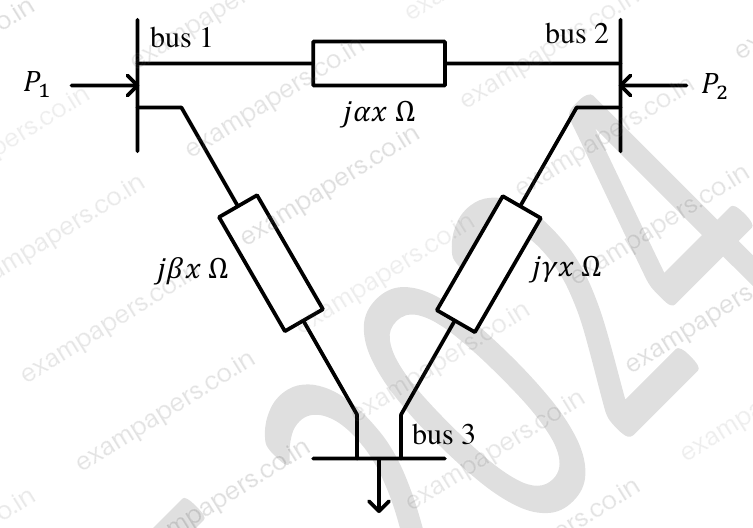
Your answerChoose one option.
Log in to check the answer
You can attempt this question now. Sign in to view the answer key, explanations and discussion.Log in to check answerQuestion 46
Open questionEEMSQ2 marksNeeds review
For a two-phase network, the phase voltages
and
are to be expressed in terms of sequence voltages
and
as
. The possible option(s) for matrix
is/areYour answerSelect all correct options. You can choose more than one.
Log in to check the answer
You can attempt this question now. Sign in to view the answer key, explanations and discussion.Log in to check answerQuestion 47
Open questionEEMSQ2 marksNeeds review
Which of the following options is/are correct for the Automatic Generation Control (AGC) and Automatic Voltage Regulator (AVR) installed with synchronous generators?
Your answerSelect all correct options. You can choose more than one.
Log in to check the answer
You can attempt this question now. Sign in to view the answer key, explanations and discussion.Log in to check answerQuestion 56
Open questionEENAT2 marksNeeds review
The single line diagram of a lossless system is shown in the figure. The system is operating in steady-state at a stable equilibrium point with the power output of the generator being
, where
is the load angle and the mechanical power input is
. A fault occurs on line 2 such that the power output of the generator is less than
during the fault. After the fault is cleared by opening line 2, the power output of the generator is
. If the critical fault clearing angle is
radians, the accelerating area on the power angle curve is _____ times
(rounded off to 2 decimal places). 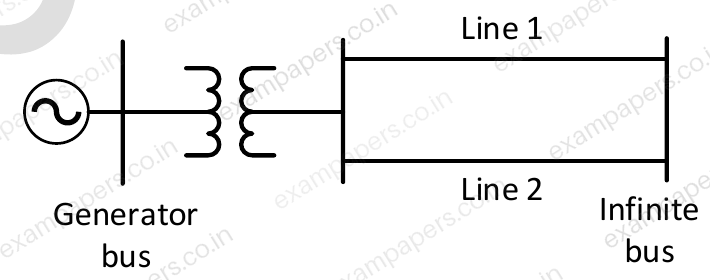
Log in to check the answer
You can attempt this question now. Sign in to view the answer key, explanations and discussion.Log in to check answerQuestion 20
Open questionEEMCQ1 markNeeds review
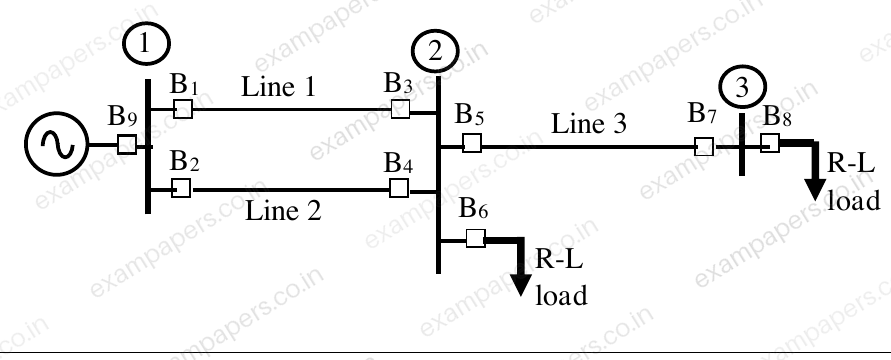
For the three-bus power system shown in the figure, the trip signals to the circuit breakers B₁ to B₉ are provided by overcurrent relays R₁ to R₉, respectively, some of which have directional properties also. The necessary condition for the system to be protected for short circuit fault at any part of the system between bus 1 and the R-L loads with isolation of minimum portion of the network using minimum number of directional relays is
Your answerChoose one option.
Log in to check the answer
You can attempt this question now. Sign in to view the answer key, explanations and discussion.Log in to check answerQuestion 21
Open questionEEMCQ1 markNeeds review
The expressions of fuel cost of two thermal generation units as a function of the respective power generation
and
are given as
where a is a constant. For a given value of a, optimal dispatch requires the total load of 290 MW to be shared as
and
. With the load remaining unchanged, the value of a is increased by 10% and optimal dispatch is carried out. The changes in
and the total cost of generation, F (= F₁ + F₂) in Rs/hour will be as followsYour answerChoose one option.
Log in to check the answer
You can attempt this question now. Sign in to view the answer key, explanations and discussion.Log in to check answer