
Electrical Engineering
GATE EE topic:quantitative-aptitude PYQs
Build your understanding with focused practice from past exam papers.
Questions 11–20 of 50. Imported answers require independent review unless marked reviewed.
Question 5
Open questionGAMCQ1 markNeeds review
If, for non-zero real variables
,
, and real parameter
,
then, the ratio
isYour answerChoose one option.
Log in to check the answer
You can attempt this question now. Sign in to view the answer key, explanations and discussion.Log in to check answerQuestion 7
Open questionGAMCQ2 marksNeeds review
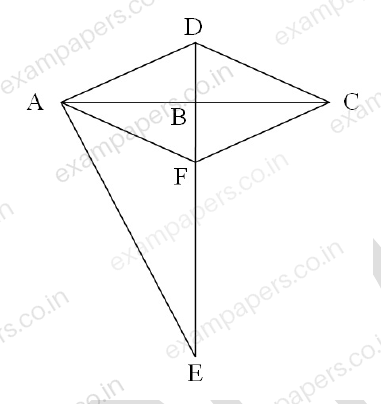
In the following figure,
CD = 5 cm, BE = 10 cm, AE = 12 cm,
∠DAB = ∠DCB, and ∠DAE = ∠DBC = 90°
Points AFC D create a rhombus.
The length of BF (in cm) is
Your answerChoose one option.
Log in to check the answer
You can attempt this question now. Sign in to view the answer key, explanations and discussion.Log in to check answerQuestion 8
Open questionGAMCQ2 marksNeeds review
The chart below shows the data of the number of cars bought by Millennials and Gen X people in a country from the year 2010 to 2020 as well as the yearly fuel consumption of the country (in Million liters).
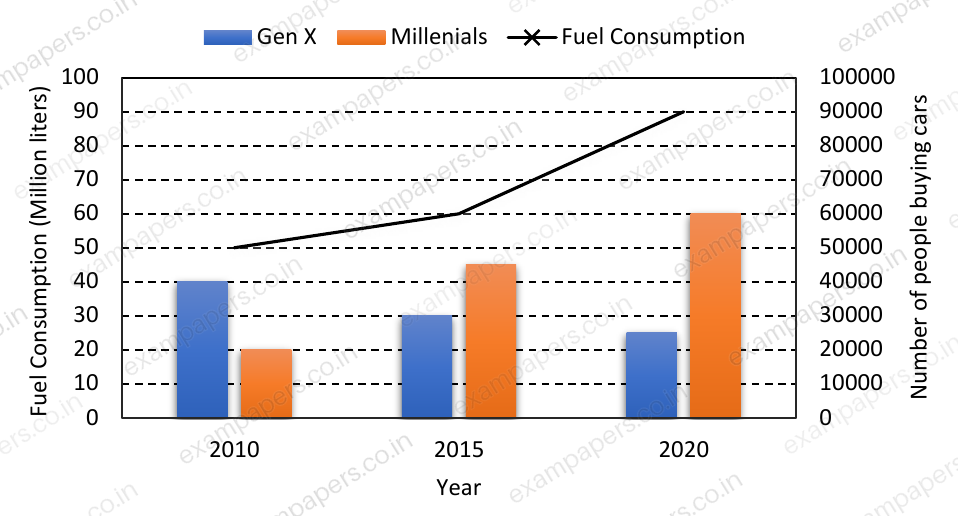
Considering the data presented in the chart, which one of the following options is true?
Your answerChoose one option.
Log in to check the answer
You can attempt this question now. Sign in to view the answer key, explanations and discussion.Log in to check answerQuestion 10
Open questionGAMCQ2 marksNeeds review
A surveyor has to measure the horizontal distance from her position to a distant reference point C. Using her position as the center, a 200 m horizontal line segment is drawn with the two endpoints A and B. Points A, B, and C are not collinear. Each of the angles ∠CAB and ∠CBA are measured as 87.8°. The distance (in m) of the reference point C from her position is nearest to
Your answerChoose one option.
Log in to check the answer
You can attempt this question now. Sign in to view the answer key, explanations and discussion.Log in to check answerQuestion 3
Open questionGAMCQ1 markNeeds review
Given a fair six-faced dice where the faces are labelled ‘1’, ‘2’, ‘3’, ‘4’, ‘5’, and ‘6’, what is the probability of getting a ‘1’ on the first roll of the dice and a ‘4’ on the second roll?
Your answerChoose one option.
Log in to check the answer
You can attempt this question now. Sign in to view the answer key, explanations and discussion.Log in to check answerQuestion 7
Open questionGAMCQ2 marksNeeds review
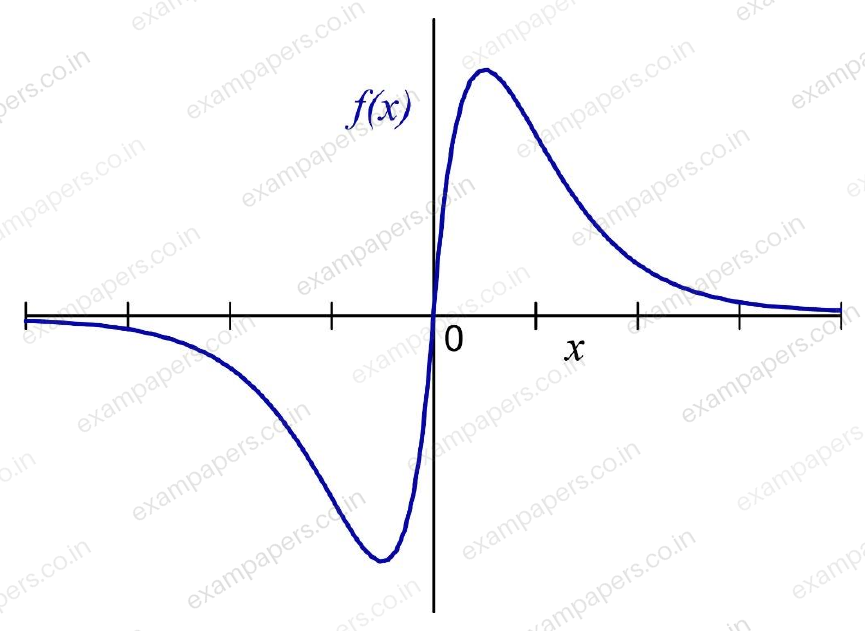
Which one of the following options represents the given graph?
Your answerChoose one option.
Log in to check the answer
You can attempt this question now. Sign in to view the answer key, explanations and discussion.Log in to check answerQuestion 9
Open questionGAMCQ2 marksNeeds review
The digit in the unit’s place of the product
is ______.Your answerChoose one option.
Log in to check the answer
You can attempt this question now. Sign in to view the answer key, explanations and discussion.Log in to check answerQuestion 10
Open questionGAMCQ2 marksNeeds review
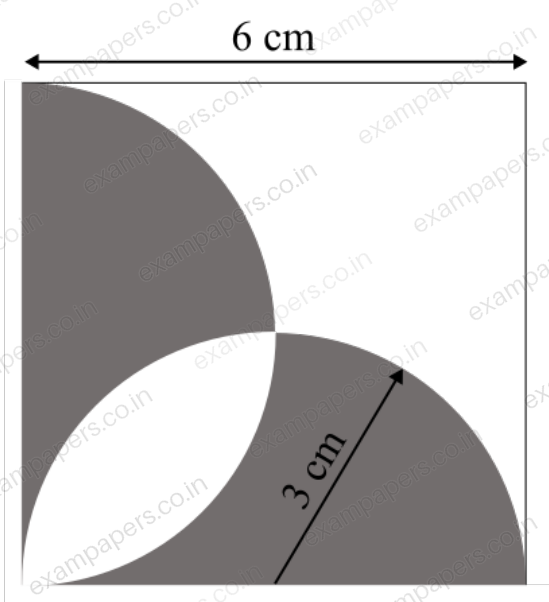
A square with sides of length 6 cm is given. The boundary of the shaded region is defined by two semi-circles whose diameters are the sides of the square, as shown.
The area of the shaded region is ______ cm
. 
Your answerChoose one option.
Log in to check the answer
You can attempt this question now. Sign in to view the answer key, explanations and discussion.Log in to check answerQuestion 2
Open questionGAMCQ1 markNeeds review
In a 500 m race, P and Q have speeds in the ratio of 3 : 4. Q starts the race when P has already covered 140 m.
What is the distance between P and Q (in m) when P wins the race?
Your answerChoose one option.
Log in to check the answer
You can attempt this question now. Sign in to view the answer key, explanations and discussion.Log in to check answerQuestion 3
Open questionGAMCQ1 markNeeds review
Three bells P, Q, and R are rung periodically in a school. P is rung every 20 minutes; Q is rung every 30 minutes and R is rung every 50 minutes.
If all the three bells are rung at 12:00 PM, when will the three bells ring together again the next time?
Your answerChoose one option.
Log in to check the answer
You can attempt this question now. Sign in to view the answer key, explanations and discussion.Log in to check answer