
Electrical Engineering
GATE EE topic:signals-and-systems PYQs
Build your understanding with focused practice from past exam papers.
Questions 41–50 of 59. Imported answers require independent review unless marked reviewed.
Question 39
Open questionEEMCQ2 marksNeeds review
Which of the following options is true for a linear time-invariant discrete time system that obeys the difference equation:
Your answerChoose one option.
Log in to check the answer
You can attempt this question now. Sign in to view the answer key, explanations and discussion.Log in to check answerQuestion 1
Open questionEEMCQ1 markNeeds review
The inverse Laplace transform of
for
isYour answerChoose one option.
Log in to check the answer
You can attempt this question now. Sign in to view the answer key, explanations and discussion.Log in to check answerQuestion 7
Open questionEEMCQ1 markNeeds review
The symbols,
and
, represent positive quantities, and
is the unit step function. Which one of the following impulse responses is NOT the output of a causal linear time-invariant system?Your answerChoose one option.
Log in to check the answer
You can attempt this question now. Sign in to view the answer key, explanations and discussion.Log in to check answerQuestion 28
Open questionEEMCQ2 marksNeeds review
A periodic function
, with a period of
, is represented as its Fourier series,
If
the Fourier series coefficients
and
of
areYour answerChoose one option.
Log in to check the answer
You can attempt this question now. Sign in to view the answer key, explanations and discussion.Log in to check answerQuestion 16
Open questionEEMCQ1 markNeeds review
A continuous-time input signal x(t) is an eigenfunction of an LTI system, if the output is
Your answerChoose one option.
Log in to check the answer
You can attempt this question now. Sign in to view the answer key, explanations and discussion.Log in to check answerQuestion 38
Open questionEEMCQ2 marksNeeds review
Consider the two continuous-time signals defined below:
These signals are sampled with a sampling period of
seconds to obtain discrete-time signals
and
, respectively. Which one of the following statements is true?Your answerChoose one option.
Log in to check the answer
You can attempt this question now. Sign in to view the answer key, explanations and discussion.Log in to check answerQuestion 39
Open questionEEMCQ2 marksNeeds review
The signal energy of the continuous-time signal
isYour answerChoose one option.
Log in to check the answer
You can attempt this question now. Sign in to view the answer key, explanations and discussion.Log in to check answerQuestion 40
Open questionEENAT2 marksNeeds review
The Fourier transform of a continuous-time signal
is given by
,
, where
and
denotes frequency. Then the value of
at
is ________ (up to 1 decimal place). (ln denotes the logarithm to base e)Log in to check the answer
You can attempt this question now. Sign in to view the answer key, explanations and discussion.Log in to check answerQuestion 3
Open questionEEMCQ1 markNeeds review
Let
, where “
” denotes convolution. Let
be a positive real-valued constant. Choose the correct expression for
.Your answerChoose one option.
Log in to check the answer
You can attempt this question now. Sign in to view the answer key, explanations and discussion.Log in to check answerQuestion 4
Open questionEE-2MCQ1 markNeeds review
The pole-zero plots of three discrete-time systems P, Q and R on the z-plane are shown below.
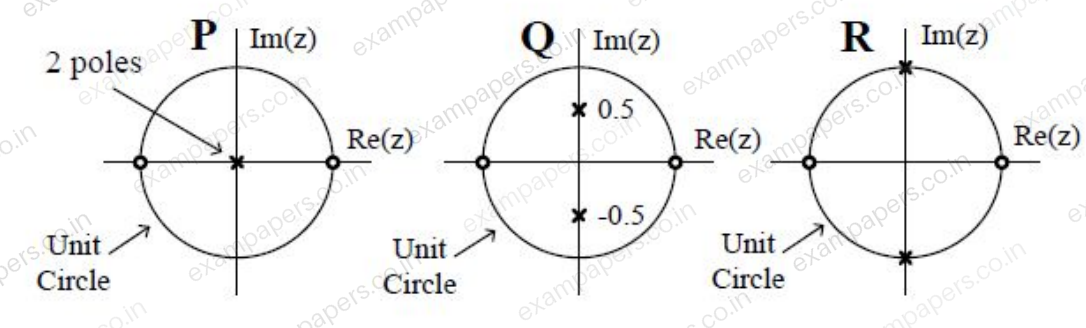
Which one of the following is TRUE about the frequency selectivity of these systems?
Your answerChoose one option.
Log in to check the answer
You can attempt this question now. Sign in to view the answer key, explanations and discussion.Log in to check answer