
Environmental Science and Engineering
GATE ES Environmental Management Systems PYQs
Build your understanding with focused practice from past exam papers.
How to practice Environmental Management Systems
Attempt a question, record the concept and assumptions, then check the available answer. Rework mistakes after revising the relevant concepts. Topic tags can overlap; review the question context.
Questions 1–6 of 6. Imported answers require independent review unless marked reviewed.
Question 48
Open questionESMSQ2 marksNeeds review
Based on the ISO 14040 methodology for Life Cycle Assessment, match the terms with the descriptions in the table.
Term | Description |
|---|---|
(a) Goal and Scope | (i) Based on the product or system, the comparative unit must be carefully defined and be same for all scenarios |
(b) Functional Unit | (ii) The problem is described, and the objective of the study are defined |
(c) Life Cycle Inventory | (iii) Evaluates the environmental implications due to the inventorized emissions |
(d) Impact Assessment | (iv) Process based approach and input-output approach |
The correct match(es) is/are
Your answerSelect all correct options. You can choose more than one.
Log in to check the answer
You can attempt this question now. Sign in to view the answer key, explanations and discussion.Log in to check answerQuestion 27
Open questionESMCQ1 markNeeds review
Read the following statements
I. The goal of Life Cycle Analysis (LCA) is to assess the environmental impact of products from a system perspective and to identify possible improvement strategies.
II. Environmental Impact Assessment (EIA) is defined as a process of identifying, predicting, and evaluating the likely impacts of a proposed project or development to define mitigation actions to reduce negative impacts and to provide positive contributions to the natural environment and well-being.
The correct choice is
Your answerChoose one option.
Log in to check the answer
You can attempt this question now. Sign in to view the answer key, explanations and discussion.Log in to check answerQuestion 46
Open questionESMSQ2 marksNeeds review
Products P and Q have life cycle phases of material extraction, production, use, and end of life disposal. CH
, CO
emissions and mass used per functional unit (f.u.) from the different phases of the products are given in the following tables.Product P
Phase | CO emissions, kg/tonne | CH emissions, kg/tonne | Mass, tonne/functional unit (f.u.) |
|---|---|---|---|
Material Extraction | 1.0 | 0.75 | 4.0 |
Production | 1.5 | 1.0 | 2.0 |
Use | 0.5 | 0.0 | 1.0 |
End of life disposal | 1.0 | 0.25 | 1.0 |
Product Q
Phase | CO emissions, kg/tonne | CH emissions, kg/tonne | Mass, tonne/functional unit (f.u.) |
|---|---|---|---|
Material Extraction | 0.75 | 0.75 | 3.0 |
Production | 0.25 | 1.0 | 2.5 |
Use | 0.0 | 0.5 | 0.75 |
End of life disposal | 2.0 | 0.0 | 0.75 |
Based upon the information given in the tables and using global warming potential of CH
equal to 23 kg of CO
per kg of CH
, which of the following statement(s) is/are true?Your answerSelect all correct options. You can choose more than one.
Log in to check the answer
You can attempt this question now. Sign in to view the answer key, explanations and discussion.Log in to check answerQuestion 64
Open questionESNAT2 marksNeeds review
An adult of 65 kg weight and life span of 65 years drinks water for 5 years, which is contaminated with toluene of concentration 0.15 mg/L. For toluene, reference dose is 0.200 mg/kg-d. The person drinks 2 L of water per day. The hazard quotient from the toluene exposure for the adult will be ____________(rounded off to three decimal places).
Log in to check the answer
You can attempt this question now. Sign in to view the answer key, explanations and discussion.Log in to check answerQuestion 33
Open questionESMSQ1 markNeeds review
The Ministry of Environment, Forest and Climate Change (MoEF&CC), Govt. of India has published the Environment Impact Assessment (EIA) draft Notification 2020, intended to replace the existing EIA Notification, 2006 under the Environment (Protection) Act, 1986. Which of the following is/are the key change(s) from existing regulation?
Your answerSelect all correct options. You can choose more than one.
Log in to check the answer
You can attempt this question now. Sign in to view the answer key, explanations and discussion.Log in to check answerQuestion 11
Open questionESMCQ1 markNeeds review
The following block diagram highlights the typical phases of the life cycle of a product. In the figure, ‘P’, ‘Q’, and ‘R’ represent various possible scopes of analyses in life cycle assessment. Which of the following statements is true?
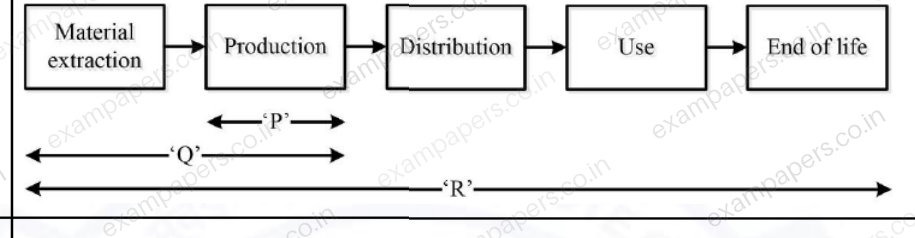
Your answerChoose one option.
Log in to check the answer
You can attempt this question now. Sign in to view the answer key, explanations and discussion.Log in to check answer