
Environmental Science and Engineering
GATE ES exam:gate PYQs
Build your understanding with focused practice from past exam papers.
Questions 121–130 of 390. Imported answers require independent review unless marked reviewed.
Question 56
Open questionESNAT2 marksNeeds review
A circular sewer pipe, having Manning’s coefficient (n) of 0.01, is laid at a bed slope of 1:100. If it is flowing 80% full for a discharge of 2 m³/s, then its diameter is ____________ m. (rounded off to three decimal places)
Log in to check the answer
You can attempt this question now. Sign in to view the answer key, explanations and discussion.Log in to check answerQuestion 57
Open questionESNAT2 marksNeeds review
You conducted a batch experiment in the lab for 10 minutes to degrade a toxic compound, which follows first order kinetics. The compound degrades from
M to
M. The information from the lab experiment will be used to design a plug flow reactor in field conditions.Given field conditions:
• Flow rate of contaminated water to be treated: 1 m³/hour
• Concentration of toxic compound in contaminated water:
M
• Target concentration of toxic compound in treated water:
M
• Temperature is same in lab and field conditions.The required volume of the plug flow reactor is ________ m³. (rounded off to two decimal places)
Log in to check the answer
You can attempt this question now. Sign in to view the answer key, explanations and discussion.Log in to check answerQuestion 58
Open questionESNAT2 marksNeeds review
A common effluent treatment plant with a capacity of 2 million litres per day (MLD) employs reverse osmosis (RO) for water reuse. The RO unit rejects 95% of the total dissolved solids (TDS) and the water recovery rate is 70%. If the TDS concentration in the RO feed is 800 parts per million (ppm), the TDS in the RO reject is ______ g/L. (rounded off to one decimal place)
Log in to check the answer
You can attempt this question now. Sign in to view the answer key, explanations and discussion.Log in to check answerQuestion 59
Open questionESNAT2 marksNeeds review
A boiler burns coal at a rate of 1 kg/s. If the coal has 3% sulfur content, assuming that there is no sulfur in ash, SO₂ emitted is _____ kg/day. (rounded off to nearest integer)
Log in to check the answer
You can attempt this question now. Sign in to view the answer key, explanations and discussion.Log in to check answerQuestion 60
Open questionESNAT2 marksNeeds review
A particle disperser has 150 spherical particles of uniform density. An air purifier is proposed to be used to remove these particles. The diameter specific number of particles in the dispersed, along with the number removal efficiency of the proposed purifier is shown in the following table:
Diameter of the particle (µm) | Number of particles | Number removal efficiency (%) |
|---|---|---|
1 | 1000 | 99 |
10 | 500 | 75 |
100 | 10 | 10 |
The overall mass removal efficiency of the proposed purifier is ______ %. (rounded off to one decimal place)
Log in to check the answer
You can attempt this question now. Sign in to view the answer key, explanations and discussion.Log in to check answerQuestion 61
Open questionESNAT2 marksNeeds review
An incandescent light bulb operated for two hours per day uses 12.2 kWh of energy per month. Burning of one kg of coal generates 2 kWh of electrical energy and releases 7 g of PM₁₀. The reduction in PM₁₀ emitted per month, if this incandescent bulb is replaced with a light emitting diode (LED) bulb that uses 1/6ᵗʰ of energy, is _____ g. (rounded off to one decimal place)
Log in to check the answer
You can attempt this question now. Sign in to view the answer key, explanations and discussion.Log in to check answerQuestion 62
Open questionESNAT2 marksNeeds review
A street sweeping machine starts from point P and ends at S, as shown in the network of streets below. It sweeps all the streets at least once.
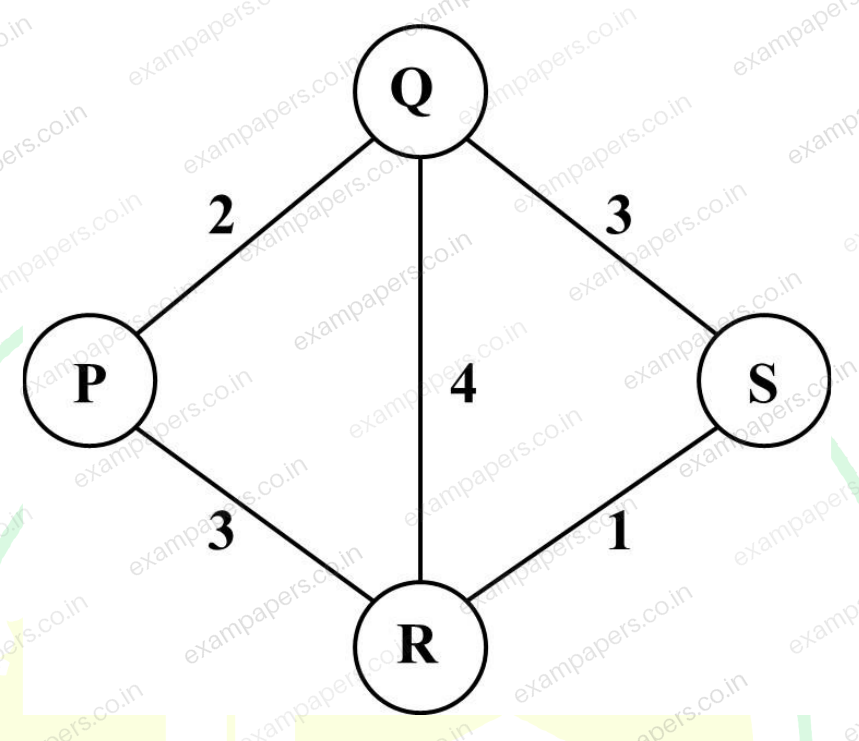
Length of the streets, in km, are shown on the network. The minimum distance travelled by the sweeping machine for completing the job of sweeping all the streets is ______ km. (round off to nearest integer)
Log in to check the answer
You can attempt this question now. Sign in to view the answer key, explanations and discussion.Log in to check answerQuestion 63
Open questionESNAT2 marksNeeds review
A solid waste of composition C
H
O
N
is to be composted aerobically in a closed vessel mechanical composting facility. Given: all ammonia generated escapes the facility; air contains 23% of Oxygen by weight; 100% excess air requirement for the closed vessel composting facility. The atomic weights: C – 12, H – 1, O – 16, N – 14. The actual air required for composting is ______ kg per kg waste. (rounded off to one decimal place)Log in to check the answer
You can attempt this question now. Sign in to view the answer key, explanations and discussion.Log in to check answerQuestion 64
Open questionESNAT2 marksNeeds review
An industry releases three greenhouse gases (GHGs), CO
(5 kg/day), CH
(0.5 kg/day), and N
O (0.1 kg/day). The industry flares the CH
before it is released to the atmosphere. The Global Warming Potential (GWP) are as follows: CO
= 1, CH
= 21, N
O = 310. The annual GWP of GHGs released from the industry is ______ kg CO
equivalent. (rounded off to the nearest integer)Log in to check the answer
You can attempt this question now. Sign in to view the answer key, explanations and discussion.Log in to check answerQuestion 65
Open questionESNAT2 marksNeeds review
Water from a hand pump located near a landfill has 1 mg/L arsenic (oral carcinogenic potency factor = 1.75 (kg-day)/mg). A person who lives nearby drinks 2 L/day water from this hand pump for 10 years. Assume body weight of 70 kg and 70 years as average life duration. Chances of this person getting excess risk of cancer is __________________ ×10
. (rounded off to three decimal places)Log in to check the answer
You can attempt this question now. Sign in to view the answer key, explanations and discussion.Log in to check answer