
Environmental Science and Engineering
GATE ES format:nat PYQs
Build your understanding with focused practice from past exam papers.
Questions 101–110 of 122. Imported answers require independent review unless marked reviewed.
Question 62
Open questionESNAT2 marksNeeds review
A sewage treatment plant with a capacity of 10 million litres per day (MLD) is treating the sewage through an aerobic biological process. The inlet and outlet BOD are measured as 100 and 30 mg/l, respectively. If the mixed microbial culture has an observed biomass yield of 0.5 g Volatile Suspended Solids (VSS)/g BOD, the sludge production rate (in kg per day, rounded off to one decimal place) when the plant is operating at 80% capacity will be __________.
Log in to check the answer
You can attempt this question now. Sign in to view the answer key, explanations and discussion.Log in to check answerQuestion 63
Open questionESNAT2 marksNeeds review
A centrifuge is processing 1000 litres per hour of water containing 2 g per litre of suspended solids. The thickened slurry coming out of the centrifuge has solids concentration of 20 g per 100 ml. If the centrifuge has 99% efficiency based on solids separation, the flow rate (in litres per hour, rounded off to one decimal place) of the supernatant stream will be __________.
Log in to check the answer
You can attempt this question now. Sign in to view the answer key, explanations and discussion.Log in to check answerQuestion 64
Open questionESNAT2 marksNeeds review
A ground level source emits 1000 g per day of SO
. In vicinity of the source, ambient temperature is measured at 10 m and 110 m as 25°C and 24.5°C, respectively. The mean wind speed is found to be 2 m per second. The dispersion coefficients at 1000 m downwind distance from the source are given in table below: | Dispersion coefficients (in m) | | |
|---|---|---|---|
| Stable | Neutral | Unstable |
Crosswind direction | 50.5 | 80.0 | 156.0 |
Vertical direction | 21.4 | 41.5 | 110.2 |
Estimated ground level concentration (in μg/m
, rounded off to two decimal places) of SO
at a downwind distance of 1000 m (at the plume centerline) from the source is __________.Log in to check the answer
You can attempt this question now. Sign in to view the answer key, explanations and discussion.Log in to check answerQuestion 65
Open questionESNAT2 marksNeeds review
Figure below gives the heat inflow into the furnace of a waste-to-energy plant along with the heat outflows from the furnace.
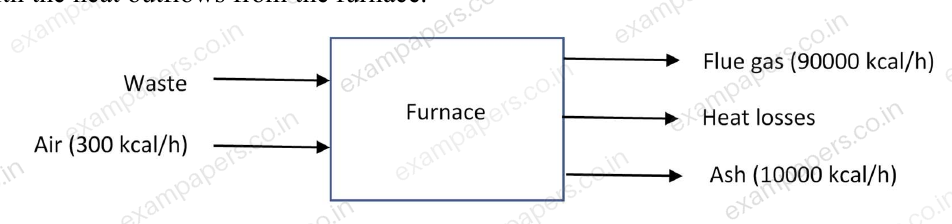
Assume: (i) total heat loss equal to 3% of heat released while burning waste, (ii) sensible heat of the waste is negligible, (iii) complete burning of the waste is ensured. If the waste feed rate into this plant is 70 kg/h, the heat content of the waste (in kcal/kg, rounded off to one decimal place) is __________.
Log in to check the answer
You can attempt this question now. Sign in to view the answer key, explanations and discussion.Log in to check answerQuestion 23
Open questionESNAT1 markNeeds review
A flocculation tank used for water treatment has a velocity gradient (G) of 800 s⁻¹. The volume of the tank is 40 m³. The dynamic viscosity of water is 9×10⁻⁴ N·s/m². The theoretical power required to maintain the given velocity gradient is __________ kW (rounded off to the nearest integer).
Log in to check the answer
You can attempt this question now. Sign in to view the answer key, explanations and discussion.Log in to check answerQuestion 24
Open questionESNAT1 markNeeds review
In a sample, the growth of microbial cells started with an initial concentration of 5×10⁴ cells per millilitre (mL) of the sample. After a certain time period, the cell concentration was found to be 1280×10⁴ cells per mL of the sample. Assuming binary fission of cells and no cell death, the number of generations of cell growth occurred in this time period is __________ (answer in integer).
Log in to check the answer
You can attempt this question now. Sign in to view the answer key, explanations and discussion.Log in to check answerQuestion 25
Open questionESNAT1 markNeeds review
A water jet discharging from a 4 cm diameter orifice has a diameter of 3.5 cm at its vena contracta. The coefficient of velocity is defined as the ratio of the actual velocity of the jet at vena contracta to the theoretical velocity of the jet. If the coefficient of velocity is 0.98, the coefficient of discharge for the orifice will be __________ (rounded off to two decimal places).
Log in to check the answer
You can attempt this question now. Sign in to view the answer key, explanations and discussion.Log in to check answerQuestion 41
Open questionESNAT2 marksNeeds review
If
, where
, then the value of the ratio
is ________ (answer in integer).Log in to check the answer
You can attempt this question now. Sign in to view the answer key, explanations and discussion.Log in to check answerQuestion 42
Open questionESNAT2 marksNeeds review
Consider a function
which satisfies the following equation:
As
,
, and at
,
.The value of
at
is ________ (answer in integer).Log in to check the answer
You can attempt this question now. Sign in to view the answer key, explanations and discussion.Log in to check answerQuestion 43
Open questionESNAT2 marksNeeds review
The concentration of NO₂ in the air at NTP is reported as 0.30 ppm (ppm by volume). The concentration of NO₂ in μg/m³ is ________ (rounded off to the nearest integer).
[At NTP, temperature = 298 K, pressure = 1 atm, and one mole of ideal gas occupies 24.45 L]
[Molecular weight of NO₂ = 46 g/mol]
Log in to check the answer
You can attempt this question now. Sign in to view the answer key, explanations and discussion.Log in to check answer