
Environmental Science and Engineering
GATE ES Groundwater Resources PYQs
Build your understanding with focused practice from past exam papers.
How to practice Groundwater Resources
Attempt a question, record the concept and assumptions, then check the available answer. Rework mistakes after revising the relevant concepts. Topic tags can overlap; review the question context.
Questions 1–10 of 11. Imported answers require independent review unless marked reviewed.
Question 57
Open questionESNAT2 marksNeeds review
A well penetrates an unconfined aquifer. The water level (i.e., head) in the well prior to pumping is 25 m. After a long period of pumping at a constant rate of 0.05 m
/s, the drawdowns at distances of 50 m and 150 m from the well are observed to be 3 m and 1.2 m, respectively.The hydraulic conductivity of the unconfined aquifer is _____
m/s (rounded off to two decimal places).Consider
.Log in to check the answer
You can attempt this question now. Sign in to view the answer key, explanations and discussion.Log in to check answerQuestion 35
Open questionESNAT1 markNeeds review
An unconfined aquifer of areal extent 20 km × 20 km has hydraulic conductivity of 4 m/day, porosity of 0.32, and storage coefficient (specific yield) of 0.18. If the initial saturated thickness of the aquifer is 30 m, and 4×10⁸ m³ of water is extracted from the aquifer, then the decline in the saturated thickness is ____________ m. (rounded off to two decimal places)
Log in to check the answer
You can attempt this question now. Sign in to view the answer key, explanations and discussion.Log in to check answerQuestion 54
Open questionESNAT2 marksNeeds review
A homogeneous isotropic confined aquifer of uniform thickness 30 m has hydraulic conductivity of 5 m/day and porosity of 0.3. There are two observation wells X and Y along a radial line from a fully penetrating pumping well at 100 m and 200 m distance, respectively. The well is pumped at a uniform rate to produce steady drawdown of 5 m at X and 3 m at Y. If a non-reactive pollutant enters at the observation well Y, then the time taken by the pollutant (under advection) to reach the observation well X is __________ days. (rounded off to two decimal places)
Log in to check the answer
You can attempt this question now. Sign in to view the answer key, explanations and discussion.Log in to check answerQuestion 40
Open questionESMCQ2 marksNeeds review
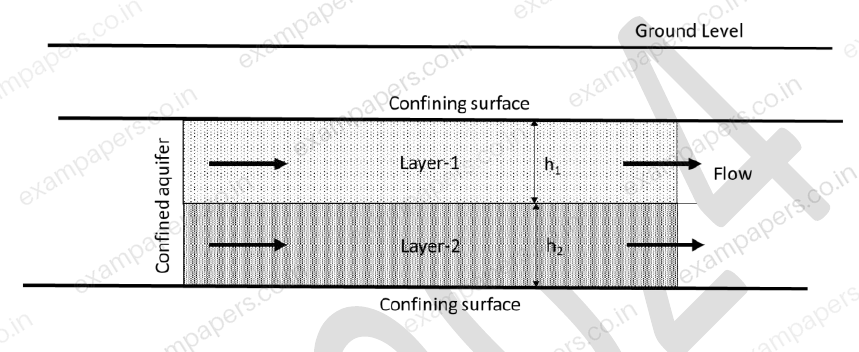
Consider two horizontal layers of an aquifer as shown in figure. Each layer is isotropic and homogenous. Flow is parallel to the stratification. Thickness and horizontal hydraulic conductivity of layer-1 are h₁ and K₁, respectively. Thickness and horizontal hydraulic conductivity of layer-2 are h₂ and K₂, respectively, where h₁ is not equal to h₂. The equivalent horizontal conductivity Kₓ for the aquifer system is given by ______.
Your answerChoose one option.
Log in to check the answer
You can attempt this question now. Sign in to view the answer key, explanations and discussion.Log in to check answerQuestion 29
Open questionESMCQ1 markNeeds review
The kinematic viscosity of glycerin and kerosene are 1.2 times and 0.95 times of that of water, respectively. Glycerin and kerosene flow through identical porous media having same hydraulic gradient. Assuming Darcy’s law is valid for the porous media, the ratio of flow rate of kerosene to that of glycerin is
Your answerChoose one option.
Log in to check the answer
You can attempt this question now. Sign in to view the answer key, explanations and discussion.Log in to check answerQuestion 54
Open questionESNAT2 marksNeeds review
A fully penetrating well is installed in a homogeneous and isotropic confined aquifer. The aquifer has uniform thickness of 16 m and hydraulic conductivity of 25 m/d. Water is being pumped out from the well at a constant rate of 0.1 m
/s till steady state condition is reached. If a drawdown of 3.5 m is observed at a distance of 75 m from the well then the drawdown at a distance of 150 m from the well will be ________________ (in m, rounded off to two decimal places).Log in to check the answer
You can attempt this question now. Sign in to view the answer key, explanations and discussion.Log in to check answerQuestion 19
Open questionESMCQ1 markNeeds review
The correct order of hydraulic conductivity for the geologic formations is
Your answerChoose one option.
Log in to check the answer
You can attempt this question now. Sign in to view the answer key, explanations and discussion.Log in to check answerQuestion 57
Open questionESNAT2 marksNeeds review
Two reservoirs having a difference of 20 m in their water surface elevations are connected through a confined aquifer (thickness = 5 m, length = 2 km, hydraulic conductivity
m/s, and porosity
) as shown in the following figure (drawn not to scale). 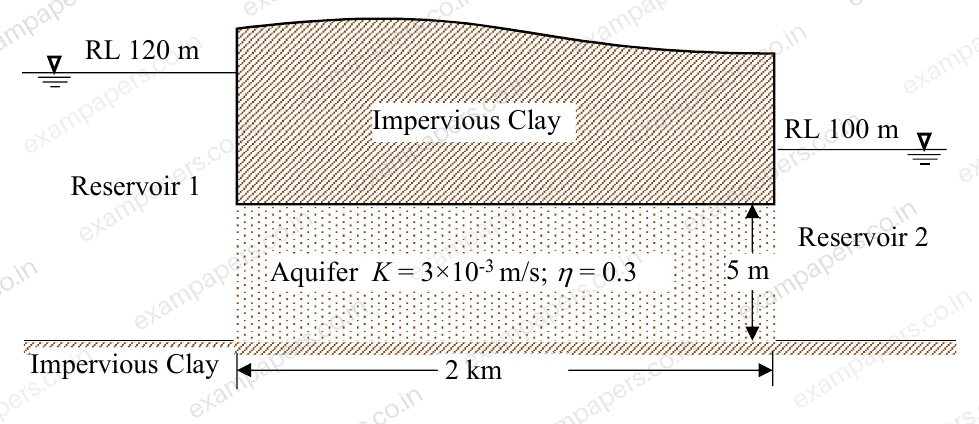
If the Reservoir 1 is contaminated by a pollutant then the time (in days, rounded off to one decimal place) taken by the pollutant to reach to the Reservoir 2 under advection will be __________.
Log in to check the answer
You can attempt this question now. Sign in to view the answer key, explanations and discussion.Log in to check answerQuestion 7
Open questionESMCQ1 markNeeds review
If
is the depth of an aquifer through which water is flowing, then the relationship between permeability
and transmissivity (also known as transmissivity)
is given by __________.Your answerChoose one option.
Log in to check the answer
You can attempt this question now. Sign in to view the answer key, explanations and discussion.Log in to check answerQuestion 46
Open questionESNAT2 marksNeeds review
In a field test of a geological formation of permeable soil (porosity = 20 %), the hydraulic gradient was found to be 2 %. The actual seepage velocity of the flow was found to be 0.0025 m/s. Assume that the flow is in the laminar regime. The permeability (K) of the aquifer is ______ m/s (rounded off to three decimal places).
Log in to check the answer
You can attempt this question now. Sign in to view the answer key, explanations and discussion.Log in to check answer