
Environmental Science and Engineering
GATE ES Surface Water Resources PYQs
Build your understanding with focused practice from past exam papers.
How to practice Surface Water Resources
Attempt a question, record the concept and assumptions, then check the available answer. Rework mistakes after revising the relevant concepts. Topic tags can overlap; review the question context.
Questions 1–10 of 12. Imported answers require independent review unless marked reviewed.
Question 34
Open questionESNAT1 markNeeds review
A 6-hour rainfall of 6 cm at a station was found to have a return period of 40 years. The probability that a 6-hour rainfall of this or larger magnitude will occur at least once in 20 successive years at that station is ______ (rounded off to three decimal places).
Log in to check the answer
You can attempt this question now. Sign in to view the answer key, explanations and discussion.Log in to check answerQuestion 56
Open questionESNAT2 marksNeeds review
The mass curve of a rainfall event of 100 min duration over a catchment is given in the table.
If the initial loss is 0.6 cm and
-index is 0.6 cm/hour, the total surface runoff from the catchment is _____ cm (rounded off to one decimal place).Time from start of rainfall (min) | 0 | 20 | 40 | 60 | 80 | 100 |
|---|---|---|---|---|---|---|
Cumulative rainfall (cm) | 0 | 0.5 | 1.2 | 2.6 | 3.3 | 3.5 |
Log in to check the answer
You can attempt this question now. Sign in to view the answer key, explanations and discussion.Log in to check answerQuestion 16
Open questionESMCQ1 markNeeds review
For flood routing, consider the following statements
P: Hydrologic routing method uses continuity equation and momentum equation
Q: Hydraulic routing method uses continuity equation and energy equation
Choose the correct option from the following
Your answerChoose one option.
Log in to check the answer
You can attempt this question now. Sign in to view the answer key, explanations and discussion.Log in to check answerQuestion 52
Open questionESNAT2 marksNeeds review
The following figure (not to scale) depicts a rainfall hyetograph for a storm over a catchment.
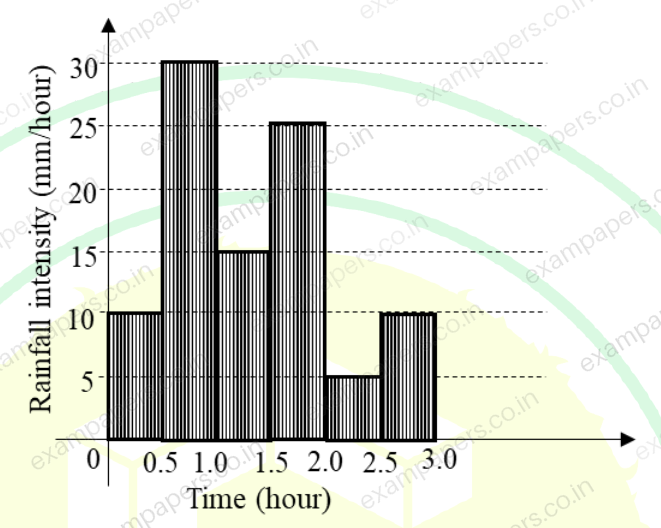
If the storm produced a direct runoff of 12.5 mm, then the
-index of the storm for the catchment is ________________ mm/hour. (rounded off to two decimal places)Log in to check the answer
You can attempt this question now. Sign in to view the answer key, explanations and discussion.Log in to check answerQuestion 53
Open questionESNAT2 marksNeeds review
The following table and figure (not to scale) show characteristics of a catchment
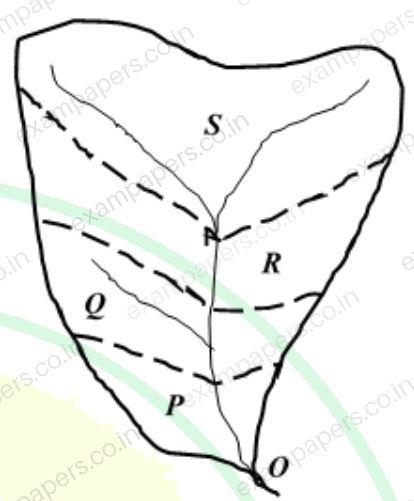
Sub-catchment | Area (ha) | Runoff coefficient | Time of concentration |
|---|---|---|---|
P | 750 | 0.5 | 1 hour |
Q | 1000 | 0.6 | 2 hour |
R | 1500 | 0.6 | 3 hour |
S | 2000 | 0.7 | 4 hour |
The hyetograph resulting from a storm that occurred uniformly over the catchment, is as follows
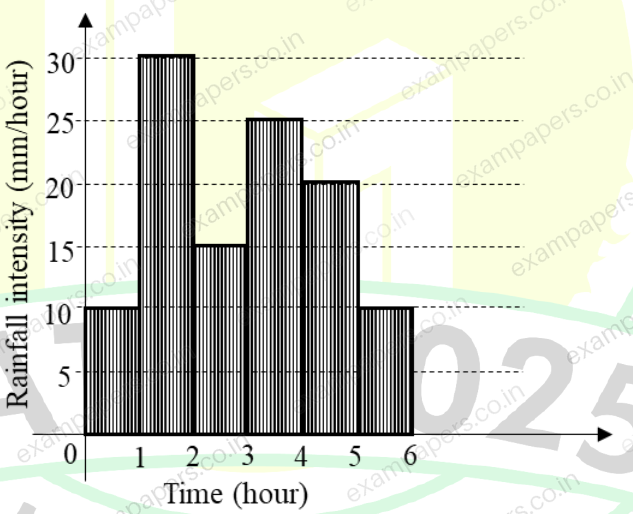
Assuming a constant base flow of 40 m³/s, the peak of the runoff hydrograph produced by storm for the catchment at the outlet O is ________________ m³/s. (rounded off to two decimal places)
Log in to check the answer
You can attempt this question now. Sign in to view the answer key, explanations and discussion.Log in to check answerQuestion 35
Open questionESNAT1 markNeeds review
A Class-A pan was setup adjacent to a lake for measuring evaporation losses in the lake. The depth of water in the pan at the begining of a certain week was 250 mm. In that week, there was a rainfall event with 10 mm depth. Water depth in the pan at the end of the week was 240 mm. The pan coefficient is 0.8.
The estimated lake evaporation during the week was ______ mm (an integer value).
Log in to check the answer
You can attempt this question now. Sign in to view the answer key, explanations and discussion.Log in to check answerQuestion 55
Open questionESNAT2 marksNeeds review
Consider a watershed and isohyets as shown in the figure. The average rainfall in the watershed is ______ mm (an integer value).
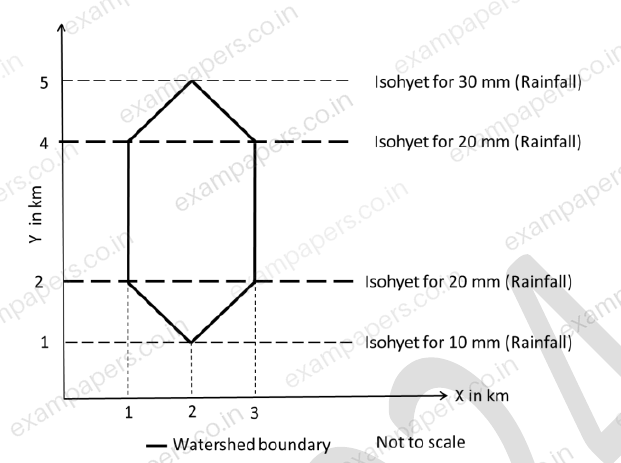
Log in to check the answer
You can attempt this question now. Sign in to view the answer key, explanations and discussion.Log in to check answerQuestion 34
Open questionESNAT1 markNeeds review
An S-hydrograph was prepared for a catchment of 240 km² using 3-hour unit hydrograph (1 cm rainfall excess). The equilibrium discharge for the S-hydrograph would be __________ (in m³/s, rounded off to two decimal places).
Log in to check the answer
You can attempt this question now. Sign in to view the answer key, explanations and discussion.Log in to check answerQuestion 51
Open questionESNAT2 marksNeeds review
The following figure (not to the scale) shows a catchment (Q, S, U, T, Q) and adjoining raingauge stations P, Q, R, S, U and V. Due to a storm, 20 mm, 25 mm, 30 mm, 15 mm, 22 mm and 18 mm rainfall depths were recorded by raingauges at P, Q, R, S, U and V, respectively.
The corresponding mean rainfall over the catchment using Thiessen polygon method is __________ (in mm, rounded off to two decimal places).
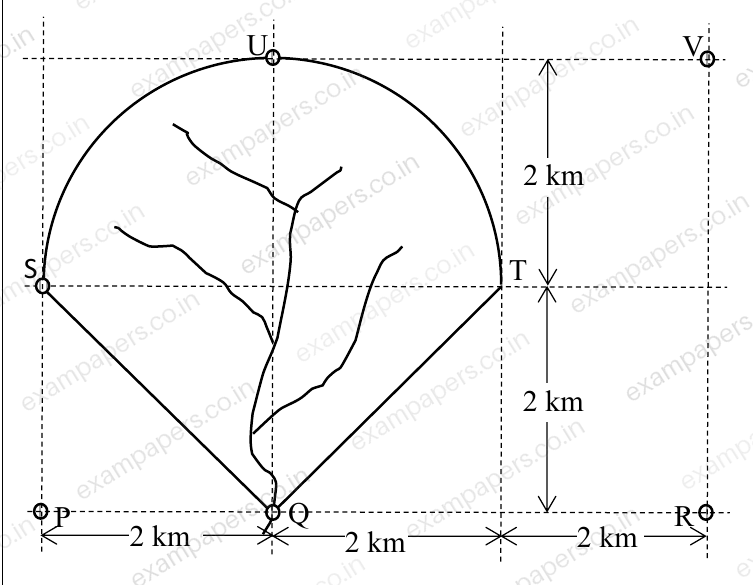
Log in to check the answer
You can attempt this question now. Sign in to view the answer key, explanations and discussion.Log in to check answerQuestion 18
Open questionESMCQ1 markNeeds review
Consider the following statements
Statement 1: Goodrich method for reservoir routing is based on hydrologic flood routing method.
Statement 2: Muskingum method for channel routing is based on hydraulic flood routing method.
Which one of the following is correct?
Your answerChoose one option.
Log in to check the answer
You can attempt this question now. Sign in to view the answer key, explanations and discussion.Log in to check answer