
Environmental Science and Engineering
GATE ES topic:air-quality-management PYQs
Build your understanding with focused practice from past exam papers.
How to practice topic:air-quality-management
Attempt a question, record the concept and assumptions, then check the available answer. Rework mistakes after revising the relevant concepts. Topic tags can overlap; review the question context.
Questions 1–10 of 10. Imported answers require independent review unless marked reviewed.
Question 40
Open questionESMCQ2 marksNeeds review
Which ONE of the following options CORRECTLY matches the atmospheric stability conditions with plume conditions/behaviors given in the table?
Atmospheric Stability Conditions | Plume Conditions/Behaviors |
|---|---|
(P) Strong instability | (i) Fanning plume |
(Q) Neutral stability | (ii) Fumigation |
(R) Surface inversion | (iii) Coning plume |
(S) Aloft inversion | (iv) Looping plume |
Your answerChoose one option.
Log in to check the answer
You can attempt this question now. Sign in to view the answer key, explanations and discussion.Log in to check answerQuestion 46
Open questionESMSQ2 marksNeeds review
Which of the following options is/are CORRECT assumption(s) in the Gaussian plume dispersion model?
Your answerSelect all correct options. You can choose more than one.
Log in to check the answer
You can attempt this question now. Sign in to view the answer key, explanations and discussion.Log in to check answerQuestion 27
Open questionESMSQ1 markNeeds review
Stable burning results in release of particulate matter, volatile organic compounds, oxides of nitrogen and sulfur, to name a few. A researcher is planning to use a conventional Gaussian dispersion model to estimate the contribution of stubble burning in a nearby state to air pollution in New Delhi.
Choose the option(s) which could explain the possible limitations in this approach
Your answerSelect all correct options. You can choose more than one.
Log in to check the answer
You can attempt this question now. Sign in to view the answer key, explanations and discussion.Log in to check answerQuestion 19
Open questionESMCQ1 markNeeds review
The environmental temperature increases by 6 °C/km with height at a particular location. The stability condition of the atmosphere at the location is ______.
Your answerChoose one option.
Log in to check the answer
You can attempt this question now. Sign in to view the answer key, explanations and discussion.Log in to check answerQuestion 59
Open questionESNAT2 marksNeeds review
An industrial stack emits 100 g/s of CO at an effective height of ‘H’, where the wind speed is 5 m/s. At 3 km distance downwind, the values of dispersion coefficient in y-direction and z-direction are 50 m and 25 m, respectively. The CO concentration at the centerline of the plume at 3 km distance downwind is ______ mg/m
(rounded off to 2 decimal places)? Use Gaussian plume model and value of π = 3.14. Neglect reactions and the ground effect of plume in the calculations.Log in to check the answer
You can attempt this question now. Sign in to view the answer key, explanations and discussion.Log in to check answerQuestion 61
Open questionESNAT2 marksNeeds review
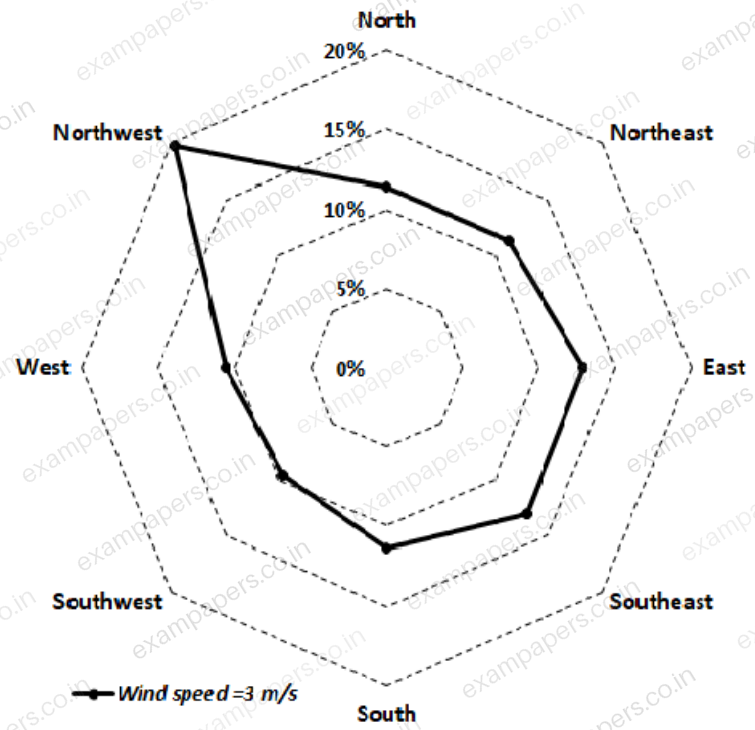
An industry with an effective stack height of 80 m emits 1200 g/h of CO. The windrose plotted using the meteorological data at the top of the stack, and the relation between dispersion coefficients and wind direction are given below:
Wind Direction | Dispersion coefficients (in m): Crosswind direction | Dispersion coefficients (in m): Vertical direction |
|---|---|---|
Northeast | 50 | 20 |
North | 45 | 30 |
Northwest | 40 | 35 |
East | 45 | 30 |
Southeast | 55 | 35 |
South | 60 | 40 |
Southwest | 65 | 45 |
West | 70 | 50 |
During the maximum duration of the year, the ground level PM₂.₅ concentration at the downwind distance of 2 km (at the plume centerline) from the stack is __________________ (in μg/m³, rounded off to two decimal places).
Log in to check the answer
You can attempt this question now. Sign in to view the answer key, explanations and discussion.Log in to check answerQuestion 48
Open questionESMSQ2 marksNeeds review
Consider the figure shown below for three different cases:
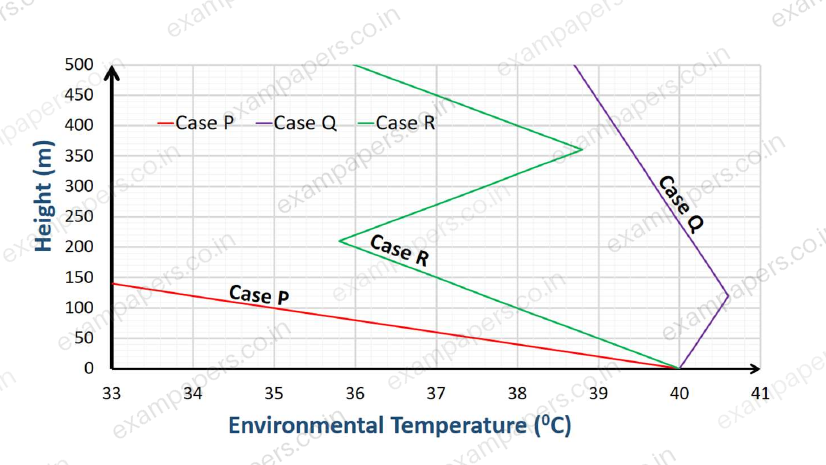
Which of the following statement(s) is/are correct for surface level emissions, given the environmental temperature?
Your answerSelect all correct options. You can choose more than one.
Log in to check the answer
You can attempt this question now. Sign in to view the answer key, explanations and discussion.Log in to check answerQuestion 64
Open questionESNAT2 marksNeeds review
A ground level source emits 1000 g per day of SO
. In vicinity of the source, ambient temperature is measured at 10 m and 110 m as 25°C and 24.5°C, respectively. The mean wind speed is found to be 2 m per second. The dispersion coefficients at 1000 m downwind distance from the source are given in table below: | Dispersion coefficients (in m) | | |
|---|---|---|---|
| Stable | Neutral | Unstable |
Crosswind direction | 50.5 | 80.0 | 156.0 |
Vertical direction | 21.4 | 41.5 | 110.2 |
Estimated ground level concentration (in μg/m
, rounded off to two decimal places) of SO
at a downwind distance of 1000 m (at the plume centerline) from the source is __________.Log in to check the answer
You can attempt this question now. Sign in to view the answer key, explanations and discussion.Log in to check answerQuestion 22
Open questionESMSQ1 markNeeds review
A wind rose is a representation of meteorological conditions. Which of the following is/are included in this representation?
Your answerSelect all correct options. You can choose more than one.
Log in to check the answer
You can attempt this question now. Sign in to view the answer key, explanations and discussion.Log in to check answerQuestion 28
Open questionESMCQ2 marksNeeds review
Match the entries in Column I with the correct entries in Column II.
Column I | Column II |
|---|---|
P. Diffusion | (i) Pasquill |
Q. Drag force | (ii) Fick |
R. Atmospheric stability | (iii) Stokes |
Your answerChoose one option.
Log in to check the answer
You can attempt this question now. Sign in to view the answer key, explanations and discussion.Log in to check answer