
Geology and Geophysics
GATE GG-1 Crystallography and mineralogy PYQs
Build your understanding with focused practice from past exam papers.
Questions 31–38 of 38. Imported answers require independent review unless marked reviewed.
Question 20
Open questionGL-1NAT2 marksNeeds review
The unit-cell of an orthorhombic mineral was compressed during deformation from 5 Å to 4.5 Å along the c-axis, with the other two dimensions remaining unaffected. The absolute value of the shift in the position of the (001) peak in its XRD pattern is ________ °2θ. (Round off to 3 decimal places) (Wavelength of X-ray used = 1.5418 Å. For orthorhombic system:
.)Log in to check the answer
You can attempt this question now. Sign in to view the answer key, explanations and discussion.Log in to check answerQuestion 31
Open questionPART-B SECTION-1MCQ2 marksNeeds review
Match the type of twining (Group I) with the mineral (Group II) that best exhibits it.
Group I
P. Carlsbad
Q. Pericline
R. Brazil
S. Geniculated (elbow)
Group II
Rutile
Quartz
Orthoclase
Plagioclase
Your answerChoose one option.
Log in to check the answer
You can attempt this question now. Sign in to view the answer key, explanations and discussion.Log in to check answerQuestion 32
Open questionPART-B SECTION-1MCQ2 marksNeeds review
On inserting a first order red interference filter in SE-NW direction, the interference figure of quartz shows
Your answerChoose one option.
Log in to check the answer
You can attempt this question now. Sign in to view the answer key, explanations and discussion.Log in to check answerQuestion 38
Open questionPART-B GEOLOGY (SECTION 1)MCQ2 marksNeeds review
Match the optical properties listed in Group I with the corresponding mineral in Group II.
Group I
P. Brown colour, very high refractive index, very high birefringence, biaxial positive
Q. Colourless, very high refractive index, low birefringence, uniaxial negative
R. Deep reddish-brown colour, very high refractive index, very high birefringence, uniaxial positive
S. Colourless, very high refractive index, very high birefringence, uniaxial positive
Group II
Apatite
Rutile
Zircon
Titanite
Your answerChoose one option.
Log in to check the answer
You can attempt this question now. Sign in to view the answer key, explanations and discussion.Log in to check answerQuestion 48
Open questionPART-B GEOLOGY (SECTION 1)NAT2 marksNeeds review
The difference in the number of faces in forms and in the holosymmetric class of the isometric system is ____________.
Log in to check the answer
You can attempt this question now. Sign in to view the answer key, explanations and discussion.Log in to check answerQuestion 12
Open questionGG-CMCQ1 markNeeds review
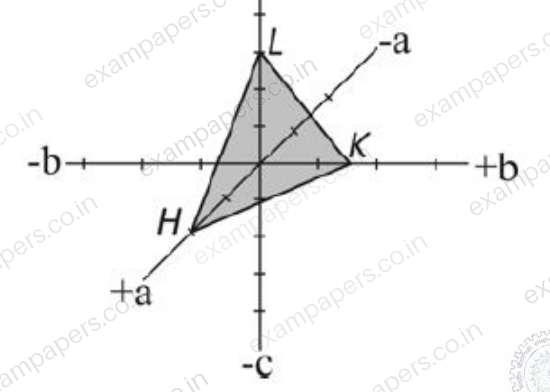
The figure below shows the intercepts of the plane HKL with the crystallographic axes a, b, c. The Miller index of the plane HKL is
Your answerChoose one option.
Log in to check the answer
You can attempt this question now. Sign in to view the answer key, explanations and discussion.Log in to check answerQuestion 37
Open questionGG-1NAT2 marksNeeds review
Fluorite crystal (CaF₂) adopts face-centered cubic structure with lattice parameter a = 5.463 Å. If the ionic radius of anion (F⁻) is 1.71 Å, the ionic radius of cation (Ca²⁺) is __________ Å.
Log in to check the answer
You can attempt this question now. Sign in to view the answer key, explanations and discussion.Log in to check answerQuestion 38
Open questionGG-1MCQ2 marksNeeds review
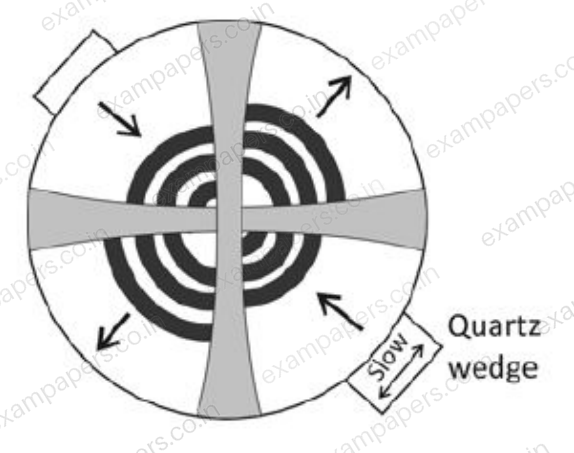
The diagram below shows the interference figure of a mineral. The mineral is
Your answerChoose one option.
Log in to check the answer
You can attempt this question now. Sign in to view the answer key, explanations and discussion.Log in to check answer