
Geology and Geophysics
GATE GG-1 Earth and planetary system PYQs
Build your understanding with focused practice from past exam papers.
How to practice Earth and planetary system
Attempt a question, record the concept and assumptions, then check the available answer. Rework mistakes after revising the relevant concepts. Topic tags can overlap; review the question context.
Questions 1–10 of 48. Imported answers require independent review unless marked reviewed.
Question 12
Open questionGGMCQ1 markNeeds review
In which one of the following layers inside the Earth, the velocity of the P-wave exceeds 13 km/s?
Your answerChoose one option.
Log in to check the answer
You can attempt this question now. Sign in to view the answer key, explanations and discussion.Log in to check answerQuestion 14
Open questionGGMCQ1 markNeeds review
If
and
, respectively, denote the equatorial and polar radii of a reference ellipsoid, then the radius,
, of its equivalent sphere is given byYour answerChoose one option.
Log in to check the answer
You can attempt this question now. Sign in to view the answer key, explanations and discussion.Log in to check answerQuestion 24
Open questionGGNAT2 marksNeeds review
If the diameter of a scaled-down model of the Earth is 45 cm, then the equivalent length on the surface of the Earth for 1 cm on the model is __________ km (rounded off to two decimal places).
[Use: Radius of the Earth = 6371 km]
Log in to check the answer
You can attempt this question now. Sign in to view the answer key, explanations and discussion.Log in to check answerQuestion 26
Open questionGGNAT2 marksNeeds review
Consider that the upper continental crust is 10 km thick and made up of granitic rock having density of 2800 kg/m³. The surface heat flow due to radiogenic heat from the granitic rock having heat production value of 10⁻⁹ W/kg is____________ mW/m² (answer in integer).
Log in to check the answer
You can attempt this question now. Sign in to view the answer key, explanations and discussion.Log in to check answerQuestion 11
Open questionGGMCQ1 markNeeds review
The most volcanically active body in our Solar System is
Your answerChoose one option.
Log in to check the answer
You can attempt this question now. Sign in to view the answer key, explanations and discussion.Log in to check answerQuestion 20
Open questionGGMSQ2 marksNeeds review
The ratio of P-wave to S-wave velocities,
, within the Earth depends onYour answerSelect all correct options. You can choose more than one.
Log in to check the answer
You can attempt this question now. Sign in to view the answer key, explanations and discussion.Log in to check answerQuestion 23
Open questionGGMSQ2 marksNeeds review
Which of the following statements is/are correct regarding the magnetic field lines of the Earth, at the magnetic poles and the magnetic equator?
Your answerSelect all correct options. You can choose more than one.
Log in to check the answer
You can attempt this question now. Sign in to view the answer key, explanations and discussion.Log in to check answerQuestion 11
Open questionGGMCQ1 markNeeds review
The Earth’s magnetic field originates from convection in which one of the following layers?
Your answerChoose one option.
Log in to check the answer
You can attempt this question now. Sign in to view the answer key, explanations and discussion.Log in to check answerQuestion 18
Open questionGGMCQ2 marksNeeds review
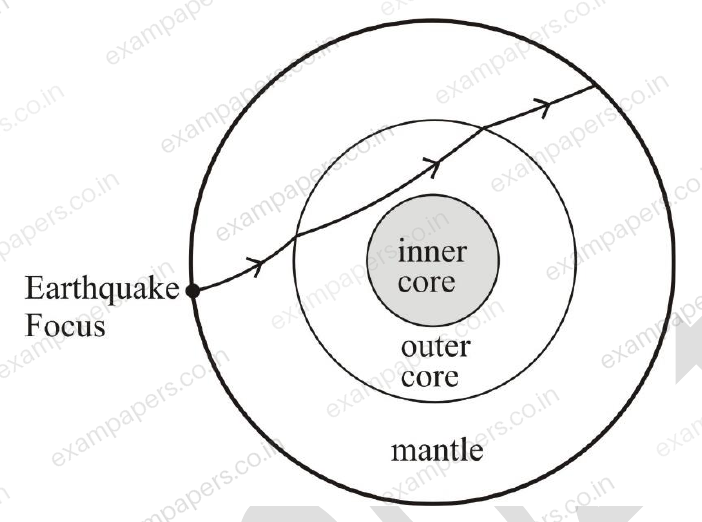
The given figure shows the ray path of a P-wave propagating through the Earth. Choose the CORRECT P-phase corresponding to the ray path.
Your answerChoose one option.
Log in to check the answer
You can attempt this question now. Sign in to view the answer key, explanations and discussion.Log in to check answerQuestion 24
Open questionGGNAT2 marksNeeds review
Assume heat producing elements are uniformly distributed within a 16 km thick layer in the crust in a heat flow province. Given that the surface heat flow and reduced heat flow are 54 mW/m² and 22 mW/m², respectively, the radiogenic heat production in the given crustal layer in µW/m³ is ____________ (in integer).
Log in to check the answer
You can attempt this question now. Sign in to view the answer key, explanations and discussion.Log in to check answer