
Geology and Geophysics
GATE GG-1 format:mcq PYQs
Build your understanding with focused practice from past exam papers.
Questions 21–30 of 422. Imported answers require independent review unless marked reviewed.
Question 30
Open questionGGMCQ1 markNeeds review
Which one of the following is NOT a diagnostic parameter in identifying a crystalline phase using powder X-ray diffraction data?
Your answerChoose one option.
Log in to check the answer
You can attempt this question now. Sign in to view the answer key, explanations and discussion.Log in to check answerQuestion 31
Open questionGGMCQ1 markNeeds review
If a dextral strike-slip fault system has a right step-over, which one of the following features will develop?
Your answerChoose one option.
Log in to check the answer
You can attempt this question now. Sign in to view the answer key, explanations and discussion.Log in to check answerQuestion 45
Open questionGGMCQ2 marksNeeds review
Which one of the following mineral reactions will result in the formation of a diagnostic granulite facies assemblage during regional metamorphism of a pelite?
Your answerChoose one option.
Log in to check the answer
You can attempt this question now. Sign in to view the answer key, explanations and discussion.Log in to check answerQuestion 46
Open questionGGMCQ2 marksNeeds review
The given table shows modal volume percentage of quartz, alkali feldspar and plagioclase in coarse-grained rocks, X and Y. Which of the following rock names of X and Y are CORRECT according to the IUGS classification?
Mineral | X (volume %) | Y (volume %) |
|---|---|---|
Quartz | 15 | 25 |
Plagioclase | 20 | 60 |
Alkali feldspar | 65 | 15 |
Your answerChoose one option.
Log in to check the answer
You can attempt this question now. Sign in to view the answer key, explanations and discussion.Log in to check answerQuestion 47
Open questionGGMCQ2 marksNeeds review
The ternary diagram given below shows phase relations for the Anorthite-Diopside-Forsterite system at 1 bar pressure. Broken lines represent isotherms with temperature in °C. If ‘P’ is the initial melt composition, which one of the following is the CORRECT sequence of crystallization assuming equilibrium between crystal and melt?
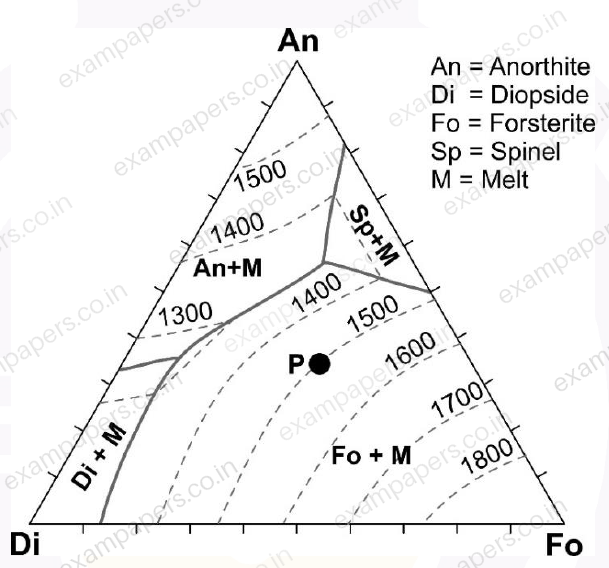
Your answerChoose one option.
Log in to check the answer
You can attempt this question now. Sign in to view the answer key, explanations and discussion.Log in to check answerQuestion 48
Open questionGGMCQ2 marksNeeds review
Accumulation of which one of the following minerals can explain positive Eu and positive Sr anomalies in the primitive mantle-normalized multielement pattern of an igneous rock?
Your answerChoose one option.
Log in to check the answer
You can attempt this question now. Sign in to view the answer key, explanations and discussion.Log in to check answerQuestion 49
Open questionGGMCQ2 marksNeeds review
Match the minerals in Group I with the corresponding elements in Group II.
Group-I | Group-II |
|---|---|
P. Smithsonite | 1. Lead |
Q. Azurite | 2. Iron |
R. Crocite | 3. Zinc |
S. Marcasite | 4. Copper |
Your answerChoose one option.
Log in to check the answer
You can attempt this question now. Sign in to view the answer key, explanations and discussion.Log in to check answerQuestion 50
Open questionGGMCQ2 marksNeeds review
Match the stratigraphic Formations in Group I with the corresponding Geologic Periods in Group II.
Group-I: P. Kopili Shale; Q. Ranikhet Formation; R. Quilon Formation; S. Dalmiapuram Formation.
Group-II: 1. Permian; 2. Eocene; 3. Cretaceous; 4. Miocene
Your answerChoose one option.
Log in to check the answer
You can attempt this question now. Sign in to view the answer key, explanations and discussion.Log in to check answerQuestion 51
Open questionGGMCQ2 marksNeeds review
Which one of the following chrons of Neogene and Quaternary geomagnetic polarity time scale is arranged in the order from oldest to youngest?
Your answerChoose one option.
Log in to check the answer
You can attempt this question now. Sign in to view the answer key, explanations and discussion.Log in to check answerQuestion 52
Open questionGGMCQ2 marksNeeds review
Match the mineral names in Group I with corresponding space groups in Group II.
Group-I: P. Diamond; Q. Coesite; R. Graphite; S. Calcite.
Group-II: 1. P6₃/mmc; 2. R3̅c; 3. Fd3̅m; 4. C2/c
Your answerChoose one option.
Log in to check the answer
You can attempt this question now. Sign in to view the answer key, explanations and discussion.Log in to check answer