
Geology and Geophysics
GATE GG-1 format:mcq PYQs
Build your understanding with focused practice from past exam papers.
Questions 51–60 of 422. Imported answers require independent review unless marked reviewed.
Question 30
Open questionGGMCQ1 markNeeds review
Shown below is a schematic plot of
(deviation of
in a sample relative to CHUR) versus time. The two solid lines represent the evolution curves for the depleted mantle reservoir and the continental crust. Which one of the four dashed lines, marked 1, 2, 3, and 4, represents the evolution of the CHUR? 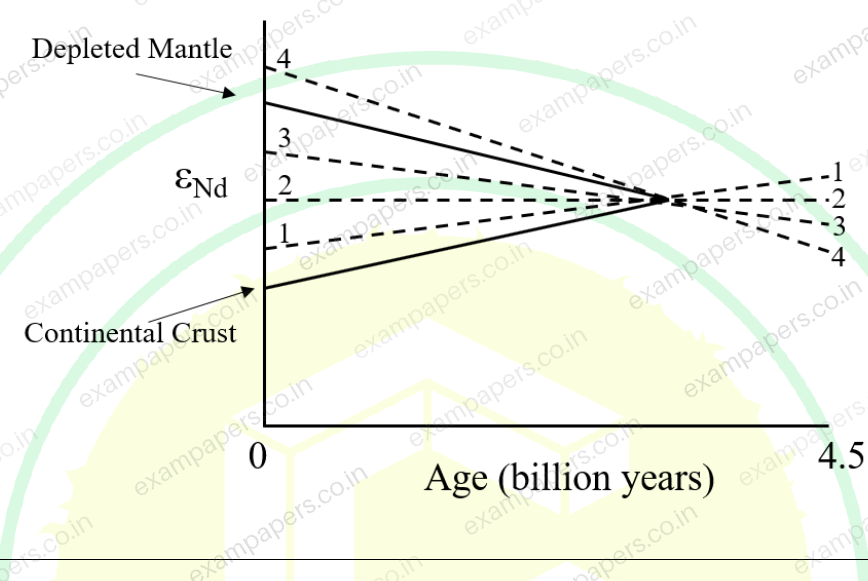
Your answerChoose one option.
Log in to check the answer
You can attempt this question now. Sign in to view the answer key, explanations and discussion.Log in to check answerQuestion 31
Open questionGGMCQ1 markNeeds review
Which one of the following expressions represents porosity of a rock?
Your answerChoose one option.
Log in to check the answer
You can attempt this question now. Sign in to view the answer key, explanations and discussion.Log in to check answerQuestion 32
Open questionGGMCQ1 markNeeds review
Choose the correct option where both organisms do NOT secrete any CaCO₃ (calcite or aragonite).
Your answerChoose one option.
Log in to check the answer
You can attempt this question now. Sign in to view the answer key, explanations and discussion.Log in to check answerQuestion 33
Open questionGGMCQ1 markNeeds review
From the following optical properties of minerals, select an appropriate option to identify the direction of analyser and polarizer if the available microscope is without a cross-hair.
Your answerChoose one option.
Log in to check the answer
You can attempt this question now. Sign in to view the answer key, explanations and discussion.Log in to check answerQuestion 34
Open questionGGMCQ1 markNeeds review
Which one of the following minerals has crystallographic axes
and all interaxial angles equal to 90°?Your answerChoose one option.
Log in to check the answer
You can attempt this question now. Sign in to view the answer key, explanations and discussion.Log in to check answerQuestion 35
Open questionGGMCQ1 markNeeds review
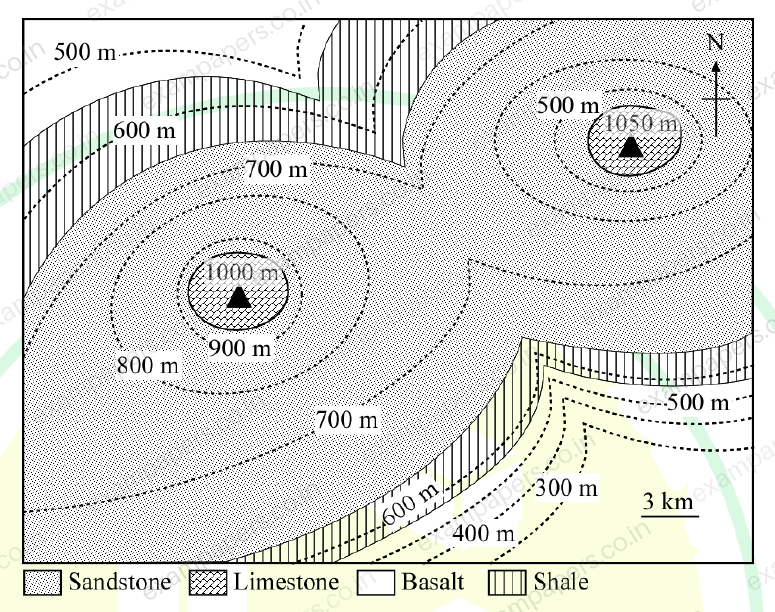
Which one of the following statements correctly describes the features in the geological map?
Your answerChoose one option.
Log in to check the answer
You can attempt this question now. Sign in to view the answer key, explanations and discussion.Log in to check answerQuestion 36
Open questionGGMCQ1 markNeeds review
In which one of the following rivers does helical flow play an important role in controlling river dynamics and channel morphology?
Your answerChoose one option.
Log in to check the answer
You can attempt this question now. Sign in to view the answer key, explanations and discussion.Log in to check answerQuestion 45
Open questionGGMCQ2 marksNeeds review
A particular Index of Alteration (IA) is defined as the molar concentration ratio (expressed as weight percentage) of fluid immobile element(s) to fluid mobile element(s) and is expressed by 100 × ([Al
O
] / ). For chemical weathering of silicate rocks, which one of the following statements is correct?Your answerChoose one option.
Log in to check the answer
You can attempt this question now. Sign in to view the answer key, explanations and discussion.Log in to check answerQuestion 46
Open questionGGMCQ2 marksNeeds review
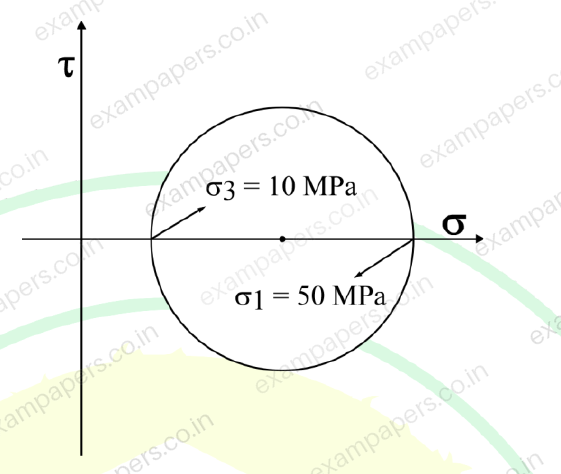
What is the value of the maximum shear stress in a rock, for which the state of stress is given by the following Mohr circle?
Your answerChoose one option.
Log in to check the answer
You can attempt this question now. Sign in to view the answer key, explanations and discussion.Log in to check answerQuestion 47
Open questionGGMCQ2 marksNeeds review
In a hypothetical scenario, the element Y has 4 stable isotopes
Y,
Y,
Y and
Y. The isotope
Y is radiogenic and is formed by β
decay of the isotope
X of the element X with a half-life of 3.51 billion years. An igneous rock, which has behaved as a closed system, has three different minerals P, Q, and R, which crystallized from the same magma 2 billion years ago, with initial X/Y ratios of 1.75, 2.05, and 0.75, respectively. Which one of the following statements is true for the ratio
Y/
Y in this igneous rock in the present day?Your answerChoose one option.
Log in to check the answer
You can attempt this question now. Sign in to view the answer key, explanations and discussion.Log in to check answer