
Geology and Geophysics
GATE GG-1 purpose:exam-prep PYQs
Build your understanding with focused practice from past exam papers.
Questions 541–550 of 650. Imported answers require independent review unless marked reviewed.
Question 11
Open questionPART-AMCQ1 markNeeds review
The supercontinent that existed in the late Mesoproterozoic to early Neoproterozoic time was
Your answerChoose one option.
Log in to check the answer
You can attempt this question now. Sign in to view the answer key, explanations and discussion.Log in to check answerQuestion 12
Open questionPART-AMCQ1 markNeeds review
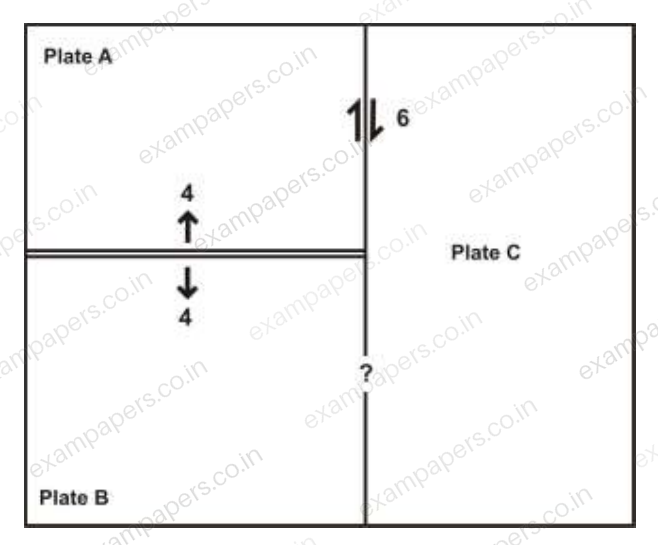
The figure below shows the triple junction between three plates A, B and C. The boundary between the plates A and B is a ridge with a half-spreading rate of 4 cm/year. The A-C and B-C boundaries are collinear and orthogonal to the A-B ridge. The A-C boundary is a dextral transform fault with a relative velocity of 6 cm/year. The boundary between plates B and C is
Your answerChoose one option.
Log in to check the answer
You can attempt this question now. Sign in to view the answer key, explanations and discussion.Log in to check answerQuestion 13
Open questionPART-AMCQ1 markNeeds review
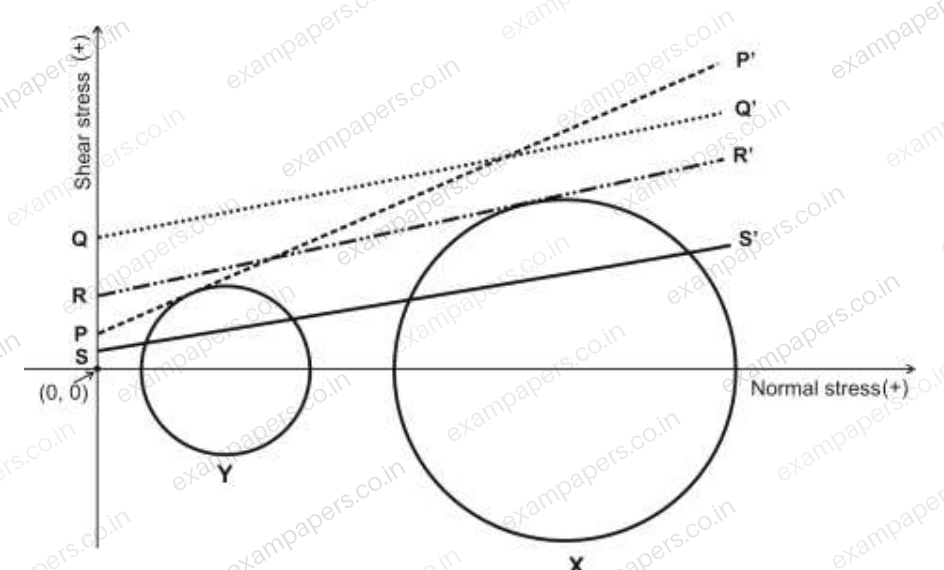
A rock follows Mohr-Coulomb failure criterion. Which one of the Mohr-Coulomb failure envelopes shown below allows failure of the rock under stress state Y, but not under stress state X?
Your answerChoose one option.
Log in to check the answer
You can attempt this question now. Sign in to view the answer key, explanations and discussion.Log in to check answerQuestion 14
Open questionPART-AMCQ1 markNeeds review
The maximum and the minimum principal stresses are denoted by
and
, respectively. The differential stress can have an absolute value greater than
whenYour answerChoose one option.
Log in to check the answer
You can attempt this question now. Sign in to view the answer key, explanations and discussion.Log in to check answerQuestion 15
Open questionPART-AMCQ1 markNeeds review
The geoid can be best defined as
Your answerChoose one option.
Log in to check the answer
You can attempt this question now. Sign in to view the answer key, explanations and discussion.Log in to check answerQuestion 16
Open questionPART-AMCQ1 markNeeds review
For a layered isotropic medium with a flat horizontal free surface, match the wave types listed in Group-I with their corresponding polarizations listed in Group II.
Group-I
P. P-waves
Q. S-waves
R. Rayleigh waves
S. Love waves
Group-II
Particle motion is transverse to the direction of wave propagation.
Particle motion is transverse to the direction of wave propagation and is confined to the horizontal plane.
Particle motion is parallel to the direction of wave propagation.
Particle motion is elliptical.
Your answerChoose one option.
Log in to check the answer
You can attempt this question now. Sign in to view the answer key, explanations and discussion.Log in to check answerQuestion 17
Open questionPART-AMCQ1 markNeeds review
A ‘gentle’ fold with an interlimb angle equal to 160° appears tight (apparent interlimb angle equal to 20°) in horizontal section. According to the plunge of the fold axis, it can also be classified as
Your answerChoose one option.
Log in to check the answer
You can attempt this question now. Sign in to view the answer key, explanations and discussion.Log in to check answerQuestion 18
Open questionPART-AMCQ1 markNeeds review
The unit of shear modulus (rigidity modulus) is
Your answerChoose one option.
Log in to check the answer
You can attempt this question now. Sign in to view the answer key, explanations and discussion.Log in to check answerQuestion 19
Open questionPART-AMCQ1 markNeeds review
With increasing activity of silica, the CORRECT order of appearance of minerals in a weathering environment with constant ratio of activities of K
and H
isYour answerChoose one option.
Log in to check the answer
You can attempt this question now. Sign in to view the answer key, explanations and discussion.Log in to check answerQuestion 20
Open questionPART-AMCQ1 markNeeds review
Match the items listed in Group-I with those listed in Group-II.
Group-I
P. Mica
Q. Uranium
R. Phosphate
S. Zinc
Group-II
Beldih
Koderma
Agucha
Gogi
Your answerChoose one option.
Log in to check the answer
You can attempt this question now. Sign in to view the answer key, explanations and discussion.Log in to check answer