
Geology and Geophysics
GATE GG-1 topic:earth-and-planetary-science PYQs
Build your understanding with focused practice from past exam papers.
Questions 11–20 of 48. Imported answers require independent review unless marked reviewed.
Question 14
Open questionGGMCQ1 markNeeds review
At a depth of about 400 km inside the Earth, which one of the following occurs?
Your answerChoose one option.
Log in to check the answer
You can attempt this question now. Sign in to view the answer key, explanations and discussion.Log in to check answerQuestion 15
Open questionGGMCQ1 markNeeds review
Equatorial radius of which one of the following planets is close to that of the Earth?
Your answerChoose one option.
Log in to check the answer
You can attempt this question now. Sign in to view the answer key, explanations and discussion.Log in to check answerQuestion 26
Open questionGGNAT2 marksNeeds review
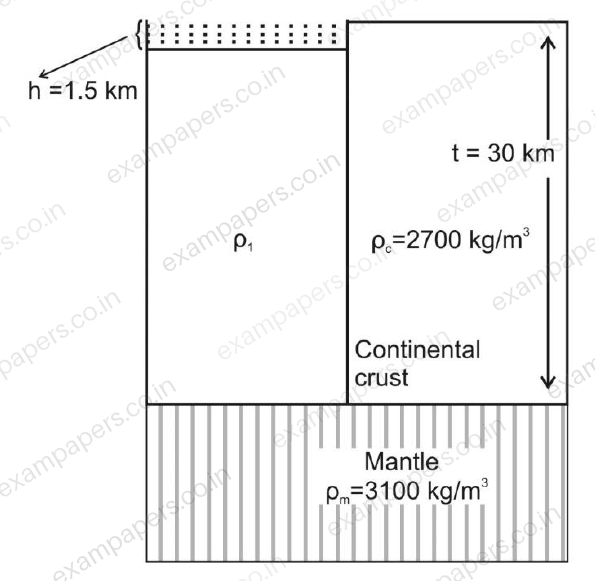
For the given figure, considering Pratt’s model of isostatic compensation at the crust mantle boundary, the crustal density (ρ₁) that explains 1.5 km deep lake is ____________ kg/m³. (Consider density of water ρw = 1000 kg/m³) [round off to 2 decimal places]
Log in to check the answer
You can attempt this question now. Sign in to view the answer key, explanations and discussion.Log in to check answerQuestion 23
Open questionGGMSQ2 marksNeeds review
Choose the CORRECT statement(s) on seismic wave propagation in an elastic isotropic medium.
Your answerSelect all correct options. You can choose more than one.
Log in to check the answer
You can attempt this question now. Sign in to view the answer key, explanations and discussion.Log in to check answerQuestion 24
Open questionGGNAT2 marksNeeds review
The difference in arrival times of P- and S-waves generated by an earthquake and recorded at a seismological station is one second. Assuming a homogeneous and isotropic Earth, a P-wave velocity (Vₚ) of 3 km/s, the ratio of P- to S-wave velocities (Vₚ/Vₛ) of 2.0, the distance between the station and the hypocenter is __________ km. [round off to 1 decimal place]
Log in to check the answer
You can attempt this question now. Sign in to view the answer key, explanations and discussion.Log in to check answerQuestion 25
Open questionGGNAT2 marksNeeds review
Assuming the rate of rotation of the Earth is 7.27 × 10⁻⁵ radians/s and the radius of Earth is 6371 km, the centrifugal acceleration at 60° latitude for a spherical rotating Earth is _____ × 10⁻³ m/s². [round off to 1 decimal place]
Log in to check the answer
You can attempt this question now. Sign in to view the answer key, explanations and discussion.Log in to check answerQuestion 26
Open questionGGNAT2 marksNeeds review
The angle of inclination of the remanent magnetization of a volcanic rock measured at a location is 45°. The magnetic latitude of the location of the volcanic rock at the time of its magnetization is ________ N. [round off to 1 decimal place]
Log in to check the answer
You can attempt this question now. Sign in to view the answer key, explanations and discussion.Log in to check answerQuestion 35
Open questionGGMCQ1 markNeeds review
A radioactive nucleus
decays to
. The number of α and β particles emitted during this decay areYour answerChoose one option.
Log in to check the answer
You can attempt this question now. Sign in to view the answer key, explanations and discussion.Log in to check answerQuestion 1
Open questionGG - G1MCQ1 markNeeds review
Which of the given planets has the highest average density?
Your answerChoose one option.
Log in to check the answer
You can attempt this question now. Sign in to view the answer key, explanations and discussion.Log in to check answerQuestion 12
Open questionGG - G1MCQ1 markNeeds review
If α and β are P- and S-wave velocities, respectively, then α² − (4/3)β² is equal to:
(κ is the bulk modulus, μ is shear modulus and ρ is density)
Your answerChoose one option.
Log in to check the answer
You can attempt this question now. Sign in to view the answer key, explanations and discussion.Log in to check answer