
Geology and Geophysics
GATE GG-1 topic:earth-and-planetary-science PYQs
Build your understanding with focused practice from past exam papers.
Questions 21–30 of 48. Imported answers require independent review unless marked reviewed.
Question 13
Open questionGG - G1MCQ1 markNeeds review
Which one of the following phases is P-wave that converts to S-wave during passage through the solid inner core?
Your answerChoose one option.
Log in to check the answer
You can attempt this question now. Sign in to view the answer key, explanations and discussion.Log in to check answerQuestion 19
Open questionGG - G1NAT1 markNeeds review
The radius (r) of the oblate spheroid at 45° latitude with ellipticity of polar flattening of 1/298.25 and equatorial radius of 6378140 m is ______ km. [round off to 2 decimal places]
Log in to check the answer
You can attempt this question now. Sign in to view the answer key, explanations and discussion.Log in to check answerQuestion 51
Open questionGG - G1NAT2 marksNeeds review
The heat flux at the Earth’s surface is 60 mWm⁻². If the thermal conductivity at the surface is 2.5 Wm⁻¹ °C⁻¹, the geothermal gradient is ________ °C/km. [in integer]
Log in to check the answer
You can attempt this question now. Sign in to view the answer key, explanations and discussion.Log in to check answerQuestion 55
Open questionGG - G1NAT2 marksNeeds review
A satellite orbits the earth at an altitude of 700 km on the equatorial plane of the earth and it revolves in the same direction as the direction of rotation of the earth. Considering the radius of a spherical earth as 6300 km and the acceleration due to gravity as 10 m/s², the tangential velocity of the satellite in the orbit is ______ km/s. [round off to 2 decimal places]
Log in to check the answer
You can attempt this question now. Sign in to view the answer key, explanations and discussion.Log in to check answerQuestion 3
Open questionCMCQ1 markNeeds review
If the ratio of gravity to total magnetic field at the equator of the Earth is
, then the ratio of gravity to total magnetic field at the pole of the Earth will be close toYour answerChoose one option.
Log in to check the answer
You can attempt this question now. Sign in to view the answer key, explanations and discussion.Log in to check answerQuestion 11
Open questionCMCQ1 markNeeds review
Kepler’s second law of planetary motion follows the principle of conservation of
Your answerChoose one option.
Log in to check the answer
You can attempt this question now. Sign in to view the answer key, explanations and discussion.Log in to check answerQuestion 12
Open questionCMCQ1 markNeeds review
Which one of the following options shows the internal structural units of the Earth arranged in the CORRECT sequence of increasing volume?
Your answerChoose one option.
Log in to check the answer
You can attempt this question now. Sign in to view the answer key, explanations and discussion.Log in to check answerQuestion 13
Open questionCMCQ1 markNeeds review
Which one of the following is NOT an earthquake intensity scale?
Your answerChoose one option.
Log in to check the answer
You can attempt this question now. Sign in to view the answer key, explanations and discussion.Log in to check answerQuestion 25
Open questionCNAT1 markNeeds review
A 4 km-high plateau is isostatically compensated as shown in the figure. Assuming Pratt’s hypothesis of isostasy, the calculated density of the plateau is ______ kg/m³.
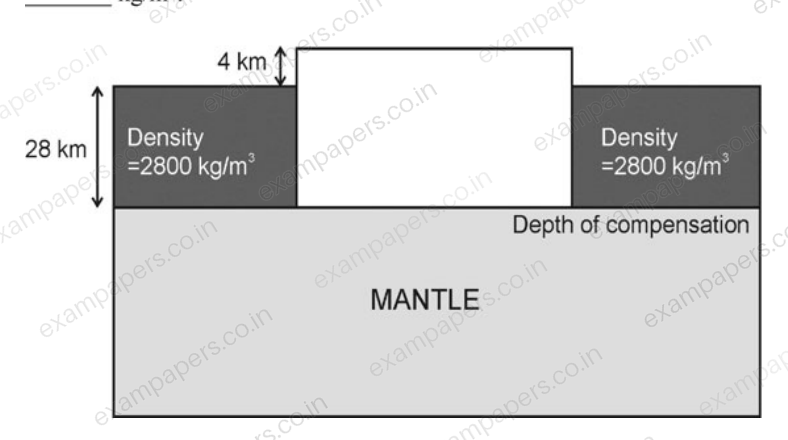
Log in to check the answer
You can attempt this question now. Sign in to view the answer key, explanations and discussion.Log in to check answerQuestion 1
Open questionPART AMCQ1 markNeeds review
On the present-day global plate tectonic map, the Reunion hotspot is located in the ______.
Your answerChoose one option.
Log in to check the answer
You can attempt this question now. Sign in to view the answer key, explanations and discussion.Log in to check answer