
Geology and Geophysics
GATE GG-1 topic:geology PYQs
Build your understanding with focused practice from past exam papers.
Questions 41–50 of 650. Imported answers require independent review unless marked reviewed.
Question 41
Open questionGGNAT1 markNeeds review
For a chemical system with 5 phases at the invariant point, the number of possible univariant reactions in pressure-temperature space is _____ (answer in integer).
Log in to check the answer
You can attempt this question now. Sign in to view the answer key, explanations and discussion.Log in to check answerQuestion 42
Open questionGGNAT1 markNeeds review
Two tectonic plates, P and Q, move in opposite directions along a transform fault boundary. If the plate velocity of P is 8 cm/year and of Q is 6 cm/year with respect to a fixed reference frame, the relative velocity between P and Q is ________ cm/year (answer in integer).
Log in to check the answer
You can attempt this question now. Sign in to view the answer key, explanations and discussion.Log in to check answerQuestion 43
Open questionGGNAT1 markNeeds review
If the atomic mass unit of ⁸⁵Rb and ⁸⁷Rb are 84.912 and 86.901, respectively, then the abundance of ⁸⁷Rb is __________ % (rounded off to nearest integer).
[Use: Average atomic mass of Rb = 85.467 amu]
Log in to check the answer
You can attempt this question now. Sign in to view the answer key, explanations and discussion.Log in to check answerQuestion 44
Open questionGGNAT1 markNeeds review
A mineral under crossed nicols displays second order greenish-yellow (Δₘ = 740 nm) interference colour. On introduction of gypsum plate (Δₐ = 550 nm) along the length of the mineral orientation, first order grey interference colour is displayed. The net retardation is ________ nm (answer in integer).
Log in to check the answer
You can attempt this question now. Sign in to view the answer key, explanations and discussion.Log in to check answerQuestion 45
Open questionGGMCQ2 marksNeeds review
Which one of the following mineral reactions will result in the formation of a diagnostic granulite facies assemblage during regional metamorphism of a pelite?
Your answerChoose one option.
Log in to check the answer
You can attempt this question now. Sign in to view the answer key, explanations and discussion.Log in to check answerQuestion 46
Open questionGGMCQ2 marksNeeds review
The given table shows modal volume percentage of quartz, alkali feldspar and plagioclase in coarse-grained rocks, X and Y. Which of the following rock names of X and Y are CORRECT according to the IUGS classification?
Mineral | X (volume %) | Y (volume %) |
|---|---|---|
Quartz | 15 | 25 |
Plagioclase | 20 | 60 |
Alkali feldspar | 65 | 15 |
Your answerChoose one option.
Log in to check the answer
You can attempt this question now. Sign in to view the answer key, explanations and discussion.Log in to check answerQuestion 47
Open questionGGMCQ2 marksNeeds review
The ternary diagram given below shows phase relations for the Anorthite-Diopside-Forsterite system at 1 bar pressure. Broken lines represent isotherms with temperature in °C. If ‘P’ is the initial melt composition, which one of the following is the CORRECT sequence of crystallization assuming equilibrium between crystal and melt?
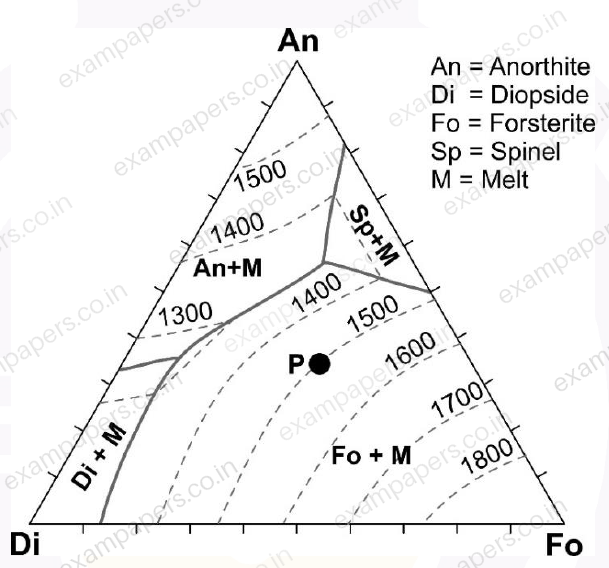
Your answerChoose one option.
Log in to check the answer
You can attempt this question now. Sign in to view the answer key, explanations and discussion.Log in to check answerQuestion 48
Open questionGGMCQ2 marksNeeds review
Accumulation of which one of the following minerals can explain positive Eu and positive Sr anomalies in the primitive mantle-normalized multielement pattern of an igneous rock?
Your answerChoose one option.
Log in to check the answer
You can attempt this question now. Sign in to view the answer key, explanations and discussion.Log in to check answerQuestion 49
Open questionGGMCQ2 marksNeeds review
Match the minerals in Group I with the corresponding elements in Group II.
Group-I | Group-II |
|---|---|
P. Smithsonite | 1. Lead |
Q. Azurite | 2. Iron |
R. Crocite | 3. Zinc |
S. Marcasite | 4. Copper |
Your answerChoose one option.
Log in to check the answer
You can attempt this question now. Sign in to view the answer key, explanations and discussion.Log in to check answerQuestion 50
Open questionGGMCQ2 marksNeeds review
Match the stratigraphic Formations in Group I with the corresponding Geologic Periods in Group II.
Group-I: P. Kopili Shale; Q. Ranikhet Formation; R. Quilon Formation; S. Dalmiapuram Formation.
Group-II: 1. Permian; 2. Eocene; 3. Cretaceous; 4. Miocene
Your answerChoose one option.
Log in to check the answer
You can attempt this question now. Sign in to view the answer key, explanations and discussion.Log in to check answer