
Geology and Geophysics
GATE GG-1 topic:geology PYQs
Build your understanding with focused practice from past exam papers.
Questions 621–630 of 650. Imported answers require independent review unless marked reviewed.
Question 36
Open questionGG-1NAT2 marksNeeds review
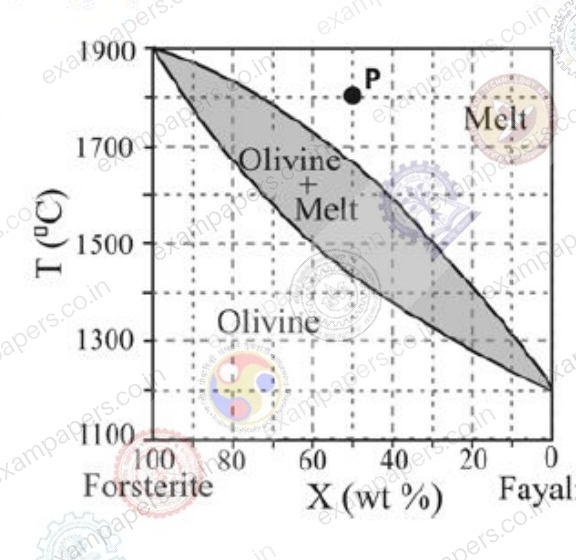
The given T–X diagram shows the phase relations in olivine solid solution at 1 bar pressure. If ‘P’ is the initial position of melt, the proportion of melt at 1500°C is ________ %.
Log in to check the answer
You can attempt this question now. Sign in to view the answer key, explanations and discussion.Log in to check answerQuestion 37
Open questionGG-1NAT2 marksNeeds review
Fluorite crystal (CaF₂) adopts face-centered cubic structure with lattice parameter a = 5.463 Å. If the ionic radius of anion (F⁻) is 1.71 Å, the ionic radius of cation (Ca²⁺) is __________ Å.
Log in to check the answer
You can attempt this question now. Sign in to view the answer key, explanations and discussion.Log in to check answerQuestion 38
Open questionGG-1MCQ2 marksNeeds review
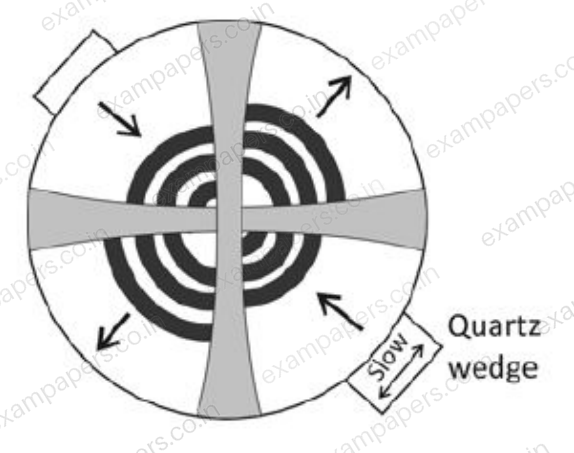
The diagram below shows the interference figure of a mineral. The mineral is
Your answerChoose one option.
Log in to check the answer
You can attempt this question now. Sign in to view the answer key, explanations and discussion.Log in to check answerQuestion 39
Open questionGG-1NAT2 marksNeeds review
The standard thermodynamic data for enstatite (Mg₂Si₂O₆), quartz (SiO₂) and forsterite (Mg₂SiO₄) is given in the table below. The Gibb’s free energy of the reaction Mg₂SiO₄ + SiO₂ = Mg₂Si₂O₆ at 600 K and 1 bar is __________ J.
(Assume Cₚ = 0 for all minerals in the reaction)
Mineral | ΔH°f, 298 (kJ) | S° (J K⁻¹) |
|---|---|---|
Enstatite | -3090.47 | 132.5 |
Quartz | -910.83 | 41.5 |
Forsterite | -2172.2 | 95.1 |
Log in to check the answer
You can attempt this question now. Sign in to view the answer key, explanations and discussion.Log in to check answerQuestion 40
Open questionGG-1NAT2 marksNeeds review
The modal abundance in an ultramafic rock and the partition coefficients of lutetium (Lu) in clinopyroxene, orthopyroxene, olivine and plagioclase are tabulated below. The bulk distribution coefficient of lutetium (D̄Lu) in the ultramafic rock is __________.
Mineral | Modal abundance (%) | Partition coefficient |
|---|---|---|
Clinopyroxene | 45 | 0.506 |
Orthopyroxene | 40 | 0.42 |
Olivine | 10 | 0.045 |
Plagioclase | 05 | 0.019 |
Log in to check the answer
You can attempt this question now. Sign in to view the answer key, explanations and discussion.Log in to check answerQuestion 41
Open questionGG-1MCQ2 marksNeeds review
Match the following classical ore deposits (Group-I) with their associated ore minerals (Group-II)
Group-I
P. Sudbury type deposit
Q. Mississippi valley type deposit
R. Climax type deposit
S. IOCG type deposit
Group-II
Molybdenite
Uraninite and chalcopyrite
Pentlandite
Psilomelane
Sphalerite and Galena
Your answerChoose one option.
Log in to check the answer
You can attempt this question now. Sign in to view the answer key, explanations and discussion.Log in to check answerQuestion 42
Open questionGG-1MCQ2 marksNeeds review
Which one of the following microfossils is commonly used in biostratigraphic correlation of Palaeozoic marine strata?
Your answerChoose one option.
Log in to check the answer
You can attempt this question now. Sign in to view the answer key, explanations and discussion.Log in to check answerQuestion 43
Open questionGG-1MCQ2 marksNeeds review
Given below are pairs of “living fossils”. Which one of the following is a brachiopod-mollusc pair?
Your answerChoose one option.
Log in to check the answer
You can attempt this question now. Sign in to view the answer key, explanations and discussion.Log in to check answerQuestion 44
Open questionGG-1MCQ2 marksNeeds review
Match the sedimentary rocks and their features listed in Group I with depositional environments listed in Group II.
Group I
(P) Sandstone with herring-bone cross bedding
(Q) Chalk with coccolith
(R) Well sorted arenite with large cross bedding (5-10 m thick)
(S) Poorly sorted sediments with faceted and striated pebbles
Group II
(1) Eolian
(2) Glacial
(3) Sabkha
(4) Tidal
(5) Pelagic
Your answerChoose one option.
Log in to check the answer
You can attempt this question now. Sign in to view the answer key, explanations and discussion.Log in to check answerQuestion 45
Open questionGG-1MCQ2 marksNeeds review
Arrange the following stratigraphic formations sequentially from older to younger.
(P) Jodhpur Sandstone
(Q) Cambay Shale
(R) Kajrahat Limestone
(S) Tipam Sandstone
Your answerChoose one option.
Log in to check the answer
You can attempt this question now. Sign in to view the answer key, explanations and discussion.Log in to check answer