
Geology and Geophysics
GATE GG-1 topic:metamorphic-petrology PYQs
Build your understanding with focused practice from past exam papers.
How to practice topic:metamorphic-petrology
Attempt a question, record the concept and assumptions, then check the available answer. Rework mistakes after revising the relevant concepts. Topic tags can overlap; review the question context.
Questions 1–10 of 29. Imported answers require independent review unless marked reviewed.
Question 41
Open questionGGNAT1 markNeeds review
For a chemical system with 5 phases at the invariant point, the number of possible univariant reactions in pressure-temperature space is _____ (answer in integer).
Log in to check the answer
You can attempt this question now. Sign in to view the answer key, explanations and discussion.Log in to check answerQuestion 45
Open questionGGMCQ2 marksNeeds review
Which one of the following mineral reactions will result in the formation of a diagnostic granulite facies assemblage during regional metamorphism of a pelite?
Your answerChoose one option.
Log in to check the answer
You can attempt this question now. Sign in to view the answer key, explanations and discussion.Log in to check answerQuestion 56
Open questionGGMSQ2 marksNeeds review
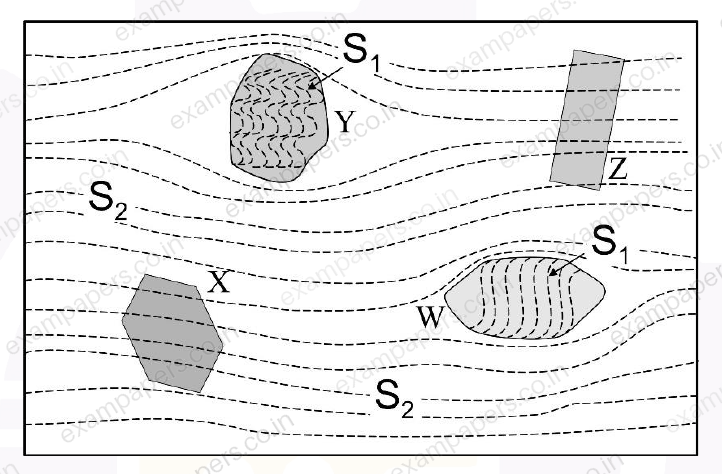
The given schematic diagram shows different stages of development of S₂ foliation after the formation of S₁ foliation. Which of the following statements CORRECTLY interpret(s) the relationships of porphyroblasts W, X, Y and Z with the matrix?
Your answerSelect all correct options. You can choose more than one.
Log in to check the answer
You can attempt this question now. Sign in to view the answer key, explanations and discussion.Log in to check answerQuestion 63
Open questionGGNAT2 marksNeeds review
The Fe-Mg exchange reaction between olivine and spinel is the following:
Mg₂SiO₄ + 2FeAl₂O₄ ↔ Fe₂SiO₄ + 2MgAl₂O₄
(Fosterite) (Fe-spinel) (Fayalite) (Mg-spinel)
Assuming ideal solid solutions, the temperature of equilibrium between olivine and spinel using the following data is __________ °C (round off to nearest integer).
[Assume that ΔHᵣ⁰ and ΔSᵣ⁰ are independent of P and T, and Kd is independent of P]
| ΔHᵣ⁰ (kJ/mol) | ΔSᵣ⁰ (J/mol. K) | Kd = [(xFe^Ol xMg^Sp)/(xMg^Ol xFe^Sp)]² | R (J/mol. K) |
| −10.91 | −3.90 | 3.024 | 8.314 |
Log in to check the answer
You can attempt this question now. Sign in to view the answer key, explanations and discussion.Log in to check answerQuestion 39
Open questionGGMSQ1 markNeeds review
Which of the following rock and texture combinations is/are CORRECT?
Your answerSelect all correct options. You can choose more than one.
Log in to check the answer
You can attempt this question now. Sign in to view the answer key, explanations and discussion.Log in to check answerQuestion 41
Open questionGGMSQ1 markNeeds review
Which of the following rocks is/are characteristic of fossil subduction zones?
Your answerSelect all correct options. You can choose more than one.
Log in to check the answer
You can attempt this question now. Sign in to view the answer key, explanations and discussion.Log in to check answerQuestion 62
Open questionGGNAT2 marksNeeds review
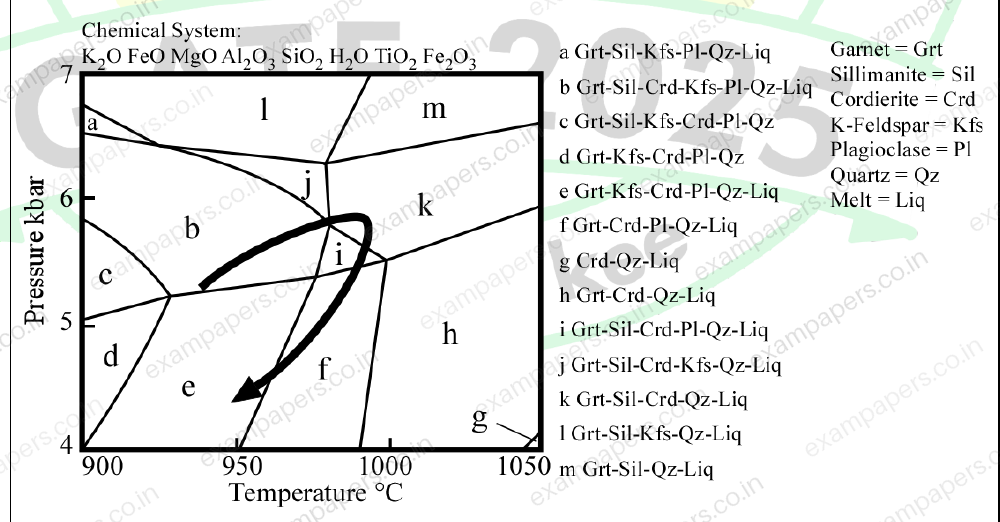
In the isochemical phase diagram shown below, the curved arrow represents the P-T path. The variance at peak metamorphism is __________
(Answer in integer)
Log in to check the answer
You can attempt this question now. Sign in to view the answer key, explanations and discussion.Log in to check answerQuestion 30
Open questionGGMCQ1 markNeeds review
Match the microstructures in Group–I with their characteristics in Group–II.
Group–I: P. Core–mantle; Q. Decussate; R. Spherule; S. Millipede
Group–II: 1. Radiating fibrous aggregate of K-feldspar with or without quartz; 2. Large strained mineral grains surrounded by fine-grained, recrystallized grains; 3. Inclusion trails in a porphyroblast curves into the matrix foliation by developing concave outward pattern; 4. Randomly oriented mineral grains dominated by crystal faces, such as in sheet silicates
Your answerChoose one option.
Log in to check the answer
You can attempt this question now. Sign in to view the answer key, explanations and discussion.Log in to check answerQuestion 32
Open questionGGMCQ1 markNeeds review
Which one of the following sequences of index minerals correctly represents the order of increasing metamorphic grade during regional metamorphism of siliceous dolitic limestones?
Your answerChoose one option.
Log in to check the answer
You can attempt this question now. Sign in to view the answer key, explanations and discussion.Log in to check answerQuestion 49
Open questionGGMCQ2 marksNeeds review
During high-temperature metamorphism of pelites, which one of the following mineral reactions represents the second sillimanite isograd?
Your answerChoose one option.
Log in to check the answer
You can attempt this question now. Sign in to view the answer key, explanations and discussion.Log in to check answer