
Geology and Geophysics
GATE GG-1 year:2017 PYQs
Build your understanding with focused practice from past exam papers.
Questions 41–50 of 65. Imported answers require independent review unless marked reviewed.
Question 41
Open questionGG-1MCQ2 marksNeeds review
Match the following classical ore deposits (Group-I) with their associated ore minerals (Group-II)
Group-I
P. Sudbury type deposit
Q. Mississippi valley type deposit
R. Climax type deposit
S. IOCG type deposit
Group-II
Molybdenite
Uraninite and chalcopyrite
Pentlandite
Psilomelane
Sphalerite and Galena
Your answerChoose one option.
Log in to check the answer
You can attempt this question now. Sign in to view the answer key, explanations and discussion.Log in to check answerQuestion 42
Open questionGG-1MCQ2 marksNeeds review
Which one of the following microfossils is commonly used in biostratigraphic correlation of Palaeozoic marine strata?
Your answerChoose one option.
Log in to check the answer
You can attempt this question now. Sign in to view the answer key, explanations and discussion.Log in to check answerQuestion 43
Open questionGG-1MCQ2 marksNeeds review
Given below are pairs of “living fossils”. Which one of the following is a brachiopod-mollusc pair?
Your answerChoose one option.
Log in to check the answer
You can attempt this question now. Sign in to view the answer key, explanations and discussion.Log in to check answerQuestion 44
Open questionGG-1MCQ2 marksNeeds review
Match the sedimentary rocks and their features listed in Group I with depositional environments listed in Group II.
Group I
(P) Sandstone with herring-bone cross bedding
(Q) Chalk with coccolith
(R) Well sorted arenite with large cross bedding (5-10 m thick)
(S) Poorly sorted sediments with faceted and striated pebbles
Group II
(1) Eolian
(2) Glacial
(3) Sabkha
(4) Tidal
(5) Pelagic
Your answerChoose one option.
Log in to check the answer
You can attempt this question now. Sign in to view the answer key, explanations and discussion.Log in to check answerQuestion 45
Open questionGG-1MCQ2 marksNeeds review
Arrange the following stratigraphic formations sequentially from older to younger.
(P) Jodhpur Sandstone
(Q) Cambay Shale
(R) Kajrahat Limestone
(S) Tipam Sandstone
Your answerChoose one option.
Log in to check the answer
You can attempt this question now. Sign in to view the answer key, explanations and discussion.Log in to check answerQuestion 46
Open questionGG-1NAT2 marksNeeds review
2 g air dried coal contains 0.2 g moisture, 0.3 g ash and 0.5 g volatile matter. The volatile matter content in the coal in dry mineral matter free (d.m.f) basis is __________ %.
(mineral matter content = 1.1×ash content)
Log in to check the answer
You can attempt this question now. Sign in to view the answer key, explanations and discussion.Log in to check answerQuestion 47
Open questionGG-1MCQ2 marksNeeds review
The approximate temperature for ‘oil window’ ranges from
Your answerChoose one option.
Log in to check the answer
You can attempt this question now. Sign in to view the answer key, explanations and discussion.Log in to check answerQuestion 48
Open questionGG-1MCQ2 marksNeeds review
Which one of the following biopolymers is the major source of liquid hydrocarbons?
Your answerChoose one option.
Log in to check the answer
You can attempt this question now. Sign in to view the answer key, explanations and discussion.Log in to check answerQuestion 49
Open questionGG-1NAT2 marksNeeds review
The hydraulic conductivity (K) of an isotropic aquifer is 10 m/day. If the hydraulic head within the aquifer drops 4 m over a distance of 750 m, the groundwater flow velocity within the aquifer is __________ m/day.
(Up to third decimal place)
Log in to check the answer
You can attempt this question now. Sign in to view the answer key, explanations and discussion.Log in to check answerQuestion 50
Open questionGG-1NAT2 marksNeeds review
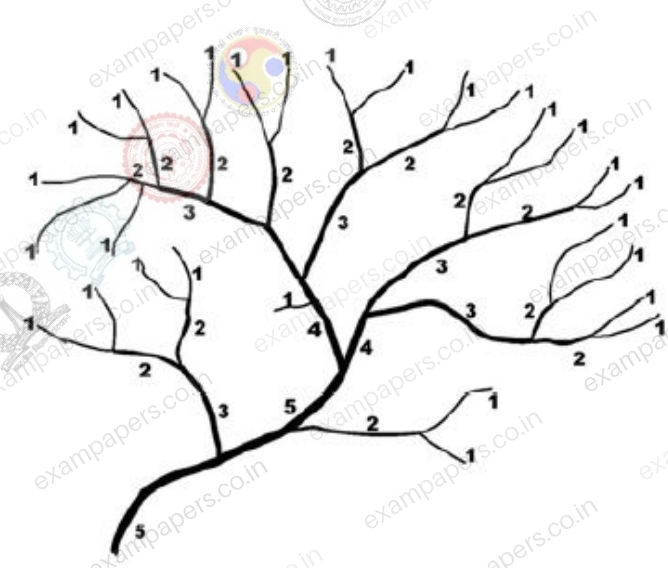
Drainage network of a watershed ordered as per the Strahler method is given below. Maximum observed bifurcation ratio for the given network is __________.
Log in to check the answer
You can attempt this question now. Sign in to view the answer key, explanations and discussion.Log in to check answer