
Geology and Geophysics
GATE GG-1 year:2023 PYQs
Build your understanding with focused practice from past exam papers.
Questions 41–50 of 65. Imported answers require independent review unless marked reviewed.
Question 41
Open questionGGNAT1 markNeeds review
The amount of Fe in a sample of 25 g of pyrrhotite (FeS) is __________ g. (Atomic wt. of Fe = 55.85 and S = 32.06) [round off to 2 decimal places]
Log in to check the answer
You can attempt this question now. Sign in to view the answer key, explanations and discussion.Log in to check answerQuestion 42
Open questionGGNAT1 markNeeds review
The rate of spreading about a symmetric spreading center at the middle of a 4000 km wide sea is 40 mm/year. The spreading began _______ million years before present. [in integer]
Log in to check the answer
You can attempt this question now. Sign in to view the answer key, explanations and discussion.Log in to check answerQuestion 43
Open questionGGNAT1 markNeeds review
A vertical aerial photograph is obtained over flat terrain with a 30 cm focal-length camera lens from an altitude of 1828 m. If the width of a dolerite dyke on this vertical photograph is 2 mm, its actual width on the terrain is __________ m. [round off to 2 decimal places]
Log in to check the answer
You can attempt this question now. Sign in to view the answer key, explanations and discussion.Log in to check answerQuestion 44
Open questionGGNAT1 markNeeds review
The decay constant of a radioactive isotope is 1.21 × 10⁻⁴ year⁻¹. The half-life of the isotope is _______________ years. [round off to nearest integer]
Log in to check the answer
You can attempt this question now. Sign in to view the answer key, explanations and discussion.Log in to check answerQuestion 45
Open questionGGMCQ2 marksNeeds review
The given outcrop pattern on a flat topography represents
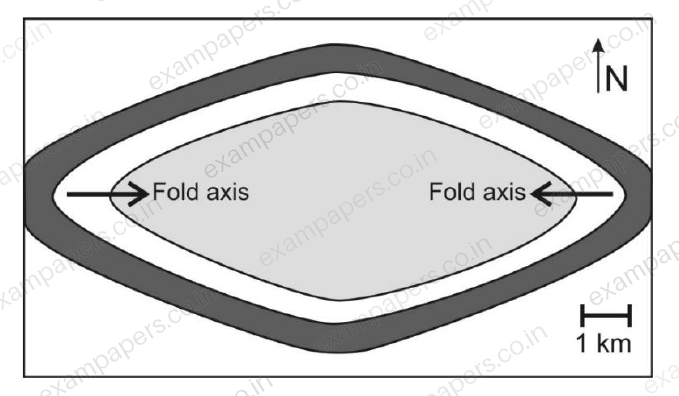
Your answerChoose one option.
Log in to check the answer
You can attempt this question now. Sign in to view the answer key, explanations and discussion.Log in to check answerQuestion 46
Open questionGGMCQ2 marksNeeds review
Match the following fossil taxa in Group I with their corresponding features in Group II.
Group I Group II
P. Bryozoa 1. Denticles
Q. Ostracoda 2. Chamber
R. Foraminifera 3. Carapace
S. Conodont 4. Zooid
Your answerChoose one option.
Log in to check the answer
You can attempt this question now. Sign in to view the answer key, explanations and discussion.Log in to check answerQuestion 47
Open questionGGMCQ2 marksNeeds review
In the given schematic diagram, cross beds are exposed on a vertical rock face. The feature XY (bold line) represents a/an
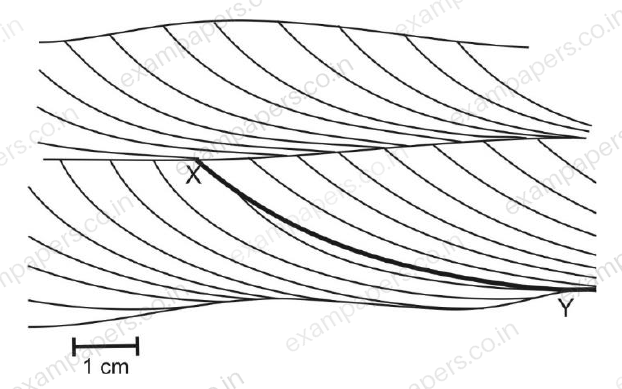
Your answerChoose one option.
Log in to check the answer
You can attempt this question now. Sign in to view the answer key, explanations and discussion.Log in to check answerQuestion 48
Open questionGGMCQ2 marksNeeds review
The schematic diagram represents thin section of a carbonate rock. The type of cement formed by large calcite crystals is known as
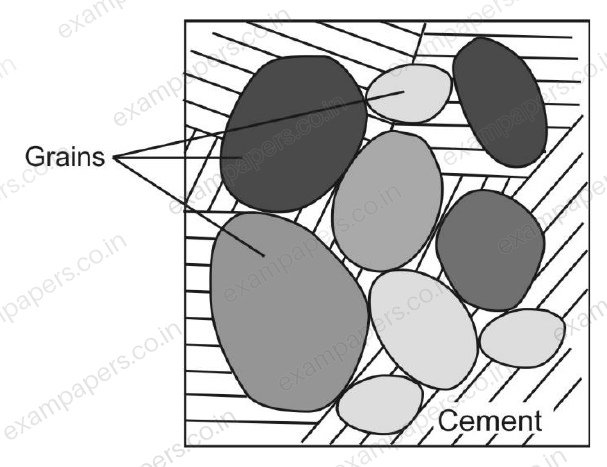
Your answerChoose one option.
Log in to check the answer
You can attempt this question now. Sign in to view the answer key, explanations and discussion.Log in to check answerQuestion 49
Open questionGGMCQ2 marksNeeds review
Based on the three statements given below, choose the CORRECT option.
Statement I: Echinoids have water vascular system.
Statement II: Delthyrium and pedicle foramen are found in the brachial valve of brachiopods.
Statement III: Cardinal teeth, adductor muscles and chondrophore are found in bivalves.
Your answerChoose one option.
Log in to check the answer
You can attempt this question now. Sign in to view the answer key, explanations and discussion.Log in to check answerQuestion 50
Open questionGGMCQ2 marksNeeds review
The total number of symmetry elements in the crystal class represented by the point group 4/m\bar2/m is
Your answerChoose one option.
Log in to check the answer
You can attempt this question now. Sign in to view the answer key, explanations and discussion.Log in to check answer