
Geology and Geophysics
GATE GG-1 year:2025 PYQs
Build your understanding with focused practice from past exam papers.
Questions 11–20 of 65. Imported answers require independent review unless marked reviewed.
Question 11
Open questionGGMCQ1 markNeeds review
The most volcanically active body in our Solar System is
Your answerChoose one option.
Log in to check the answer
You can attempt this question now. Sign in to view the answer key, explanations and discussion.Log in to check answerQuestion 12
Open questionGGMCQ1 markNeeds review
A type of fold which is relatively sharp and angular at its synformal and antiformal hinges is known as
Your answerChoose one option.
Log in to check the answer
You can attempt this question now. Sign in to view the answer key, explanations and discussion.Log in to check answerQuestion 13
Open questionGGMCQ1 markNeeds review
Which one of the following geophysical methods can provide information on deep Earth structures (of the order of 1000 km) with highest resolution?
Your answerChoose one option.
Log in to check the answer
You can attempt this question now. Sign in to view the answer key, explanations and discussion.Log in to check answerQuestion 14
Open questionGGMCQ1 markNeeds review
The continuous series of Bowen’s reaction series is represented by
Your answerChoose one option.
Log in to check the answer
You can attempt this question now. Sign in to view the answer key, explanations and discussion.Log in to check answerQuestion 15
Open questionGGMSQ1 markNeeds review
Which of the following time boundaries corres(s) to major mass extinction events?
Your answerSelect all correct options. You can choose more than one.
Log in to check the answer
You can attempt this question now. Sign in to view the answer key, explanations and discussion.Log in to check answerQuestion 16
Open questionGGNAT1 markNeeds review
A watershed has an area of 74 km
. The stream network within this watershed consists of three different stream orders. The stream lengths in each order are as follows:I
order streams: 3 km, 2.5 km, 4 km, 3 km, 2 km, 5 kmII
order streams: 10 km, 15 km, 7 kmIII
order streams: 30 kmThe drainage density of the watershed is __________ km/km
(Round off to two decimal places)
Log in to check the answer
You can attempt this question now. Sign in to view the answer key, explanations and discussion.Log in to check answerQuestion 17
Open questionGGNAT1 markNeeds review
A sample contains 7 wt% CaO and 5 wt% MgO. The molar ratio of CaO to MgO in the sample is __________
(Round off to two decimal places)
Log in to check the answer
You can attempt this question now. Sign in to view the answer key, explanations and discussion.Log in to check answerQuestion 18
Open questionGGMCQ2 marksNeeds review
Select the option that lists oxide minerals only.
Your answerChoose one option.
Log in to check the answer
You can attempt this question now. Sign in to view the answer key, explanations and discussion.Log in to check answerQuestion 19
Open questionGGMCQ2 marksNeeds review
Consider two intersecting, north-easterly striking and south-easterly dipping dikes Y1 and Y2, which are exposed on an east-west trending vertical wall of a granite (X) quarry as shown below.
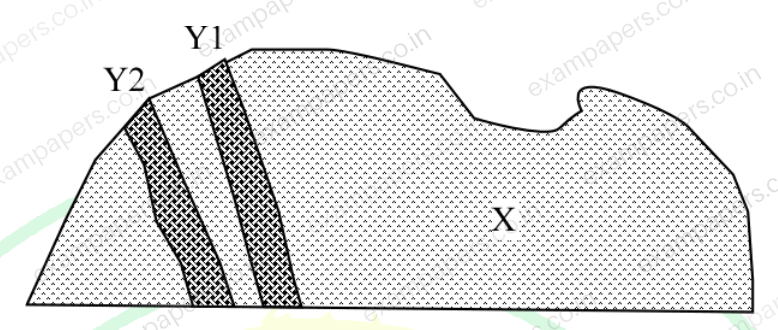
The angle that the dikes make with the horizontal on the quarry wall is
Your answerChoose one option.
Log in to check the answer
You can attempt this question now. Sign in to view the answer key, explanations and discussion.Log in to check answerQuestion 20
Open questionGGMSQ2 marksNeeds review
The ratio of P-wave to S-wave velocities,
, within the Earth depends onYour answerSelect all correct options. You can choose more than one.
Log in to check the answer
You can attempt this question now. Sign in to view the answer key, explanations and discussion.Log in to check answer