
Instrumentation Engineering
GATE IN exam:gate PYQs
Build your understanding with focused practice from past exam papers.
Questions 571–580 of 650. Imported answers require independent review unless marked reviewed.
Question 41
Open questionINNAT2 marksNeeds review
An opamp that is powered from a
V supply is used to build a non-inverting amplifier having a gain of 15. The slew rate of the opamp is
V/s. For a sinusoidal input with amplitude of 0.3 V, the maximum frequency (in kHz) up to which it can be operated without any distortion (up to one decimal place) ____.Log in to check the answer
You can attempt this question now. Sign in to view the answer key, explanations and discussion.Log in to check answerQuestion 42
Open questionINNAT2 marksNeeds review
The circuit given uses ideal opamps. The current I (in
A) drawn from the source
is (up to two decimal places) ____. 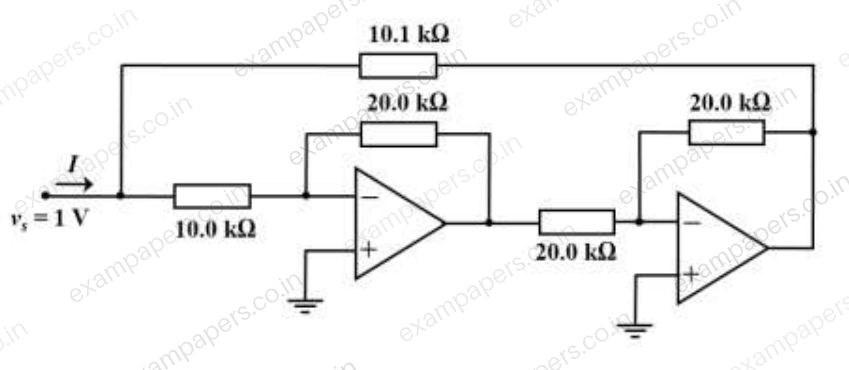
Log in to check the answer
You can attempt this question now. Sign in to view the answer key, explanations and discussion.Log in to check answerQuestion 43
Open questionINMCQ2 marksNeeds review
The product of sum expression of a Boolean function
of three variables is given by
The canonical sum of product expression of
is given byYour answerChoose one option.
Log in to check the answer
You can attempt this question now. Sign in to view the answer key, explanations and discussion.Log in to check answerQuestion 44
Open questionINMCQ2 marksNeeds review
A 2-bit synchronous counter using two J-K flip flops is shown. The expressions for the inputs to the J-K flip flops are also shown in the figure. The output sequence of the counter starting from
is 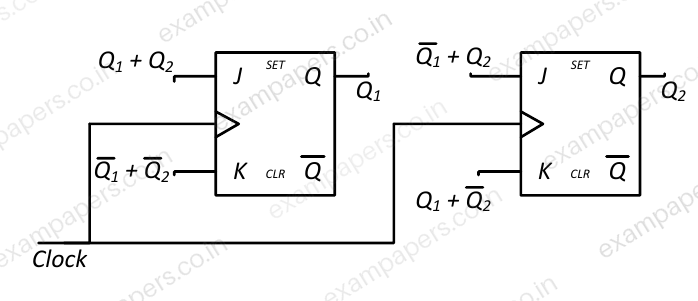
Your answerChoose one option.
Log in to check the answer
You can attempt this question now. Sign in to view the answer key, explanations and discussion.Log in to check answerQuestion 45
Open questionINNAT2 marksNeeds review
A portion of an assembly language program written for an 8-bit microprocessor is given below along with explanations. The code is intended to introduce software time delay. The processor is driven by a 5 MHz clock. The time delay (in
s) introduced by the program is ______.Instruction | Explanation |
|---|---|
MVI B, 64H | Move immediate the given byte into register B. Takes 7 clock periods. |
LOOP: DCR B | Decrement register B. Affects Flags. Takes 4 clock periods. |
JNZ LOOP | Jump to address with Label LOOP if zero flag is not set. Takes 10 clock periods when jump is performed and 7 clock periods when jump is not performed. |
Log in to check the answer
You can attempt this question now. Sign in to view the answer key, explanations and discussion.Log in to check answerQuestion 46
Open questionINMCQ2 marksNeeds review
The Boolean function F(X, Y) realized by the given circuit is
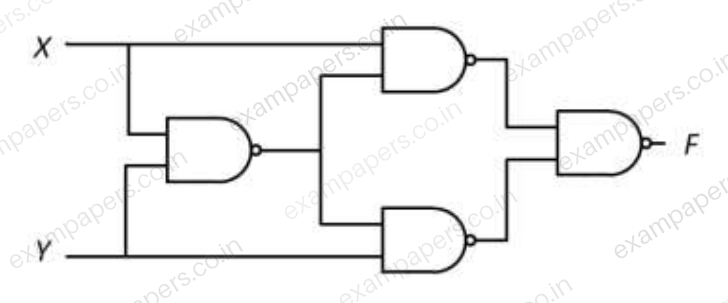
Your answerChoose one option.
Log in to check the answer
You can attempt this question now. Sign in to view the answer key, explanations and discussion.Log in to check answerQuestion 47
Open questionINNAT2 marksNeeds review
The voltage and current drawn by a resistive load are measured with a 300 V voltmeter of accuracy ± 1% of full scale and a 5 A ammeter of accuracy ± 0.5% of full scale. The readings obtained are 200 V and 2.5 A. The limiting error (in %) in computing the load resistance is (up to two decimal places) ___.
Log in to check the answer
You can attempt this question now. Sign in to view the answer key, explanations and discussion.Log in to check answerQuestion 48
Open questionINNAT2 marksNeeds review
A high Q coil having distributed (self) capacitance is tested with a Q-meter. First resonance at ω₁ = 10⁶ rad/s is obtained with a capacitance of 990 pF. The second resonance at ω₂ = 2 × 10⁶ rad/s is obtained with a 240 pF capacitance. The value of the inductance (in mH) of the coil is (up to one decimal place) _____.
Log in to check the answer
You can attempt this question now. Sign in to view the answer key, explanations and discussion.Log in to check answerQuestion 49
Open questionINNAT2 marksNeeds review
The inductance of a coil is measured using the bridge shown in the figure. Balance (D = 0) is obtained with C₁ = 1 nF, R₁ = 2.2 MΩ, R₂ = 22.2 kΩ, R₄ = 10 kΩ. The value of the inductance Lₓ (in mH) is ______.
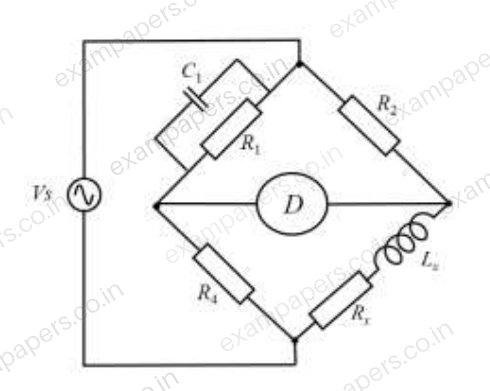
Log in to check the answer
You can attempt this question now. Sign in to view the answer key, explanations and discussion.Log in to check answerQuestion 50
Open questionINNAT2 marksNeeds review
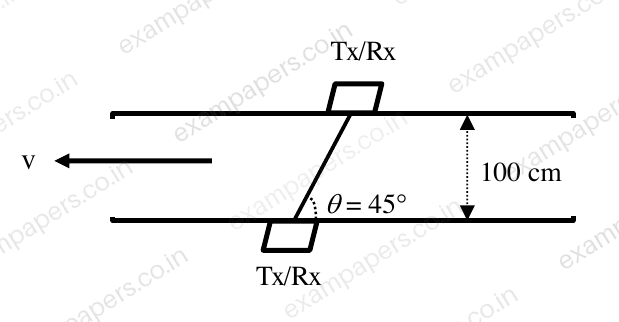
The average velocity v of flow of clear water in a 100 cm (inner) diameter tube is measured using the ultrasonic flow meter as shown in the figure. The angle θ is 45°. The measured transit times are t₁ = 0.950 ms and t₂ = 1.000 ms. The velocity v (in m/s) in the pipe is (up to one decimal place) ___.
Log in to check the answer
You can attempt this question now. Sign in to view the answer key, explanations and discussion.Log in to check answer