
Instrumentation Engineering
GATE IN format:mcq PYQs
Build your understanding with focused practice from past exam papers.
Questions 261–270 of 360. Imported answers require independent review unless marked reviewed.
Question 6
Open questionINMCQ1 markNeeds review
The input
and output
of a discrete-time system are related as
. The condition on
for which the system is Bounded-Input Bounded-Output (BIBO) stable isYour answerChoose one option.
Log in to check the answer
You can attempt this question now. Sign in to view the answer key, explanations and discussion.Log in to check answerQuestion 7
Open questionINMCQ1 markNeeds review
In a cascade control system, the closed loop transfer function of the inner loop may be assumed to have a single time constant
. Similarly, the closed loop transfer function of the outer loop may be assumed to have a single time-constant
. The desired relationship between
and
in a well-designed control system isYour answerChoose one option.
Log in to check the answer
You can attempt this question now. Sign in to view the answer key, explanations and discussion.Log in to check answerQuestion 8
Open questionINMCQ1 markNeeds review
The loop-gain function
of a control system with unity feedback is given to be
, where
. If the gain cross-over frequency of the loop-gain function is less than its phase cross-over frequency, the closed-loop system isYour answerChoose one option.
Log in to check the answer
You can attempt this question now. Sign in to view the answer key, explanations and discussion.Log in to check answerQuestion 9
Open questionINMCQ1 markNeeds review
If each of the values of inductance, capacitance and resistance of a series LCR circuit are doubled, the Q-factor of the circuit would
Your answerChoose one option.
Log in to check the answer
You can attempt this question now. Sign in to view the answer key, explanations and discussion.Log in to check answerQuestion 10
Open questionINMCQ1 markNeeds review
In the circuit shown below, the input voltage
is positive. The current (
) - voltage (
) characteristics of the diode can be assumed to be
under the forward bias condition, where
is the thermal voltage and
is the reverse saturation current. Assuming an ideal op-amp, the output voltage
of the circuit is proportional to
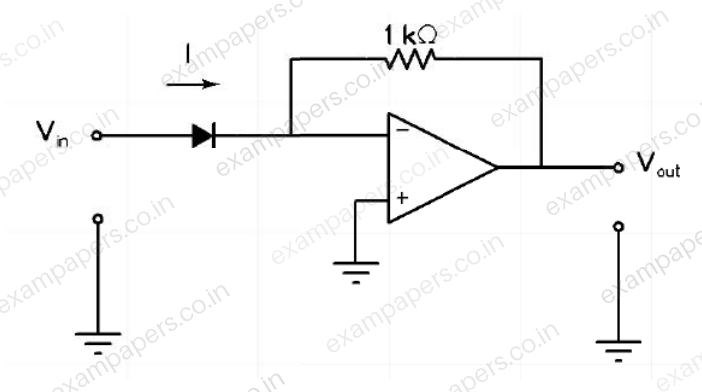
Your answerChoose one option.
Log in to check the answer
You can attempt this question now. Sign in to view the answer key, explanations and discussion.Log in to check answerQuestion 11
Open questionINMCQ1 markNeeds review
The correct biasing conditions for typical operation of light emitting diodes, photodiodes, Zener diodes are, respectively
Your answerChoose one option.
Log in to check the answer
You can attempt this question now. Sign in to view the answer key, explanations and discussion.Log in to check answerQuestion 12
Open questionINMCQ1 markNeeds review
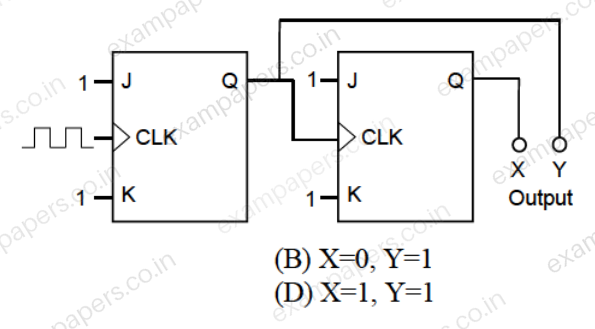
The circuit shown in the figure below uses ideal positive edge-triggered synchronous J-K flip flops with outputs X and Y. If the initial state of the output is X=0 and Y=0 just before the arrival of the first clock pulse, the state of the output just before the arrival of the second clock pulse is
Your answerChoose one option.
Log in to check the answer
You can attempt this question now. Sign in to view the answer key, explanations and discussion.Log in to check answerQuestion 13
Open questionINMCQ1 markNeeds review
Thermocouples measure temperature based on
Your answerChoose one option.
Log in to check the answer
You can attempt this question now. Sign in to view the answer key, explanations and discussion.Log in to check answerQuestion 14
Open questionINMCQ1 markNeeds review
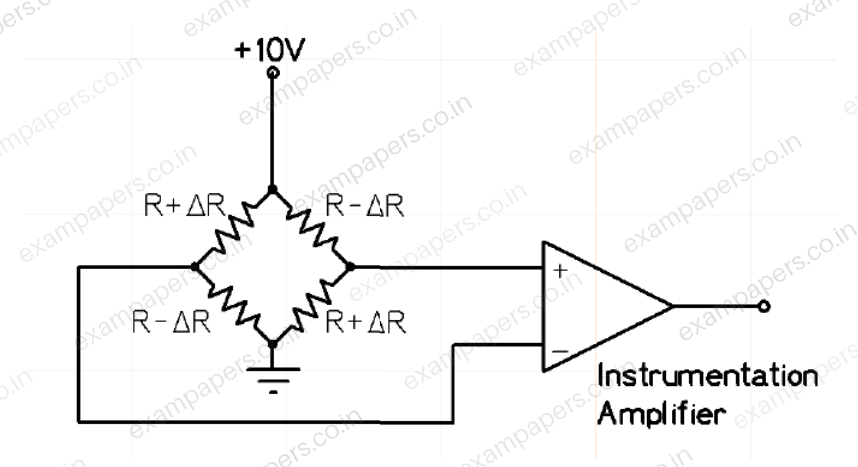
Four strain gauges in a Wheatstone bridge configuration are connected to an instrumentation amplifier as shown in the figure. From the choices given below, the preferred value for the common mode rejection ratio (CMRR) of the amplifier, in dB, would be
Your answerChoose one option.
Log in to check the answer
You can attempt this question now. Sign in to view the answer key, explanations and discussion.Log in to check answerQuestion 15
Open questionINMCQ1 markNeeds review
In a single-mode optical fiber, the zero-dispersion wavelength refers to the wavelength at which the
Your answerChoose one option.
Log in to check the answer
You can attempt this question now. Sign in to view the answer key, explanations and discussion.Log in to check answer