
Instrumentation Engineering
GATE IN Signals and Systems PYQs
Build your understanding with focused practice from past exam papers.
How to practice Signals and Systems
Attempt a question, record the concept and assumptions, then check the available answer. Rework mistakes after revising the relevant concepts. Topic tags can overlap; review the question context.
Questions 1–10 of 62. Imported answers require independent review unless marked reviewed.
Question 18
Open questionINMCQ1 markNeeds review
A square wave signal of frequency 20 kHz is passed through an ideal low-pass filter with cut-off frequency of 21 kHz. The output signal is a ______.
Your answerChoose one option.
Log in to check the answer
You can attempt this question now. Sign in to view the answer key, explanations and discussion.Log in to check answerQuestion 19
Open questionINMCQ1 markNeeds review
Given
, where t is in seconds.The fundamental period of
is ____ seconds.Your answerChoose one option.
Log in to check the answer
You can attempt this question now. Sign in to view the answer key, explanations and discussion.Log in to check answerQuestion 41
Open questionINMCQ2 marksNeeds review
A signal
is shown below. The plot of
is shown in _____. 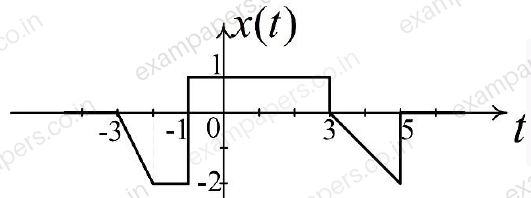
Your answerChoose one option.
Log in to check the answer
You can attempt this question now. Sign in to view the answer key, explanations and discussion.Log in to check answerQuestion 42
Open questionINMCQ2 marksNeeds review
In the table shown below, List-I are the system responses to input
and List-II are the system properties. The correct matching is ____.List-I
(M)
(N)
(O)
(P)
List-II
(I) Linear and Time-invariant
(II) Non-linear and Time-varying
(III) Linear and Time-varying
(IV) Non-linear and Time-invariant
Your answerChoose one option.
Log in to check the answer
You can attempt this question now. Sign in to view the answer key, explanations and discussion.Log in to check answerQuestion 43
Open questionINMCQ2 marksNeeds review
Given two signals:
, and
.If
, then
is _____.Your answerChoose one option.
Log in to check the answer
You can attempt this question now. Sign in to view the answer key, explanations and discussion.Log in to check answerQuestion 16
Open questionINMCQ1 markNeeds review
Let a continuous-time signal be
, where
and
is in seconds. The fundamental period of magnitude of
, in seconds, isYour answerChoose one option.
Log in to check the answer
You can attempt this question now. Sign in to view the answer key, explanations and discussion.Log in to check answerQuestion 39
Open questionINMCQ2 marksNeeds review
Let
, where
and real, represent a difference equation of a causal discrete-time linear time invariant system. The system is initially at rest. If
where
, the value of
isYour answerChoose one option.
Log in to check the answer
You can attempt this question now. Sign in to view the answer key, explanations and discussion.Log in to check answerQuestion 48
Open questionINMCQ2 marksNeeds review
Let
and
represent continuous-time real-valued signals. If
denotes cross-correlation between
and
, its continuous-time Fourier transform
equalsNote:
and
denote the continuous-time Fourier transforms of
and
, respectively.Your answerChoose one option.
Log in to check the answer
You can attempt this question now. Sign in to view the answer key, explanations and discussion.Log in to check answerQuestion 51
Open questionINMSQ2 marksNeeds review
Choose the eigenfunction(s) of stable linear time-invariant continuous-time systems from the following options.
Your answerSelect all correct options. You can choose more than one.
Log in to check the answer
You can attempt this question now. Sign in to view the answer key, explanations and discussion.Log in to check answerQuestion 54
Open questionINNAT2 marksNeeds review
Let
represent the discrete time Fourier transform of a 4-length sequence
, where
,
,
, and
.
is sampled at
to generate a periodic sequence in
with period 3, where
represents an integer. Let
represent another sequence such that its discrete Fourier transform
is given as
for
. The value of
is_____ (in integer).Log in to check the answer
You can attempt this question now. Sign in to view the answer key, explanations and discussion.Log in to check answer