
Mechanical Engineering
GATE ME concept:linear-programming PYQs
Build your understanding with focused practice from past exam papers.
How to practice concept:linear-programming
Attempt a question, record the concept and assumptions, then check the available answer. Rework mistakes after revising the relevant concepts. Topic tags can overlap; review the question context.
Questions 1–4 of 4. Imported answers require independent review unless marked reviewed.
Question 39
Open questionMEMCQ2 marksNeeds review
At the current basic feasible solution (bfs)
(
), the simplex method yields the following form of a linear programming problem in standard form.
Here the objective function is written as a function of the non-basic variables. If the simplex method moves to the adjacent bfs
(
) that best improves the objective function, which of the following represents the objective function at
, assuming that the objective function is written in the same manner as above?Your answerChoose one option.
Log in to check the answer
You can attempt this question now. Sign in to view the answer key, explanations and discussion.Log in to check answerQuestion 14
Open questionMEMCQ1 markNeeds review
Which one of the options given represents the feasible region of the linear programming model:
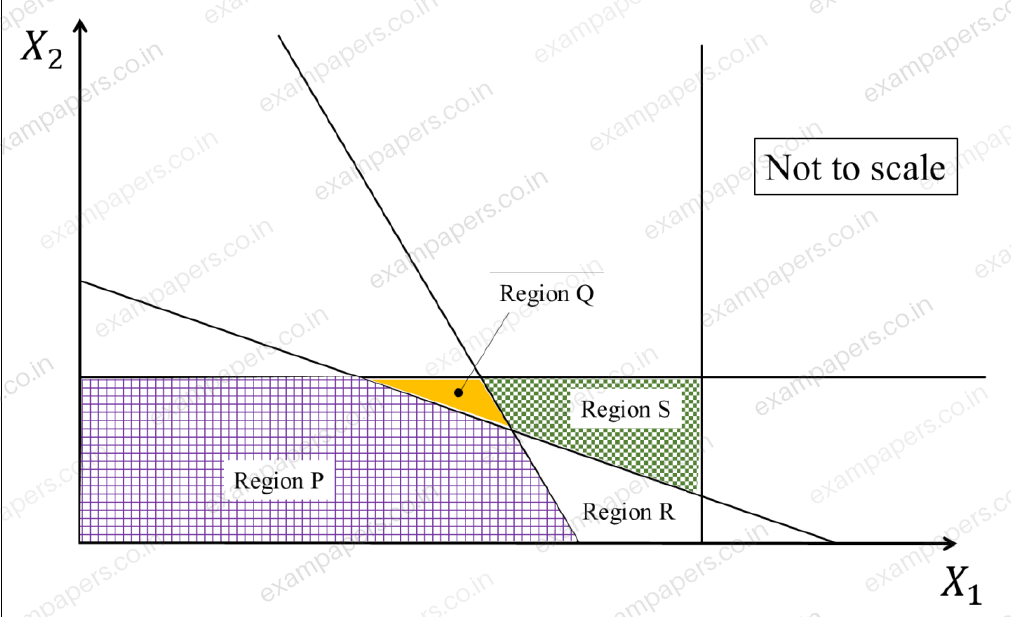
Your answerChoose one option.
Log in to check the answer
You can attempt this question now. Sign in to view the answer key, explanations and discussion.Log in to check answerQuestion 21
Open questionMEMCQ1 markNeeds review
In a linear programming problem, if a resource is not fully utilized, the shadow price of that resource is
Your answerChoose one option.
Log in to check the answer
You can attempt this question now. Sign in to view the answer key, explanations and discussion.Log in to check answerQuestion 47
Open questionMENAT2 marksNeeds review
Two business owners Sheta and Ashok run their business in two different states. Each of them, independent of the other, produces two products A and B, sells them at Rs. 2,000 per kg and Rs. 3,000 per kg, respectively, and uses Linear Programming to determine the optimal quantity of A and B to maximize their respective daily revenue. Their constraints are as follows: i) for each business owner, the production process is such that the daily production of A has to be at least as much B, and the upper limit for production of B is 10 kg per day, and ii) the respective state regulations restrict Sheta’s production of A to less than 20 kg per day, and Ashok’s production of A to less than 15 kg per day. The demand of both A and B in both the states is very high and everything produced is sold.
The absolute value of the difference in daily (optimal) revenue of Sheta and Ashok is ______ thousand Rupees (round off to 2 decimal places).
Log in to check the answer
You can attempt this question now. Sign in to view the answer key, explanations and discussion.Log in to check answer