
Mechanical Engineering
GATE ME exam:gate PYQs
Build your understanding with focused practice from past exam papers.
Questions 341–350 of 1040. Imported answers require independent review unless marked reviewed.
Question 41
Open questionMEMCQ2 marksNeeds review
In Fe-Fe₃C phase diagram, the eutectoid composition is 0.8 weight % of carbon at 725 °C. The maximum solubility of carbon in α-ferrite phase is 0.025 weight % of carbon. A steel sample, having no other alloying element except 0.5 weight % of carbon, is slowly cooled from 1000 °C to room temperature. The fraction of pro-eutectoid α-ferrite in the above steel sample at room temperature is
Your answerChoose one option.
Log in to check the answer
You can attempt this question now. Sign in to view the answer key, explanations and discussion.Log in to check answerQuestion 41
Open questionMEMCQ2 marksNeeds review
Parts P1-P7 are machined first on a milling machine and then polished at a separate machine. Using the information in the following table, the minimum total completion time required for carrying out both the operations for all 7 parts is ______ hours.
Part | Milling (hours) | Polishing (hours) |
|---|---|---|
P1 | 8 | 6 |
P2 | 3 | 2 |
P3 | 3 | 4 |
P4 | 4 | 6 |
P5 | 5 | 7 |
P6 | 6 | 4 |
P7 | 2 | 1 |
Your answerChoose one option.
Log in to check the answer
You can attempt this question now. Sign in to view the answer key, explanations and discussion.Log in to check answerQuestion 42
Open questionMEMCQ2 marksNeeds review
Activities A to K are required to complete a project. The time estimates and the immediate predecessors of these activities are given in the table. If the project is to be completed in the minimum possible time, the latest finish time for the activity G is ____________ hours.
Activity | Time (hours) | Immediate predecessors |
|---|---|---|
A | 2 | — |
B | 3 | — |
C | 2 | — |
D | 4 | A |
E | 5 | B |
F | 4 | B |
G | 3 | C |
H | 10 | D, E |
I | 5 | F |
J | 8 | G |
K | 3 | H, I, J |
Your answerChoose one option.
Log in to check the answer
You can attempt this question now. Sign in to view the answer key, explanations and discussion.Log in to check answerQuestion 42
Open questionMEMCQ2 marksNeeds review
A manufacturing unit produces two products P1 and P2. For each piece of P1 and P2, the table below provides quantities of materials M1, M2, and M3 required, and also the profit earned. The maximum quantity available per day for M1, M2 and M3 is also provided. The maximum possible profit per day is ₹__________.
| M1 | M2 | M3 | Profit per piece (₹) |
|---|---|---|---|---|
P1 | 2 | 2 | 0 | 150 |
P2 | 3 | 1 | 2 | 100 |
Maximum quantity available per day | 70 | 50 | 40 | |
Your answerChoose one option.
Log in to check the answer
You can attempt this question now. Sign in to view the answer key, explanations and discussion.Log in to check answerQuestion 43
Open questionMEMCQ2 marksNeeds review
A solid spherical bead of lead (uniform density = 1100 kg/m
) of diameter
mm sinks with a constant velocity
in a large stagnant pool of a liquid (dynamic viscosity =
kg·m
·s
). The coefficient of drag is given by
, where the Reynolds number (Re) is defined on the basis of the diameter of the bead. The drag force acting on the bead is expressed as
, where
is the density of the liquid. Neglect the buoyancy force. Using
m/s
, the velocity
is ________ m/s.Your answerChoose one option.
Log in to check the answer
You can attempt this question now. Sign in to view the answer key, explanations and discussion.Log in to check answerQuestion 43
Open questionMEMCQ2 marksNeeds review
A tube of uniform diameter
is immersed in a steady flowing inviscid liquid stream of velocity
, as shown in the figure. Gravitational acceleration is represented by
. The volume flow rate through the tube is _____. 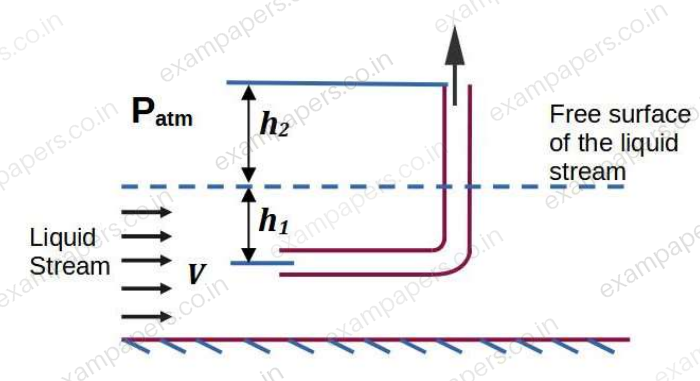
Your answerChoose one option.
Log in to check the answer
You can attempt this question now. Sign in to view the answer key, explanations and discussion.Log in to check answerQuestion 44
Open questionMEMCQ2 marksNeeds review
Consider steady, one-dimensional compressible flow of a gas in a pipe of diameter 1 m. At one location in the pipe, the density and velocity are 1 kg/m
and 100 m/s, respectively. At a downstream location in the pipe, the velocity is 170 m/s. If the pressure drop between these two locations is 10 kPa, the force exerted by the gas on the pipe between these two locations is __________ N.Your answerChoose one option.
Log in to check the answer
You can attempt this question now. Sign in to view the answer key, explanations and discussion.Log in to check answerQuestion 44
Open questionMEMCQ2 marksNeeds review
The steady velocity field in an inviscid fluid of density 1.5 is given to be
. Neglecting body forces, the pressure gradient at
is __________.Your answerChoose one option.
Log in to check the answer
You can attempt this question now. Sign in to view the answer key, explanations and discussion.Log in to check answerQuestion 45
Open questionMEMCQ2 marksNeeds review
Consider a rod of uniform thermal conductivity whose one end (
) is insulated and the other end (
) is exposed to flow of air at temperature
with convective heat transfer coefficient
. The cylindrical surface of the rod is insulated so that the heat transfer is strictly along the axis of the rod. The rate of internal heat generation per unit volume inside the rod is given as
The steady state temperature at the mid-location of the rod is given as
. What will be the temperature at the same location, if the convective heat transfer coefficient increases to
?Your answerChoose one option.
Log in to check the answer
You can attempt this question now. Sign in to view the answer key, explanations and discussion.Log in to check answerQuestion 45
Open questionMEMCQ2 marksNeeds review
In a vapour compression refrigeration cycle, the refrigerant enters the compressor in saturated vapour state at evaporator pressure, with specific enthalpy equal to 250 kJ/kg. The exit of the compressor is superheated at condenser pressure with specific enthalpy equal to 300 kJ/kg. At the condenser exit, the refrigerant is throttled to the evaporator pressure. The coefficient of performance (COP) of the cycle is 3. If the specific enthalpy of the saturated liquid at evaporator pressure is 50 kJ/kg, then the dryness fraction of the refrigerant at entry to evaporator is __________.
Your answerChoose one option.
Log in to check the answer
You can attempt this question now. Sign in to view the answer key, explanations and discussion.Log in to check answer