
Mechanical Engineering
GATE ME exam:gate PYQs
Build your understanding with focused practice from past exam papers.
Questions 761–770 of 1040. Imported answers require independent review unless marked reviewed.
Question 46
Open questionMENAT2 marksNeeds review
A cube of side 100 mm is placed at the bottom of an empty container on one of its faces. The density of the material of the cube is 800 kg/m
. Liquid of density 1000 kg/m
is now poured into the container. The minimum height to which the liquid needs to be poured into the container for the cube to just lift up is ______ mm.Log in to check the answer
You can attempt this question now. Sign in to view the answer key, explanations and discussion.Log in to check answerQuestion 46
Open questionMENAT2 marksNeeds review
Hot and cold fluids enter a parallel flow double tube heat exchanger at 100 °C and 15 °C, respectively. The heat capacity rates of hot and cold fluids are C_h = 2000 W/K and C_c = 1200 W/K, respectively. If the outlet temperature of the cold fluid is 45 °C, the log mean temperature difference (LMTD) of the heat exchanger is ________ K (round off to two decimal places).
Log in to check the answer
You can attempt this question now. Sign in to view the answer key, explanations and discussion.Log in to check answerQuestion 47
Open questionMENAT2 marksNeeds review
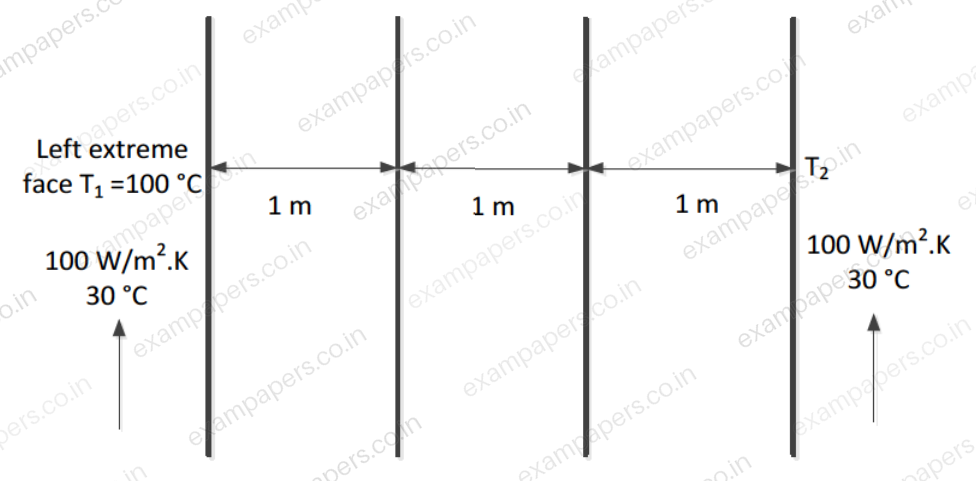
Three slabs are joined together as shown in the figure. There is no thermal contact resistance at the interfaces. The center slab experiences a non-uniform internal heat generation with an average value equal to 1000 Wm
, while the left and right slabs have no internal heat generation. All slabs have thickness equal to 1 m and thermal conductivity of each slab is equal to 5 Wm
K
. The two extreme faces are exposed to fluid with heat transfer coefficient 100 Wm
K
and bulk temperature 30 °C as shown. The heat transfer in the slabs is assumed to be one dimensional and steady, and all properties are constant. If the left extreme face temperature
is measured to be 10 °C, the right extreme face temperature
is ______ °C.
Log in to check the answer
You can attempt this question now. Sign in to view the answer key, explanations and discussion.Log in to check answerQuestion 47
Open questionMENAT2 marksNeeds review
Water flowing at the rate of 1 kg/s through a system is heated using an electric heater such that the specific enthalpy of the water increases by 2.50 kJ/kg and the specific entropy increases by 0.007 kJ/kg K. The power input to the electric heater is 2.50 kW. There is no other work or heat interaction between the system and the surroundings. Assuming an ambient temperature of 300 K, the irreversibility rate of the system is ________ kW (round off to two decimal places).
Log in to check the answer
You can attempt this question now. Sign in to view the answer key, explanations and discussion.Log in to check answerQuestion 48
Open questionMENAT2 marksNeeds review
If one mole of H
gas occupies a rigid container with a capacity of 1000 litres and the temperature is raised from 27 °C to 37 °C, the change in pressure of the contained gas (round off to two decimal places), assuming ideal gas behaviour, is ______ Pa. (
=8.314 J/mol·K)Log in to check the answer
You can attempt this question now. Sign in to view the answer key, explanations and discussion.Log in to check answerQuestion 48
Open questionMENAT2 marksNeeds review
An idealized centrifugal pump (blade outer radius of 50 mm) consumes 2 kW power while running at 300 rpm. The entry of the liquid into the pump is axial and exit from the pump is radial with respect to impeller. If the losses are neglected, then the mass flow rate of the liquid through the pump is ______ kg/s (round off to two decimal places).
Log in to check the answer
You can attempt this question now. Sign in to view the answer key, explanations and discussion.Log in to check answerQuestion 49
Open questionMENAT2 marksNeeds review
A steam power cycle with regeneration as shown below on the T-s diagram employs a single open feedwater heater for efficiency improvement. The fluids mix with each other in an open feedwater heater. The turbine is isentropic and the input (bleed) to the feedwater heater from the turbine is at state 2 as shown in the figure. Process 3-4 occurs in the condenser. The pump work is negligible. The input to the boiler is at state 5. The following information is available from the steam tables:
State | 1 | 2 | 3 | 4 | 5 | 6 |
|---|---|---|---|---|---|---|
Enthalpy (kJ/kg) | 3350 | 2800 | 2300 | 175 | 700 | 1000 |
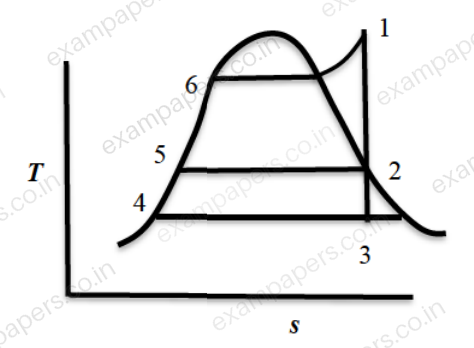 |
The mass flow rate of steam bled from the turbine as a percentage of the total mass flow rate at the inlet to the turbine at state 1 is ______.
Log in to check the answer
You can attempt this question now. Sign in to view the answer key, explanations and discussion.Log in to check answerQuestion 49
Open questionMENAT2 marksNeeds review
An air standard Otto cycle has thermal efficiency of 0.5 and the mean effective pressure of the cycle is 1000 kPa. For air, assume specific heat ratio
and specific gas constant R = 0.287 kJ/kg·K. If the pressure and temperature at the beginning of the compression stroke are 100 kPa and 300 K, respectively, then the specific net work output of the cycle is _____ kJ/kg (round off to two decimal places).Log in to check the answer
You can attempt this question now. Sign in to view the answer key, explanations and discussion.Log in to check answerQuestion 50
Open questionMENAT2 marksNeeds review
A gas turbine with air as the working fluid has an isentropic efficiency of 0.70 when operating at a pressure ratio of 3. Now, the pressure ratio of the turbine is increased to 5, while maintaining the same inlet conditions. Assume air as a perfect gas with specific heat ratio
=1.4. If the specific work output remains the same for both the cases, the isentropic efficiency of the turbine at the pressure ratio of 5 is ______ (round off to two decimal places)Log in to check the answer
You can attempt this question now. Sign in to view the answer key, explanations and discussion.Log in to check answerQuestion 50
Open questionMENAT2 marksNeeds review
The figure shows a pouring arrangement for casting of a metal block.
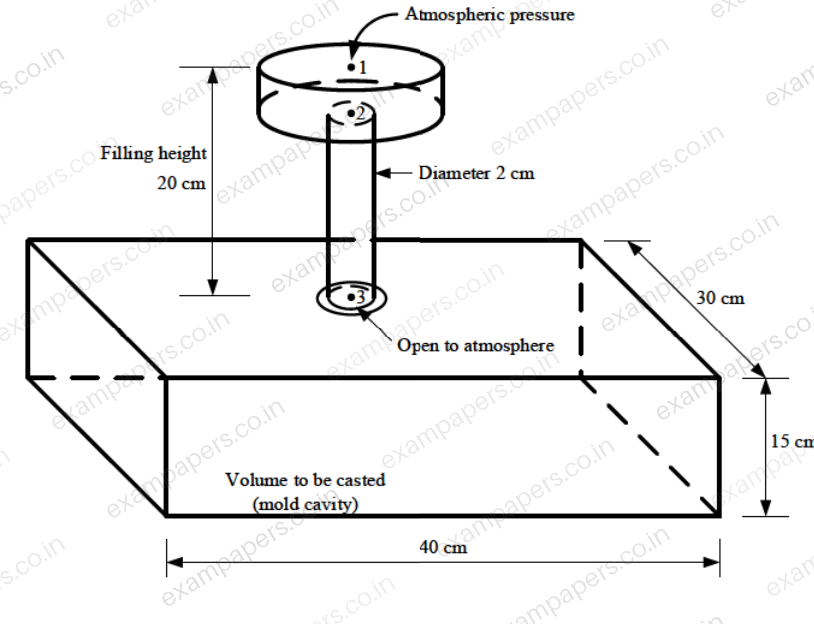
Frictional losses are negligible. The acceleration due to gravity is 9.81 m/s². The time (in s, round off to two decimal places) to fill up the mold cavity (of size 40 cm × 30 cm × 15 cm) is _____
Log in to check the answer
You can attempt this question now. Sign in to view the answer key, explanations and discussion.Log in to check answer