
Mechanical Engineering
GATE ME format:nat PYQs
Build your understanding with focused practice from past exam papers.
Questions 281–290 of 418. Imported answers require independent review unless marked reviewed.
Question 43
Open questionMENAT2 marksNeeds review
Water flows through two different pipes A and B of the same circular cross-section but at different flow rates. The length of pipe A is 1.0 m and that of pipe B is 2.0 m. The flow in both the pipes is laminar and fully developed. If the frictional head loss across the length of the pipes is the same, the ratio of volume flow rates
is ______ (round off to two decimal places).Log in to check the answer
You can attempt this question now. Sign in to view the answer key, explanations and discussion.Log in to check answerQuestion 44
Open questionMENAT2 marksNeeds review
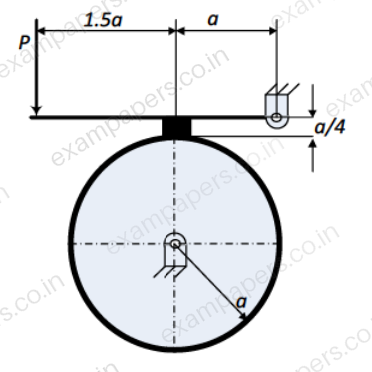
A single block brake with a short shoe and torque capacity of 250 N·m is shown. The cylindrical brake drum rotates anticlockwise at 100 rpm and the coefficient of friction is 0.25. The value of
, in mm (round off to one decimal place), such that the maximum actuating force
is 2000 N, is ______.
Log in to check the answer
You can attempt this question now. Sign in to view the answer key, explanations and discussion.Log in to check answerQuestion 44
Open questionMENAT2 marksNeeds review
The aerodynamic drag on a sports car depends on its shape. The car has a drag coefficient of 0.1 with the windows and the roof closed. With the windows and the roof open, the drag coefficient becomes 0.8. The car travels at 44 km/h with the windows and roof closed. For the same amount of power needed to overcome the aerodynamic drag, the speed of the car with the windows and roof open (round off to two decimal places), is ______ km/h (The density of air and the frontal area may be assumed to be constant).
Log in to check the answer
You can attempt this question now. Sign in to view the answer key, explanations and discussion.Log in to check answerQuestion 45
Open questionMENAT2 marksNeeds review
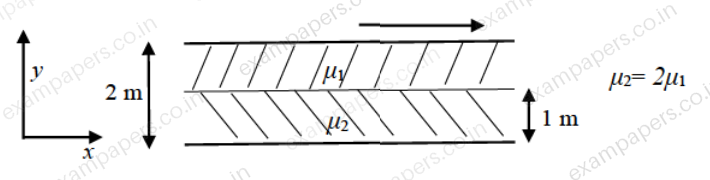
Two immiscible, incompressible, viscous fluids having same densities but different viscosities are contained between two infinite horizontal parallel plates, 2 m apart as shown below. The bottom plate is fixed and the upper plate moves to the right with a constant velocity of 3 m/s. With the assumptions of Newtonian fluid, steady, and fully developed laminar flow with zero pressure gradient in all directions, the momentum equations simplify to
If the dynamic viscosity of the lower fluid,
, is twice that of the upper fluid,
, then the velocity at the interface (round off to two decimal places) is ______ m/s.
Log in to check the answer
You can attempt this question now. Sign in to view the answer key, explanations and discussion.Log in to check answerQuestion 45
Open questionMENAT2 marksNeeds review
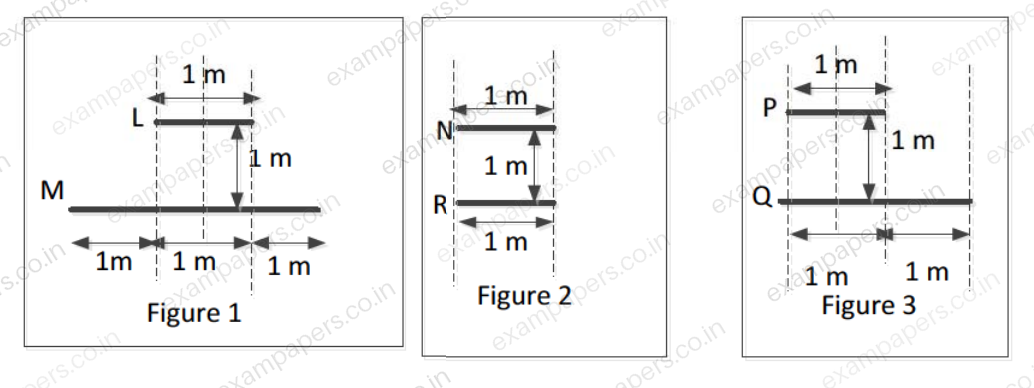
Three sets of parallel plates LM, NR and PQ are given in Figures 1, 2 and 3. The view factor F_ is defined as the fraction of radiation leaving plate I that is intercepted by plate J. Assume that the values of F_ and F_ are 0.8 and 0.4, respectively. The value of F_ (round off to one decimal place) is ______.
Log in to check the answer
You can attempt this question now. Sign in to view the answer key, explanations and discussion.Log in to check answerQuestion 46
Open questionMENAT2 marksNeeds review
A cube of side 100 mm is placed at the bottom of an empty container on one of its faces. The density of the material of the cube is 800 kg/m
. Liquid of density 1000 kg/m
is now poured into the container. The minimum height to which the liquid needs to be poured into the container for the cube to just lift up is ______ mm.Log in to check the answer
You can attempt this question now. Sign in to view the answer key, explanations and discussion.Log in to check answerQuestion 46
Open questionMENAT2 marksNeeds review
Hot and cold fluids enter a parallel flow double tube heat exchanger at 100 °C and 15 °C, respectively. The heat capacity rates of hot and cold fluids are C_h = 2000 W/K and C_c = 1200 W/K, respectively. If the outlet temperature of the cold fluid is 45 °C, the log mean temperature difference (LMTD) of the heat exchanger is ________ K (round off to two decimal places).
Log in to check the answer
You can attempt this question now. Sign in to view the answer key, explanations and discussion.Log in to check answerQuestion 47
Open questionMENAT2 marksNeeds review
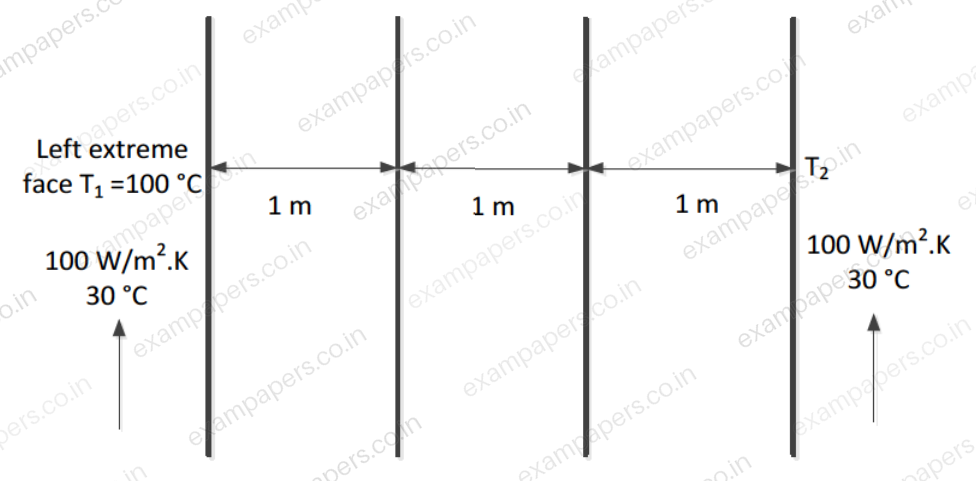
Three slabs are joined together as shown in the figure. There is no thermal contact resistance at the interfaces. The center slab experiences a non-uniform internal heat generation with an average value equal to 1000 Wm
, while the left and right slabs have no internal heat generation. All slabs have thickness equal to 1 m and thermal conductivity of each slab is equal to 5 Wm
K
. The two extreme faces are exposed to fluid with heat transfer coefficient 100 Wm
K
and bulk temperature 30 °C as shown. The heat transfer in the slabs is assumed to be one dimensional and steady, and all properties are constant. If the left extreme face temperature
is measured to be 10 °C, the right extreme face temperature
is ______ °C.
Log in to check the answer
You can attempt this question now. Sign in to view the answer key, explanations and discussion.Log in to check answerQuestion 47
Open questionMENAT2 marksNeeds review
Water flowing at the rate of 1 kg/s through a system is heated using an electric heater such that the specific enthalpy of the water increases by 2.50 kJ/kg and the specific entropy increases by 0.007 kJ/kg K. The power input to the electric heater is 2.50 kW. There is no other work or heat interaction between the system and the surroundings. Assuming an ambient temperature of 300 K, the irreversibility rate of the system is ________ kW (round off to two decimal places).
Log in to check the answer
You can attempt this question now. Sign in to view the answer key, explanations and discussion.Log in to check answerQuestion 48
Open questionMENAT2 marksNeeds review
If one mole of H
gas occupies a rigid container with a capacity of 1000 litres and the temperature is raised from 27 °C to 37 °C, the change in pressure of the contained gas (round off to two decimal places), assuming ideal gas behaviour, is ______ Pa. (
=8.314 J/mol·K)Log in to check the answer
You can attempt this question now. Sign in to view the answer key, explanations and discussion.Log in to check answer