
Mechanical Engineering
GATE ME Heat-Transfer PYQs
Build your understanding with focused practice from past exam papers.
Questions 51–54 of 54. Imported answers require independent review unless marked reviewed.
Question 37
Open questionME-1NAT2 marksNeeds review
Two black surfaces, AB and BC, of lengths 5 m and 6 m, respectively, are oriented as shown. Both surfaces extend infinitely into the third dimension. Given that view factor
,
,
,
and Stefan Boltzmann constant,
W/(m
K
), the heat transfer rate from Surface 2 to the surrounding environment is ________ kW. 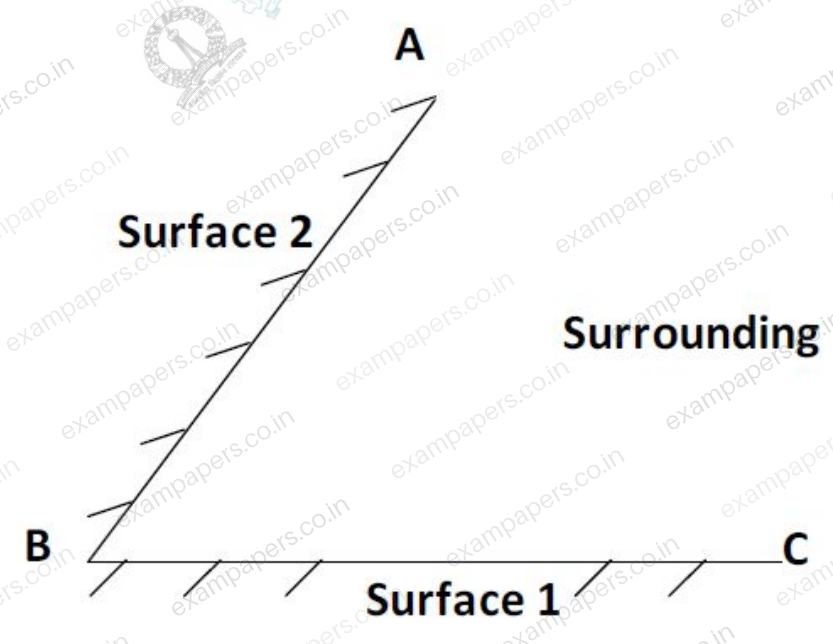
Log in to check the answer
You can attempt this question now. Sign in to view the answer key, explanations and discussion.Log in to check answerQuestion 38
Open questionME-1NAT2 marksNeeds review
Heat is generated uniformly in a long solid cylindrical rod (diameter = 10 mm) at the rate of
W/m³. The thermal conductivity of the rod material is 25 W/m.K. Under steady state conditions, the temperature difference between the centre and the surface of the rod is __________ °C.Log in to check the answer
You can attempt this question now. Sign in to view the answer key, explanations and discussion.Log in to check answerQuestion 46
Open questionME-2MCQ2 marksNeeds review
In a counter-flow heat exchanger, water is heated at the rate of 1.5 kg/s from 40 °C to 80 °C by an oil entering at 120 °C and leaving at 60 °C. The specific heats of water and oil are 4.2 kJ/kg·K and 2 kJ/kg·K, respectively. The overall heat transfer coefficient is 400 W/m
·K. The required heat transfer surface area (in m
) isYour answerChoose one option.
Log in to check the answer
You can attempt this question now. Sign in to view the answer key, explanations and discussion.Log in to check answerQuestion 47
Open questionME-2MCQ2 marksNeeds review
A metal ball of diameter 60 mm is initially at 220 °C. The ball is suddenly cooled by an air jet of 20 °C. The heat transfer coefficient is 200 W/m
·K. The specific heat, thermal conductivity and density of the metal ball are 400 J/kg·K, 400 W/m·K and 900 kg/m
, respectively. The ball temperature (in °C) after 90 seconds will be approximatelyYour answerChoose one option.
Log in to check the answer
You can attempt this question now. Sign in to view the answer key, explanations and discussion.Log in to check answer