
Mechanical Engineering
GATE ME Machining and Machine Tool Operations PYQs
Build your understanding with focused practice from past exam papers.
Questions 11–20 of 63. Imported answers require independent review unless marked reviewed.
Question 44
Open questionMEMCQ2 marksNeeds review
In an ideal orthogonal cutting experiment (see figure), the cutting speed V is 1 m/s, the rake angle of the tool
, and the shear angle,
, is known to be
.Applying the ideal orthogonal cutting model, consider two shear planes PQ and RS close to each other. As they approach the thin shear zone (shown as a thick line in the figure), plane RS gets sheared with respect to PQ (point R1 shears to R2, and S1 shears to S2).
Assuming that the perpendicular distance between PQ and RS is
m, what is the value of shear strain rate (in s
) that the material undergoes at the shear zone? 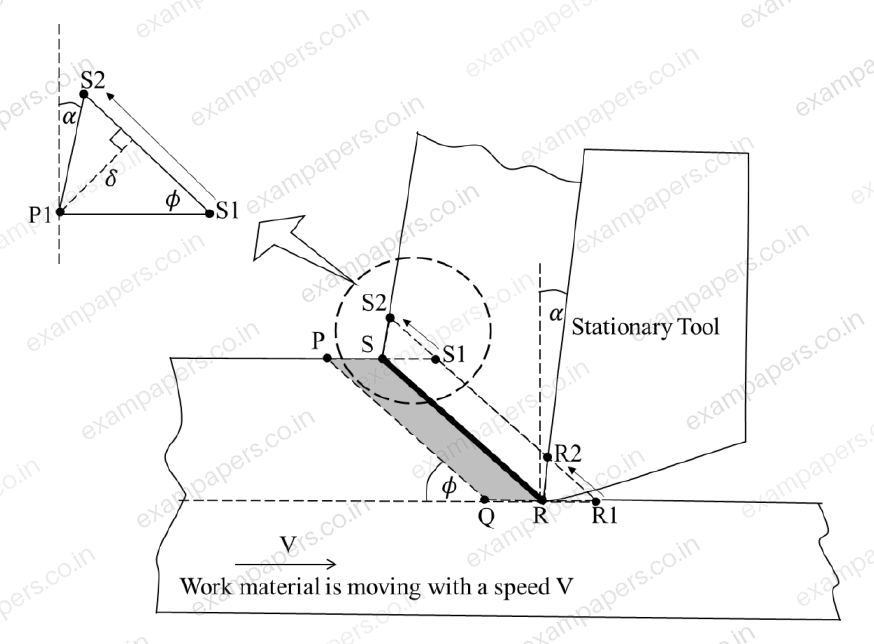
Your answerChoose one option.
Log in to check the answer
You can attempt this question now. Sign in to view the answer key, explanations and discussion.Log in to check answerQuestion 19
Open questionMEMCQ1 markNeeds review
A CNC worktable is driven in a linear direction by a lead screw connected directly to a stepper motor. The pitch of the lead screw is 5 mm. The stepper motor completes one full revolution upon receiving 600 pulses. If the worktable speed is 5 m/minute and there is no missed pulse, then the pulse rate being received by the stepper motor is
Your answerChoose one option.
Log in to check the answer
You can attempt this question now. Sign in to view the answer key, explanations and discussion.Log in to check answerQuestion 28
Open questionMEMSQ1 markNeeds review
Which of these processes involve(s) melting in metallic workpieces?
Your answerSelect all correct options. You can choose more than one.
Log in to check the answer
You can attempt this question now. Sign in to view the answer key, explanations and discussion.Log in to check answerQuestion 33
Open questionMENAT1 markNeeds review
Electrochemical machining operations are performed with tungsten as the tool, and copper and aluminum as two different workpiece materials. Properties of copper and aluminum are given in the table below.
Material | Atomic mass (amu) | Valency | Density (g/cm ) |
|---|---|---|---|
Copper | 63 | 2 | 9 |
Aluminum | 27 | 3 | 2.7 |
Ignore overpotentials, and assume that current efficiency is 100% for both the workpiece materials. Under identical conditions, if the material removal rate (MRR) of copper is 100 mg/s, the MRR of aluminum will be ______________ mg/s (round-off to two decimal places).
Log in to check the answer
You can attempt this question now. Sign in to view the answer key, explanations and discussion.Log in to check answerQuestion 54
Open questionMENAT2 marksNeeds review
Under orthogonal cutting condition, a turning operation is carried out on a metallic workpiece at a cutting speed of 4 m/s. The orthogonal rake angle of the cutting tool is 5°. The uncut chip thickness and width of cut are 0.2 mm and 3 mm, respectively. In this turning operation, the resultant friction angle and shear angle are 45° and 25°, respectively. If the dynamic yield shear strength of the workpiece material under this cutting condition is 100 MPa, then the cutting force is ____________ N (round off to one decimal place).
Log in to check the answer
You can attempt this question now. Sign in to view the answer key, explanations and discussion.Log in to check answerQuestion 54
Open questionMENAT2 marksNeeds review
A straight-teeth horizontal slab milling cutter is shown in the figure. It has 4 teeth and diameter (
) of 200 mm. The rotational speed of the cutter is 100 rpm and the linear feed given to the workpiece is 1000 mm/minute. The width of the workpiece (
) is 100 mm, and the entire width is milled in a single pass of the cutter. The cutting force/tooth is given by
, where specific cutting force
N/mm²,
is the width of cut, and
is the uncut chip thickness. The depth of cut (
) is
, and hence the assumption of
is invalid. The maximum cutting force required is ______ kN (round off to one decimal place). 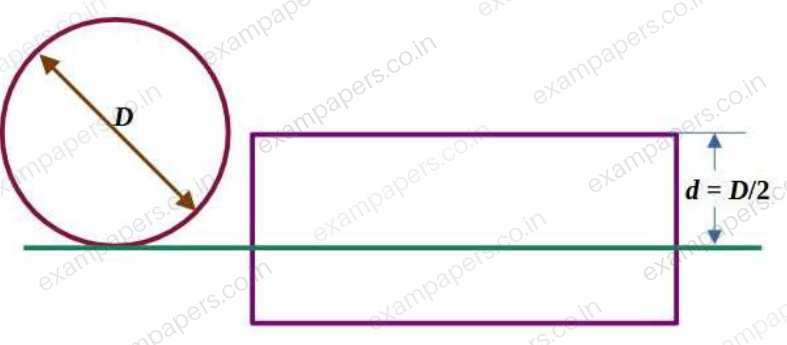
Log in to check the answer
You can attempt this question now. Sign in to view the answer key, explanations and discussion.Log in to check answerQuestion 55
Open questionMENAT2 marksNeeds review
A 1 mm thick cylindrical tube, 100 mm in diameter, is orthogonally turned such that the entire wall thickness of the tube is cut in a single pass. The axial feed of the tool is 1 m/minute and the specific cutting energy (
) of the tube material is 6 J/mm
. Neglect contribution of feed force towards power. The power required to carry out this operation is ________ kW (round off to one decimal place).Log in to check the answer
You can attempt this question now. Sign in to view the answer key, explanations and discussion.Log in to check answerQuestion 55
Open questionMENAT2 marksNeeds review
In an orthogonal machining operation, the cutting and thrust forces are equal in magnitude. The uncut chip thickness is 0.5 mm and the shear angle is 15°. The orthogonal rake angle of the tool is 0° and the width of cut is 2 mm. The workpiece material is perfectly plastic and its yield shear strength is 500 MPa. The cutting force is ________ N (round off to the nearest integer).
Log in to check the answer
You can attempt this question now. Sign in to view the answer key, explanations and discussion.Log in to check answerQuestion 6
Open questionMEMCQ1 markNeeds review
In a CNC machine tool, the function of an interpolator is to generate
Your answerChoose one option.
Log in to check the answer
You can attempt this question now. Sign in to view the answer key, explanations and discussion.Log in to check answerQuestion 7
Open questionMEMCQ1 markNeeds review
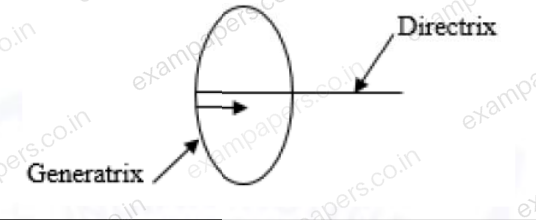
In a machining operation, if a cutting tool traces the workpiece such that the directrix is perpendicular to the plane of the generatrix as shown in figure, the surface generated is
Your answerChoose one option.
Log in to check the answer
You can attempt this question now. Sign in to view the answer key, explanations and discussion.Log in to check answer