
Mechanical Engineering
GATE ME purpose:exam-prep PYQs
Build your understanding with focused practice from past exam papers.
Questions 621–630 of 1040. Imported answers require independent review unless marked reviewed.
Question 41
Open questionMENAT2 marksNeeds review
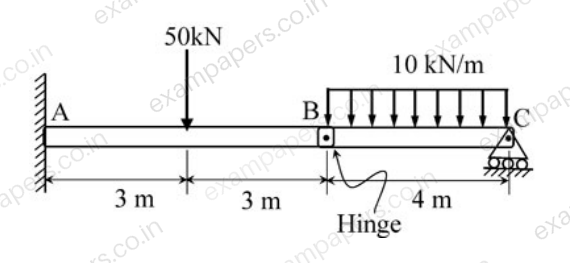
The magnitude of reaction force at joint C of the hinge-beam shown in the figure is ____ kN (round off to 2 decimal places).
Log in to check the answer
You can attempt this question now. Sign in to view the answer key, explanations and discussion.Log in to check answerQuestion 41
Open questionMENAT2 marksNeeds review
A steel spur pinion has a module (
) of 1.25 mm, 20 teeth and 20° pressure angle. The pinion rotates at 1200 rpm and transmits power to a 60 teeth gear. The face width (
) is 50 mm, Lewis form factor
and a dynamic factor
. The bending stress (
) induced in a tooth can be calculated by using the Lewis formula given below.If the maximum bending stress experienced by the pinion is 400 MPa, the power transmitted is ______ kW (round off to one decimal place).
Lewis formula:
, where
is the tangential load acting on the pinion.Log in to check the answer
You can attempt this question now. Sign in to view the answer key, explanations and discussion.Log in to check answerQuestion 42
Open questionMENAT2 marksNeeds review
A slot of 25 mm × 25 mm is to be milled in a workpiece of 300 mm length using a side and face milling cutter of diameter 100 mm, width 25 mm and having 20 teeth. For a depth of cut 5 mm, feed per tooth 0.1 mm, cutting speed 35 m/min and approach and over travel distance of 5 mm each, the time required for milling the slot is ______ minutes (round off to one decimal place).
Log in to check the answer
You can attempt this question now. Sign in to view the answer key, explanations and discussion.Log in to check answerQuestion 42
Open questionMENAT2 marksNeeds review
A mould cavity of 120 cm
volume has to be filled through a sprue of 10 cm length feeding a horizontal runner. Cross-sectional area at the base of the sprue is 2 cm
. Consider acceleration due to gravity as 9.81 m/s
. Neglecting frictional losses due to molten metal flow, the time taken to fill the mould cavity is ______ seconds (round off to 2 decimal places).Log in to check the answer
You can attempt this question now. Sign in to view the answer key, explanations and discussion.Log in to check answerQuestion 43
Open questionMENAT2 marksNeeds review
The following data applies to basic shaft system:
tolerance for hole = 0.002 mm,
tolerance for shaft = 0.01 mm,
allowance = 0.003 mm,
basic size = 50 mm.
The maximum hole size is _____ nm (round off to 3 decimal places).
Log in to check the answer
You can attempt this question now. Sign in to view the answer key, explanations and discussion.Log in to check answerQuestion 43
Open questionMENAT2 marksNeeds review
A cylindrical bar with 200 mm diameter is being turned with a tool having geometry 0° - 9° - 7° - 8° - 15° - 30° - 0.05 inch (Coordinate system, ASA) resulting in a cutting force
. If the tool geometry is changed to 0° - 9° - 7° - 8° - 15° - 0° - 0.05 inch (Coordinate system, ASA) and all other parameters remain unchanged, the cutting force changes to
. Specific cutting energy (in J/mm
) is
, where
is the specific energy coefficient, and
is the uncut thickness in mm. The value of percentage change in cutting force
, i.e.
, is ______ (round off to one decimal place).Log in to check the answer
You can attempt this question now. Sign in to view the answer key, explanations and discussion.Log in to check answerQuestion 44
Open questionMENAT2 marksNeeds review
A steel part with surface area of 125 cm² is to be chrome coated through an electroplating process using chromium acid sulfate as an electrolyte. An increasing current is applied to the part according to the following current time relation:
where,
= current (A) and
= time (minutes). The part is submerged in the plating solution for a duration of 20 minutes for plating purpose. Assuming the code efficiency of chromium to be 15% and the plating constant of chromium acid sulfate to be 2.50 × 10⁻² mm³/A·s, the resulting coating thickness on the part surface is ______ μm (round off to one decimal place).Log in to check the answer
You can attempt this question now. Sign in to view the answer key, explanations and discussion.Log in to check answerQuestion 44
Open questionMENAT2 marksNeeds review
There are two identical shape machines S
and S
. In machine S
, the width of the workpiece is increased by 10% and the feed is decreased by 10%, with respect to that of S
. If all other conditions remain the same then the ratio of total time per pass in S
and S
will be ______ (round off to one decimal place).Log in to check the answer
You can attempt this question now. Sign in to view the answer key, explanations and discussion.Log in to check answerQuestion 45
Open questionMENAT2 marksNeeds review
In a turning process using orthogonal tool geometry, a chip length of 100 mm is obtained for an uncut chip length of 250 mm.
The cutting conditions are: cutting speed = 30 m/min, rake angle = 20°.
The shear plane angle is ______ degrees (round off to one decimal place).
Log in to check the answer
You can attempt this question now. Sign in to view the answer key, explanations and discussion.Log in to check answerQuestion 45
Open questionMENAT2 marksNeeds review
Bars of 250 mm length and 25 mm diameter are to be turned on a lathe with a feed of 0.2 mm/rev. Each grinding of the tool costs Rs. 20. The time required for each tool change is 1 min. Tool life equation is
(where cutting speed
is in m/min and tool life
is in min). The optimum tool cost per piece for maximum production rate is Rs. ______ (round off to 2 decimal places).Log in to check the answer
You can attempt this question now. Sign in to view the answer key, explanations and discussion.Log in to check answer