
Mechanical Engineering
GATE ME Quantitative Aptitude PYQs
Build your understanding with focused practice from past exam papers.
Questions 61–65 of 65. Imported answers require independent review unless marked reviewed.
Question 62
Open questionGAMCQ2 marksNeeds review
X bullocks and Y tractors take 8 days to plough a field. If we halve the number of bullocks and double the number of tractors, it takes 5 days to plough the same field. How many days will it take X bullocks alone to plough the field?
Your answerChoose one option.
Log in to check the answer
You can attempt this question now. Sign in to view the answer key, explanations and discussion.Log in to check answerQuestion 63
Open questionGAMCQ2 marksNeeds review
Let
be the plane figure consisting of the points
given by the inequalities
and
. Let
be the plane figure given by the inequalities
,
, and
. Let
be the union of
and
. The area of
isYour answerChoose one option.
Log in to check the answer
You can attempt this question now. Sign in to view the answer key, explanations and discussion.Log in to check answerQuestion 63
Open questionGAMCQ2 marksNeeds review
There are 4 women P, Q, R, S, and 5 men W, X, Y, Z in a group. We are required to form pairs each consisting of one woman and one man. P is not to be paired with Z, and Y must necessarily be paired with someone. In how many ways can 4 such pairs be formed?
Your answerChoose one option.
Log in to check the answer
You can attempt this question now. Sign in to view the answer key, explanations and discussion.Log in to check answerQuestion 65
Open questionGAMCQ2 marksNeeds review
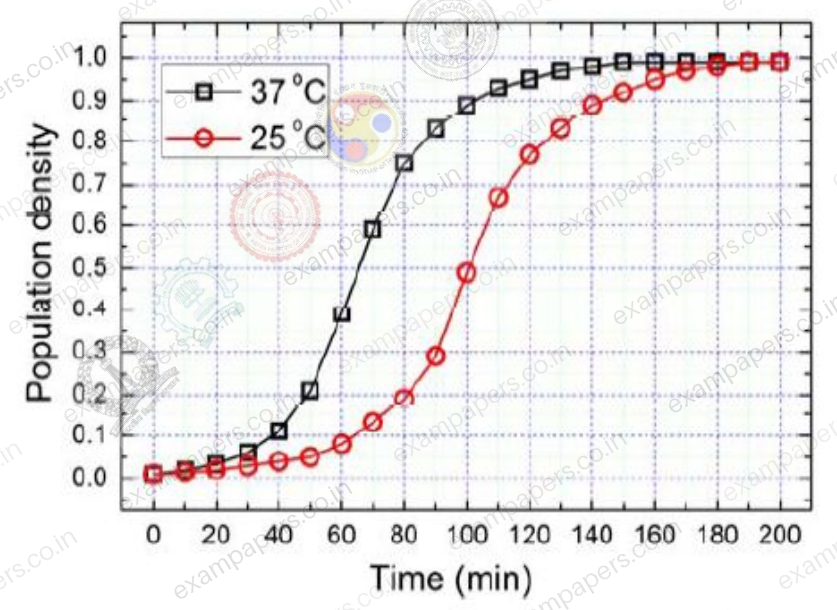
The growth of bacteria (lactobacillus) in milk leads to curd formation. A minimum bacterial population density of 0.8 (in suitable units) is needed to form curd. In the graph below, the population density of lactobacillus in 1 litre of milk is plotted as a function of time, at two different temperatures, 25 °C and 37 °C.
Consider the following statements based on the data shown above:
i. The growth in bacterial population stops earlier at 37 °C as compared to 25 °C.
ii. The time taken for curd formation at 25 °C is twice the time taken at 37 °C
Which one of the following options is correct?
Your answerChoose one option.
Log in to check the answer
You can attempt this question now. Sign in to view the answer key, explanations and discussion.Log in to check answerQuestion 65
Open questionGAMCQ2 marksNeeds review
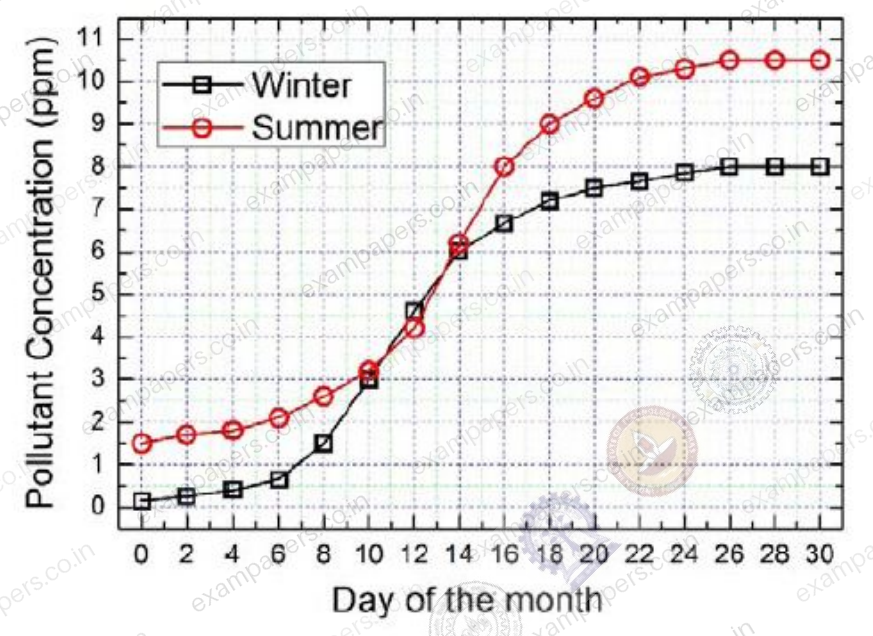
In the graph below, the concentration of a particular pollutant in a lake is plotted over (alternate) days of a month in winter (average temperature 10 °C) and a month in summer (average temperature 30 °C).
Consider the following statements based on the data shown above:
i. Over the given months, the difference between the maximum and the minimum pollutant concentrations is the same in both winter and summer.
ii. There are at least four days in the summer month such that the pollutant concentrations on those days are within 1 ppm of the pollutant concentrations on the corresponding days in the winter month.
Which one of the following options is correct?
Your answerChoose one option.
Log in to check the answer
You can attempt this question now. Sign in to view the answer key, explanations and discussion.Log in to check answer