
Mechanical Engineering
GATE ME Thermodynamics PYQs
Build your understanding with focused practice from past exam papers.
Questions 11–20 of 58. Imported answers require independent review unless marked reviewed.
Question 22
Open questionMEMCQ1 markNeeds review
A heat engine extracts heat (
) from a thermal reservoir at a temperature of 100 K and rejects heat (
) to a thermal reservoir at a temperature of 100 K, while producing work (
). Which one of the combinations of [
and
] given is allowed?Your answerChoose one option.
Log in to check the answer
You can attempt this question now. Sign in to view the answer key, explanations and discussion.Log in to check answerQuestion 41
Open questionMEMCQ2 marksNeeds review
Which one of the following statements is FALSE?
Your answerChoose one option.
Log in to check the answer
You can attempt this question now. Sign in to view the answer key, explanations and discussion.Log in to check answerQuestion 42
Open questionMEMCQ2 marksNeeds review
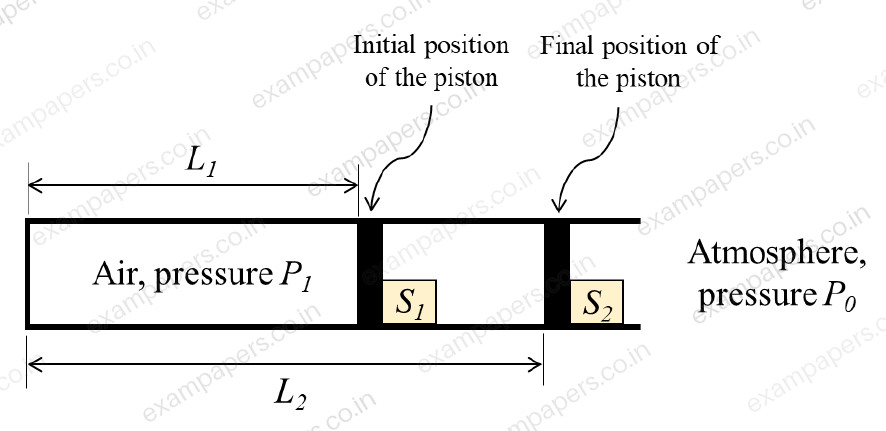
Consider a fully adiabatic piston-cylinder arrangement as shown in the figure. The piston is massless and cross-sectional area of the cylinder is A. The fluid inside the cylinder is air (considered as a perfect gas), with
being the ratio of the specific heat at constant pressure to the specific heat at constant volume for air. The piston is initially located at a position
. The initial pressure of the air inside the cylinder is
, where
is the atmospheric pressure. The stop
is instantaneously removed and the piston moves to the position
, where the equilibrium pressure of air inside the cylinder is
.What is the work done by the piston on the atmosphere during this process?
Your answerChoose one option.
Log in to check the answer
You can attempt this question now. Sign in to view the answer key, explanations and discussion.Log in to check answerQuestion 61
Open questionMENAT2 marksNeeds review
Consider a mixture of two ideal gases, X and Y, with molar masses
and
, respectively, in a container. The total pressure in the container is 100 kPa, the total volume of the container is 10 m
and the temperature of the contents of the container is 300 K. If the mass of gas-X in the container is 2 kg, then the mass of gas-Y in the container is ____ kg. (Rounded off to one decimal place)Assume that the universal gas constant is 8314 J kmol
K
.Log in to check the answer
You can attempt this question now. Sign in to view the answer key, explanations and discussion.Log in to check answerQuestion 23
Open questionMEMCQ1 markNeeds review
The Clausius inequality holds good for
Your answerChoose one option.
Log in to check the answer
You can attempt this question now. Sign in to view the answer key, explanations and discussion.Log in to check answerQuestion 23
Open questionMEMCQ1 markNeeds review
Which one of the following is an intensive property of a thermodynamic system?
Your answerChoose one option.
Log in to check the answer
You can attempt this question now. Sign in to view the answer key, explanations and discussion.Log in to check answerQuestion 34
Open questionMENAT1 markNeeds review
A polytropic process is carried out from an initial pressure of 110 kPa and volume of 5 m³ to a final volume of 2.5 m³. The polytropic index is given by
. The absolute value of the work done during the process is ______ kJ (round off to 2 decimal places).Log in to check the answer
You can attempt this question now. Sign in to view the answer key, explanations and discussion.Log in to check answerQuestion 34
Open questionMENAT1 markNeeds review
Consider 1 kg of an ideal gas at 1 bar and 300 K contained in a rigid and perfectly insulated container. The specific heat of the gas at constant volume
is equal to 750 J·kg⁻¹·K⁻¹. A stirrer performs 225 kJ of work on the gas. Assume that the container does not participate in the thermodynamic interaction. The final pressure of the gas will be ______ bar (in integer).Log in to check the answer
You can attempt this question now. Sign in to view the answer key, explanations and discussion.Log in to check answerQuestion 60
Open questionMENAT2 marksNeeds review
A rigid tank of volume of 8 m
is being filled up with air from a pipeline connected through a valve. Initially the valve is closed and the tank is assumed to be completely evacuated. The air pressure and temperature inside the pipeline are maintained at 600 kPa and 306 K, respectively. The filling of the tank begins by opening the valve and the process ends when the tank pressure is equal to the pipeline pressure. During the filling process, heat loss to the surrounding is 1000 kJ. The specific heats of air at constant pressure and at constant volume are 1.005 kJ/kg.K and 0.718 kJ/kg.K, respectively. Neglect changes in kinetic energy and potential energy.The final temperature of the tank after the completion of the filling process is __________ K (round off to the nearest integer).
Log in to check the answer
You can attempt this question now. Sign in to view the answer key, explanations and discussion.Log in to check answerQuestion 61
Open questionMENAT2 marksNeeds review
At steady state, 500 kg/s of steam enters a turbine with specific enthalpy equal to 3500 kJ/kg and specific entropy equal to 6.5 kJ·kg⁻¹·K⁻¹. It expands reversibly in the turbine to the condenser pressure. Heat loss occurs reversibly in the turbine at a temperature of 500 K. If the exit specific enthalpy and specific entropy are 2500 kJ/kg and 6.3 kJ·kg⁻¹·K⁻¹, respectively, the work output from the turbine is ________ MW (in integer).
Log in to check the answer
You can attempt this question now. Sign in to view the answer key, explanations and discussion.Log in to check answer