
Mechanical Engineering
GATE ME topic:thermodynamics PYQs
Build your understanding with focused practice from past exam papers.
How to practice topic:thermodynamics
Attempt a question, record the concept and assumptions, then check the available answer. Rework mistakes after revising the relevant concepts. Topic tags can overlap; review the question context.
Questions 1–10 of 58. Imported answers require independent review unless marked reviewed.
Question 23
Open questionMEMCQ1 markNeeds review
For an ideal gas, starting from state point 1, two different process take place. The corresponding final states in these two processes are 2 and 3, lying on same isotherm. If
and
represent pressure and enthalpy, respectively, then which one of the following options is correct?Your answerChoose one option.
Log in to check the answer
You can attempt this question now. Sign in to view the answer key, explanations and discussion.Log in to check answerQuestion 28
Open questionMEMCQ1 markNeeds review
For the isothermal expansion of an ideal gas in a piston cylinder system, the net heat supplied during the process is equal to the net work. Which one of the following statements is correct for the given process?
Your answerChoose one option.
Log in to check the answer
You can attempt this question now. Sign in to view the answer key, explanations and discussion.Log in to check answerQuestion 56
Open questionMENAT2 marksNeeds review
A liquid comes out of the reactor of a chemical plant at 250 °C temperature with a flow rate of 100 LPM. The ambient temperature is 25 °C. Density and specific heat of the liquid remain constant at 1000 kg/m³ and 4.18 kJ/kg K, respectively, for the given range of temperature. The rate of energy associated with the hot liquid stream at the exit of the plant is ______ kW (rounded off to 2 decimal places).
Log in to check the answer
You can attempt this question now. Sign in to view the answer key, explanations and discussion.Log in to check answerQuestion 57
Open questionMENAT2 marksNeeds review
A rigid closed vertical cylindrical vessel of 15 cm diameter contains 5 kg water at 80 °C with 10% quality. The water is heated till its temperature reaches 130 °C. Considering only a horizontal separated interface between liquid and vapor, the dip in the liquid level after the heating process is ______ cm (rounded off to 2 decimal places).
Properties of water at various saturation temperatures are given in the table below.
Temperature | Specific volume | | Specific internal energy | |
|---|---|---|---|---|
(°C) | (m³/kg) | (m³/kg) | (kJ/kg) | (kJ/kg) |
80 | 0.001029 | 3.4053 | 334.97 | 2481.60 |
130 | 0.001070 | 0.6680 | 546.10 | 2539.50 |
,
, and
are temperature, specific volume, and specific internal energy, respectively. Subscripts
and
represent saturated liquid and saturated vapor, respectively.Log in to check the answer
You can attempt this question now. Sign in to view the answer key, explanations and discussion.Log in to check answerQuestion 18
Open questionMEMCQ1 markNeeds review
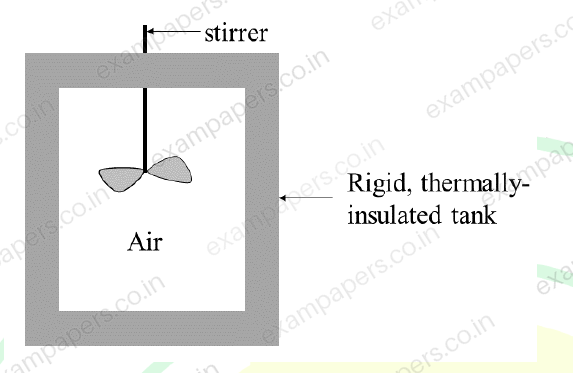
Air inside a rigid, thermally-insulated tank undergoes stirring as shown in the figure below. Which one of the following options is correct?
Your answerChoose one option.
Log in to check the answer
You can attempt this question now. Sign in to view the answer key, explanations and discussion.Log in to check answerQuestion 54
Open questionMENAT2 marksNeeds review
A thermodynamically closed system contains 1 kg of hydrogen. The system undergoes a reversible polytropic process with polytropic index 1.3. The work output during the process is 400 kJ. During the process, hydrogen behaves as an ideal gas with constant specific heats. The absolute value of heat transfer during the process is __________ kJ (rounded off to 1 decimal place).
Specific heat of hydrogen at constant pressure = 14.56 kJ kg
K
Specific heat of hydrogen at constant volume = 10.4 kJ kg
K
Log in to check the answer
You can attempt this question now. Sign in to view the answer key, explanations and discussion.Log in to check answerQuestion 20
Open questionMEMCQ1 markNeeds review
A furnace can supply heat steadily at 1200 K at a rate of 2400 kJ/min. The maximum amount of power (in kW) that can be produced by using the heat supplied by this furnace in an environment at 300 K is
Your answerChoose one option.
Log in to check the answer
You can attempt this question now. Sign in to view the answer key, explanations and discussion.Log in to check answerQuestion 45
Open questionMENAT2 marksNeeds review
Consider an air-standard Brayton cycle with adiabatic compressor and turbine, and a regenerator, as shown in the figure. Air enters the compressor at 100 kPa and 300 K and exits the compressor at 600 kPa and 550 K. The air exits the combustion chamber at 1250 K and exits the adiabatic turbine at 100 kPa and 800 K. The exhaust air from the turbine is used to preheat the air in the regenerator. The exhaust air exits the regenerator (state 6) at 600 K. There is no pressure drop across the regenerator and the combustion chamber. Also, there is no heat loss from the regenerator to the surroundings. The ratio of specific heats at constant pressure and volume is
. The thermal efficiency of the cycle is ________ % (answer in integer). 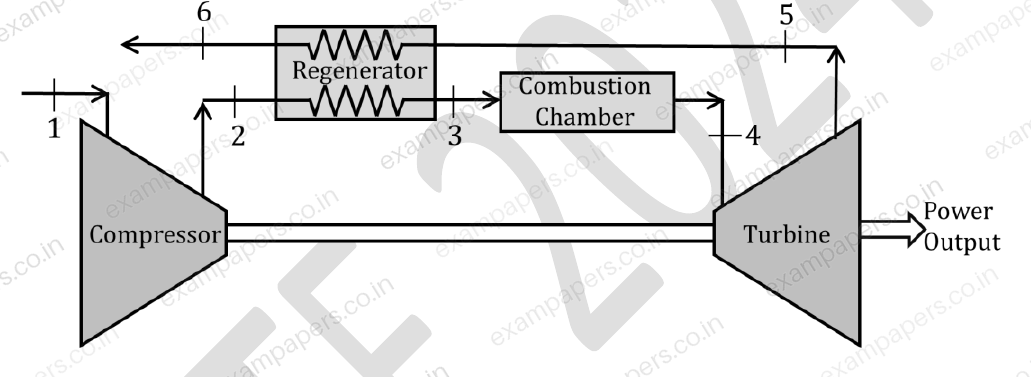
Log in to check the answer
You can attempt this question now. Sign in to view the answer key, explanations and discussion.Log in to check answerQuestion 46
Open questionMENAT2 marksNeeds review
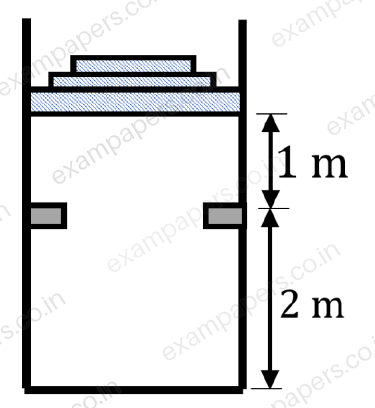
A piston-cylinder arrangement shown in the figure has a stop located 2 m above the base. The cylinder initially contains air at 140 kPa and 350 °C and the piston is at rest in equilibrium at a position which is 1 m above the stops. The system is now cooled to the ambient temperature of 25 °C. Consider air to be an ideal gas with a value of gas constant
kJ/(kg.K).The absolute value of specific work done during the process is ______ kJ/kg (rounded off to 1 decimal place).
Log in to check the answer
You can attempt this question now. Sign in to view the answer key, explanations and discussion.Log in to check answerQuestion 47
Open questionMENAT2 marksNeeds review
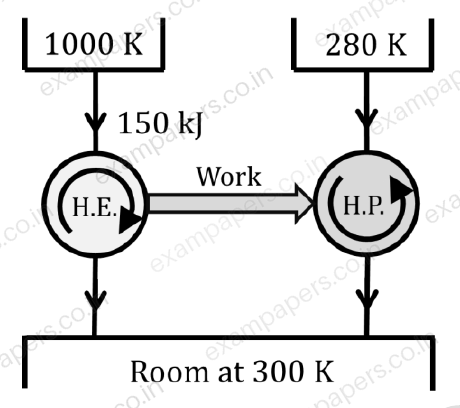
A heat pump (H.P.) is driven by the work output of a heat engine (H.E.) as shown in the figure. The heat engine extracts 150 kJ of heat from the source at 1000 K. The heat pump absorbs heat from the ambient at 280 K and delivers heat to the room which is maintained at 300 K. Considering the combined system to be ideal, the total amount of heat delivered to the room together by the heat engine and heat pump is ______kJ (answer in integer).
Log in to check the answer
You can attempt this question now. Sign in to view the answer key, explanations and discussion.Log in to check answer