
Mechanical Engineering
GATE ME topic:thermodynamics PYQs
Build your understanding with focused practice from past exam papers.
Questions 41–50 of 58. Imported answers require independent review unless marked reviewed.
Question 33
Open questionMEMCQ2 marksNeeds review
A gas is heated in a duct as it flows over a resistance heater. Consider a 101 kW electric heating system. The gas enters the heating section of the duct at 100 kPa and 27 °C with a volume flow rate of 15 m³/s. If heat is lost from the gas in the duct to the surroundings at a rate of 51 kW, the exit temperature of the gas is
(Assume constant pressure, ideal gas, negligible change in kinetic and potential energies and constant specific heat,
kJ/kg·K;
kJ/kg·K.)Your answerChoose one option.
Log in to check the answer
You can attempt this question now. Sign in to view the answer key, explanations and discussion.Log in to check answerQuestion 33
Open questionMEMCQ2 marksNeeds review
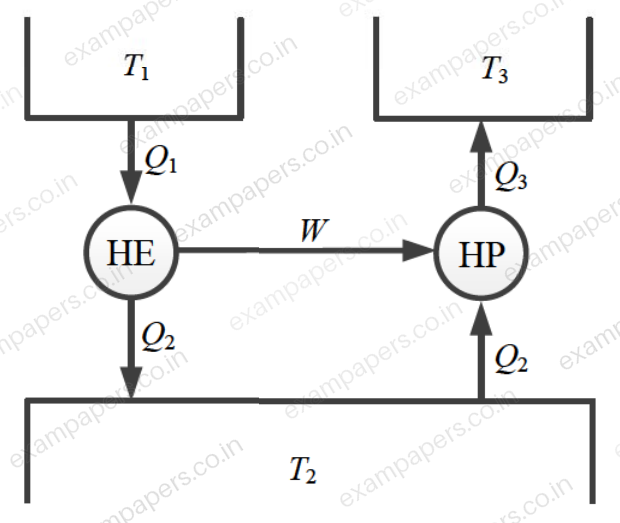
The figure shows a heat engine (HE) working between two reservoirs. The amount of heat (
) rejected by the heat engine is drawn by a heat pump (HP). The heat pump receives the entire work output (
) of the heat engine. If temperatures,
, then the relation between the efficiency (
) of the heat engine and the coefficient of performance (COP) of the heat pump is
Your answerChoose one option.
Log in to check the answer
You can attempt this question now. Sign in to view the answer key, explanations and discussion.Log in to check answerQuestion 47
Open questionMENAT2 marksNeeds review
Water flowing at the rate of 1 kg/s through a system is heated using an electric heater such that the specific enthalpy of the water increases by 2.50 kJ/kg and the specific entropy increases by 0.007 kJ/kg K. The power input to the electric heater is 2.50 kW. There is no other work or heat interaction between the system and the surroundings. Assuming an ambient temperature of 300 K, the irreversibility rate of the system is ________ kW (round off to two decimal places).
Log in to check the answer
You can attempt this question now. Sign in to view the answer key, explanations and discussion.Log in to check answerQuestion 48
Open questionMENAT2 marksNeeds review
If one mole of H
gas occupies a rigid container with a capacity of 1000 litres and the temperature is raised from 27 °C to 37 °C, the change in pressure of the contained gas (round off to two decimal places), assuming ideal gas behaviour, is ______ Pa. (
=8.314 J/mol·K)Log in to check the answer
You can attempt this question now. Sign in to view the answer key, explanations and discussion.Log in to check answerQuestion 49
Open questionMENAT2 marksNeeds review
An air standard Otto cycle has thermal efficiency of 0.5 and the mean effective pressure of the cycle is 1000 kPa. For air, assume specific heat ratio
and specific gas constant R = 0.287 kJ/kg·K. If the pressure and temperature at the beginning of the compression stroke are 100 kPa and 300 K, respectively, then the specific net work output of the cycle is _____ kJ/kg (round off to two decimal places).Log in to check the answer
You can attempt this question now. Sign in to view the answer key, explanations and discussion.Log in to check answerQuestion 10
Open questionMEMCQ1 markNeeds review
Which one of the following statements is correct for a superheated vapour?
Your answerChoose one option.
Log in to check the answer
You can attempt this question now. Sign in to view the answer key, explanations and discussion.Log in to check answerQuestion 10
Open questionMEMCQ1 markNeeds review
For an ideal gas with constant properties undergoing a quasi-static process, which one of the following represents the change of entropy (
) from state 1 to 2?Your answerChoose one option.
Log in to check the answer
You can attempt this question now. Sign in to view the answer key, explanations and discussion.Log in to check answerQuestion 23
Open questionMENAT1 markNeeds review
An ideal gas undergoes a process from state 1 (T₁ = 300 K, p₁ = 100 kPa) to state 2 (T₂ = 600 K, p₂ = 500 kPa). The specific heats of the ideal gas are: cₚ = 1 kJ/kg-K and cᵥ = 0.7 kJ/kg-K. The change in specific entropy of the ideal gas from state 1 to state 2 (in kJ/kg-K) is __________(correct to two decimal places).
Log in to check the answer
You can attempt this question now. Sign in to view the answer key, explanations and discussion.Log in to check answerQuestion 23
Open questionMENAT1 markNeeds review
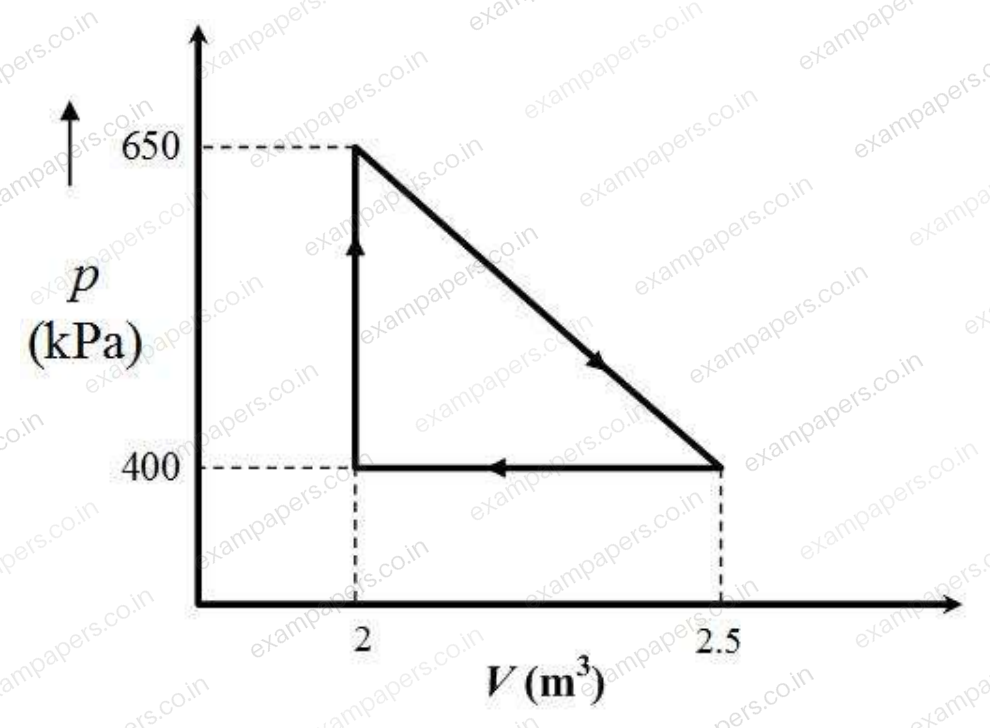
An engine operates on the reversible cycle as shown in the figure. The work output from the engine (in kJ/cycle) is ______ (correct to two decimal places).
Log in to check the answer
You can attempt this question now. Sign in to view the answer key, explanations and discussion.Log in to check answerQuestion 42
Open questionMENAT2 marksNeeds review
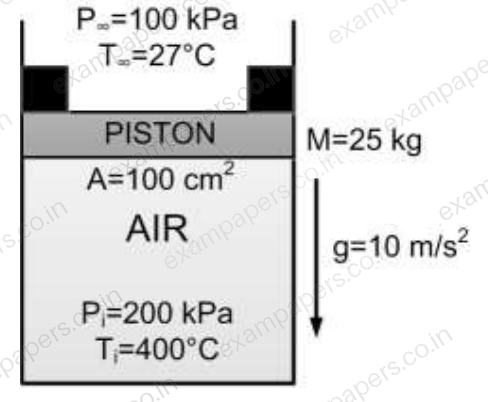
Air is held inside a non-insulated cylinder using a piston (mass
kg and area
cm
) and stoppers (of negligible area), as shown in the figure. The initial pressure
and temperature
of air inside the cylinder are 200 kPa and 400°C, respectively. The ambient pressure
and temperature
are 100 kPa and 27°C, respectively. The temperature of the air inside the cylinder (°C) at which the piston will begin to move is ________ (correct to two decimal places).
Log in to check the answer
You can attempt this question now. Sign in to view the answer key, explanations and discussion.Log in to check answer