
Mechanical Engineering
GATE ME topic:vibrations PYQs
Build your understanding with focused practice from past exam papers.
How to practice topic:vibrations
Attempt a question, record the concept and assumptions, then check the available answer. Rework mistakes after revising the relevant concepts. Topic tags can overlap; review the question context.
Questions 1–10 of 27. Imported answers require independent review unless marked reviewed.
Question 18
Open questionMEMCQ1 markNeeds review
In a single degree of freedom vibrating system with only viscous damping, the critical damping coefficient is 350 N s/m and the damping coefficient is 35 N s/m.
The logarithmic decrement of the vibrating system is
Your answerChoose one option.
Log in to check the answer
You can attempt this question now. Sign in to view the answer key, explanations and discussion.Log in to check answerQuestion 42
Open questionMEMCQ2 marksNeeds review
A 5 kg mass is suspended at the free end of an overhanging massless beam, having a pin support and a roller support, as shown in the figure below. Young’s modulus of the material of the beam is 200 GPa and moment of inertia of the beam is
m
. The natural frequency of the beam in rad/s is 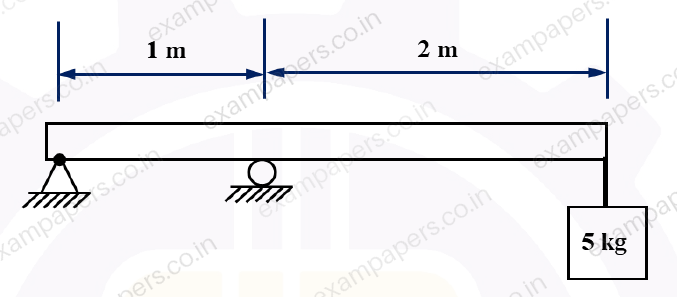
Your answerChoose one option.
Log in to check the answer
You can attempt this question now. Sign in to view the answer key, explanations and discussion.Log in to check answerQuestion 35
Open questionMENAT1 markNeeds review
A block of mass 1 kg connected to a spring of stiffness 10 N m
is operating in a viscous medium such that the damping ratio (or damping factor) is equal to the ratio of the damped frequency to the natural frequency. The magnitude of the damping ratio for this system is ________ (rounded off to 2 decimal places).Log in to check the answer
You can attempt this question now. Sign in to view the answer key, explanations and discussion.Log in to check answerQuestion 42
Open questionMEMCQ2 marksNeeds review
The system shown in the figure below consists of a cantilever beam (with flexural rigidity
and negligible mass), a spring (with spring constant
and negligible mass) and a block of mass
. Assuming a lumped parameter model for the system, the fundamental natural frequency (
) of the system is 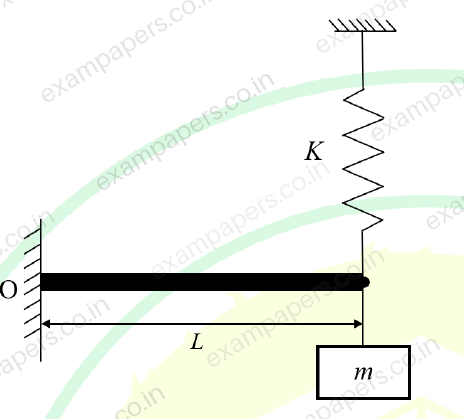
Your answerChoose one option.
Log in to check the answer
You can attempt this question now. Sign in to view the answer key, explanations and discussion.Log in to check answerQuestion 25
Open questionMEMCQ1 markNeeds review
A linear spring-mass-dashpot system with a mass of 2 kg is set in motion with viscous damping. If the natural frequency is 15 Hz, and the amplitudes of two successive cycles measured are 7.75 mm and 7.20 mm, the coefficient of viscous damping (in N.s/m) is
Your answerChoose one option.
Log in to check the answer
You can attempt this question now. Sign in to view the answer key, explanations and discussion.Log in to check answerQuestion 55
Open questionMENAT2 marksNeeds review
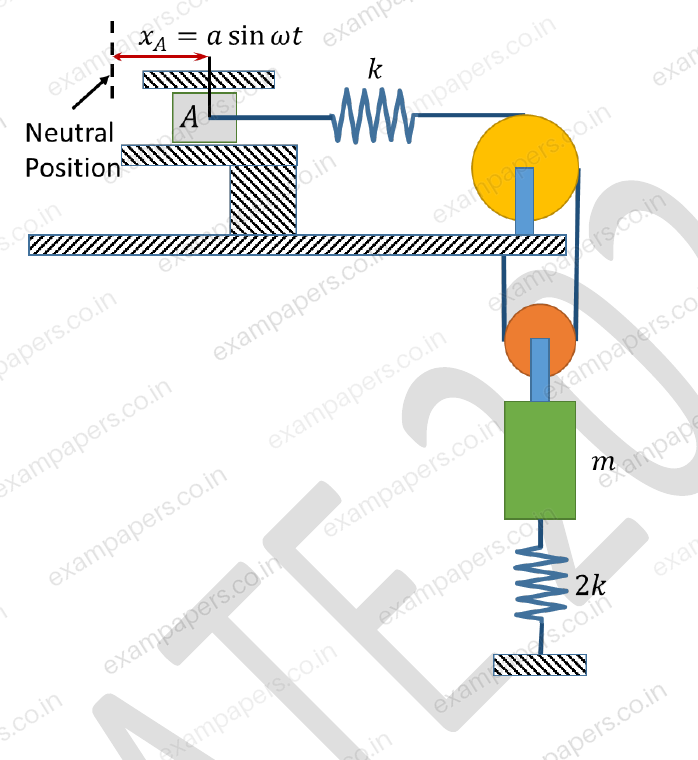
A vibratory system consists of mass
, a vertical spring of stiffness
and a horizontal spring of stiffness
. The end A of the horizontal spring is given a horizontal motion
. The other end of the spring is connected to an inextensible rope that passes over two massless pulleys as shown. Assume
kg,
kN/m, and neglect friction. The magnitude of critical driving frequency for which the oscillations of mass
tend to become excessively large is ________ rad/s (answer in integer).
Log in to check the answer
You can attempt this question now. Sign in to view the answer key, explanations and discussion.Log in to check answerQuestion 30
Open questionMENAT1 markNeeds review
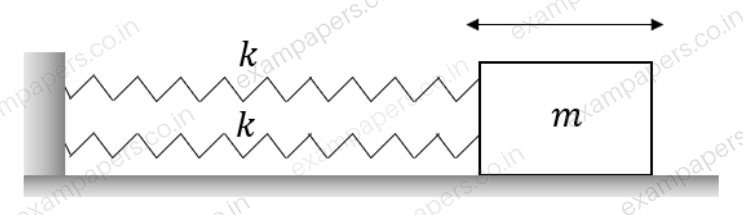
The figure shows a block of mass m = 20 kg attached to a pair of identical linear springs, each having a spring constant k = 1000 N/m. The block oscillates on a frictionless horizontal surface. Assuming free vibrations, the time taken by the block to complete ten oscillations is ________ seconds. (Rounded off to two decimal places)
Take π = 3.14.
Log in to check the answer
You can attempt this question now. Sign in to view the answer key, explanations and discussion.Log in to check answerQuestion 31
Open questionMENAT1 markNeeds review
For a dynamical system governed by the equation,
the damping ratio
is equal to
. The displacement
of this system is measured during a hammer test. A displacement peak in the positive displacement direction is measured to be 4 mm. Neglecting higher powers (>1) of the damping ratio, the displacement at the next peak in the positive direction will be ______ mm (in integer).Log in to check the answer
You can attempt this question now. Sign in to view the answer key, explanations and discussion.Log in to check answerQuestion 39
Open questionMEMCQ2 marksNeeds review
Consider a forced single degree-of-freedom system governed by
, where
and
are the damping ratio and undamped natural frequency of the system, respectively, while
is the forcing frequency. The amplitude of the forced steady state response of this system is given by
, where
. The peak amplitude of this response occurs at a frequency
. If
denotes the damped natural frequency of this system, which one of the following options is true?Your answerChoose one option.
Log in to check the answer
You can attempt this question now. Sign in to view the answer key, explanations and discussion.Log in to check answerQuestion 40
Open questionMEMCQ2 marksNeeds review
A spring mass damper system (mass
, stiffness
, and damping coefficient
) excited by a force
, where
,
and
are the amplitude, frequency and time, respectively, is shown in the figure. Four different responses of the system (marked as (i) to (iv)) are shown just to the right of the system figure. In the figures of the responses,
is the amplitude of response shown in red color and the dashed lines indicate its envelope. The responses represent only the qualitative trend and these are not drawn to any specific scale.Four different parameter and forcing conditions are mentioned below.
(P)
and
(Q)
and
(R)
and
(S)
and
Which one of the following options gives correct match (indicated by arrow →) of the parameter and forcing conditions to the responses?
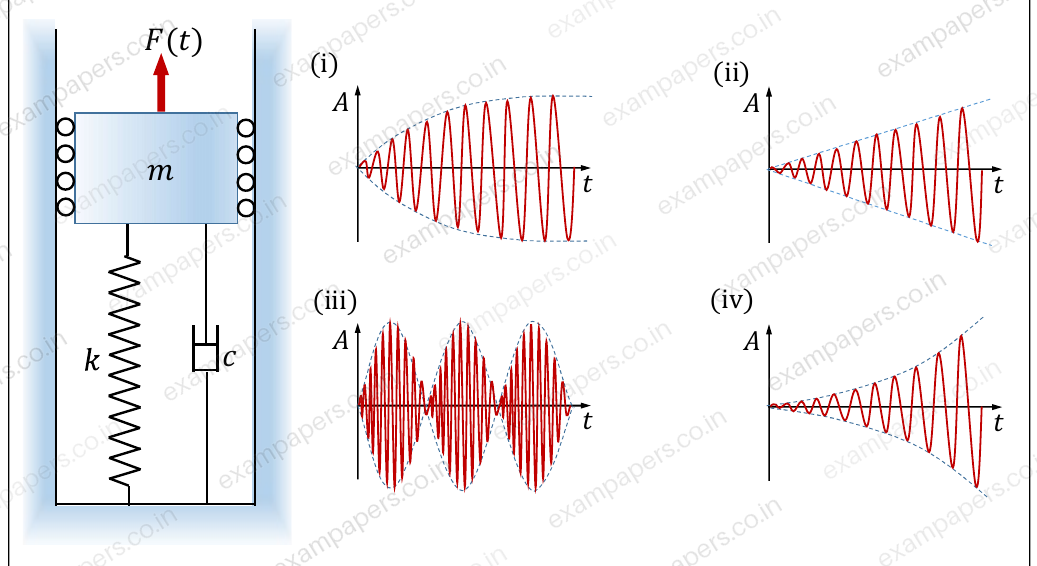
Your answerChoose one option.
Log in to check the answer
You can attempt this question now. Sign in to view the answer key, explanations and discussion.Log in to check answer