
Mechanical Engineering
GATE ME topic:vibrations PYQs
Build your understanding with focused practice from past exam papers.
Questions 11–20 of 27. Imported answers require independent review unless marked reviewed.
Question 25
Open questionMENAT1 markNeeds review
Consider a single degree of freedom system comprising a mass
, supported on a spring and a dashpot as shown in the figure. 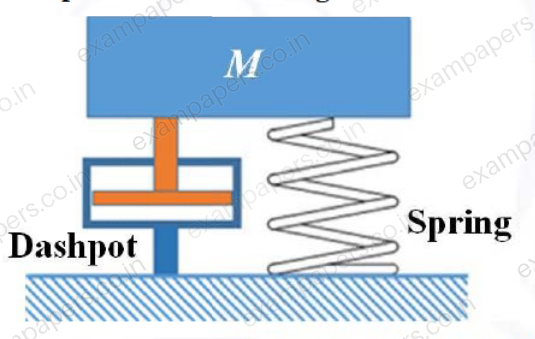
If the amplitude of the free vibration response reduces from 8 mm to 1.5 mm in 3 cycles, the damping ratio of the system is ______ (round off to three decimal places).
Log in to check the answer
You can attempt this question now. Sign in to view the answer key, explanations and discussion.Log in to check answerQuestion 32
Open questionMEMCQ2 marksNeeds review
A tapet valve mechanism in an IC engine comprises a rocker arm ABC that is hinged at B as shown in the figure. The rocker is assumed rigid and it oscillates about the hinge B. The mass moment of inertia of the rocker about B is
kg.m
. The rocker arm dimensions are
cm and
cm. A pushrod pushes the rocker at location A, when moved vertically by a cam that rotates at
rpm. The pushrod is assumed massless and has a stiffness of 15 N/mm. At the other end C, the rocker pushes a valve against a spring of stiffness 10 N/mm. The valve is assumed massless and rigid. 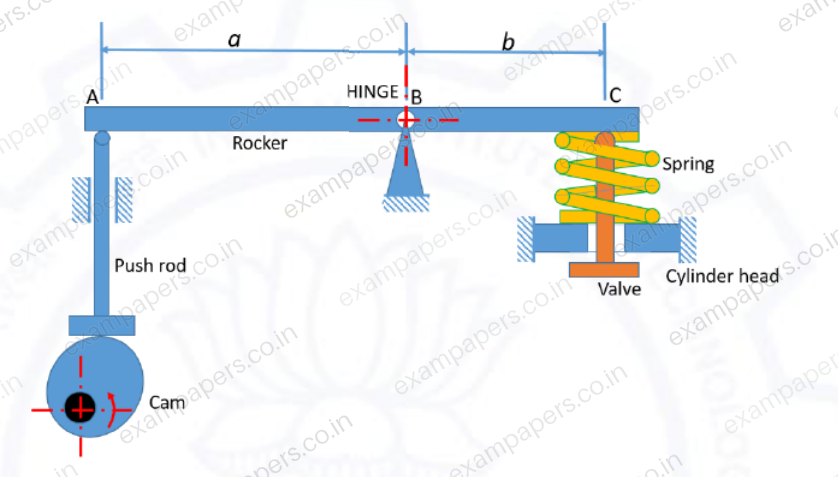
Resonance in the rocker system occurs when the cam shaft runs at a speed of ______ rpm (round off to the nearest integer).
Your answerChoose one option.
Log in to check the answer
You can attempt this question now. Sign in to view the answer key, explanations and discussion.Log in to check answerQuestion 33
Open questionMEMCQ2 marksNeeds review
A machine of mass 100 kg is subjected to an external harmonic force with a frequency of 40 rad/s. The designer decides to mount the machine on an isolator to reduce the force transmitted to the foundation. The isolator can be considered as a combination of stiffness (
) and damper (damping factor,
) in parallel. The designer has the following four isolators:
kN/m,
kN/m,
kN/m,
kN/m,
Arrange the isolators in the ascending order of the force transmitted to the foundation.Your answerChoose one option.
Log in to check the answer
You can attempt this question now. Sign in to view the answer key, explanations and discussion.Log in to check answerQuestion 34
Open questionMEMCQ2 marksNeeds review
Consider the system shown in the figure. A rope goes over a pulley. A mass,
, is hanging from the rope. A spring of stiffness,
, is attached at one end of the rope. Assume rope is inextensible, massless and there is no slip between pulley and rope. 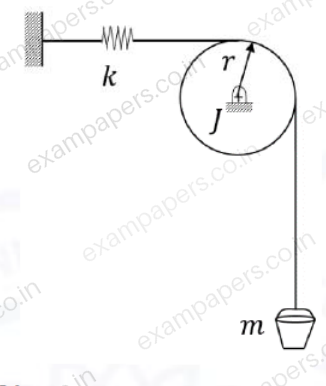
The pulley radius is
and its mass moment of inertia is
. Assume that the mass is vibrating harmonically about its static equilibrium position. The natural frequency of the system isYour answerChoose one option.
Log in to check the answer
You can attempt this question now. Sign in to view the answer key, explanations and discussion.Log in to check answerQuestion 6
Open questionMEMCQ1 markNeeds review
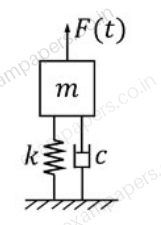
A single-degree-of-freedom oscillator is subjected to harmonic excitation
as shown in the figure.
The non-zero value of
, for which the amplitude of the force transmitted to the ground will be
, isYour answerChoose one option.
Log in to check the answer
You can attempt this question now. Sign in to view the answer key, explanations and discussion.Log in to check answerQuestion 7
Open questionMEMCQ1 markNeeds review
The equation of motion of a spring-mass-damper system is given by
The damping factor for the system isYour answerChoose one option.
Log in to check the answer
You can attempt this question now. Sign in to view the answer key, explanations and discussion.Log in to check answerQuestion 31
Open questionMEMCQ2 marksNeeds review
A rigid mass-less rod of length
is connected to a disc (pulley) of mass
and radius
through a friction-less revolute joint. The other end of that rod is attached to a wall through a friction-less hinge. A spring of stiffness
is attached to the rod at its mid-span. An inextensible rope passes over half the disc periphery and is securely tied to a spring of stiffness
at point C as shown in the figure. There is no slip between the rope and the pulley. The system is in static equilibrium in the configuration shown in the figure and the rope is always taut.
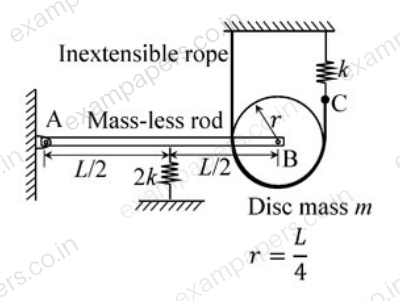
Neglecting the influence of gravity, the natural frequency of the system for small amplitude vibration is
Your answerChoose one option.
Log in to check the answer
You can attempt this question now. Sign in to view the answer key, explanations and discussion.Log in to check answerQuestion 6
Open questionMEMCQ1 markNeeds review
The natural frequencies corresponding to the spring-mass systems I and II are
and
, respectively. The ratio
is 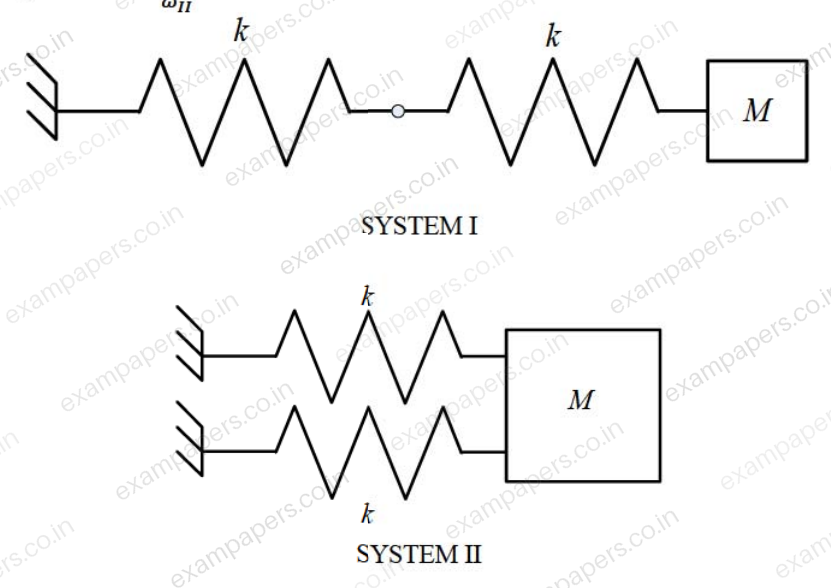
Your answerChoose one option.
Log in to check the answer
You can attempt this question now. Sign in to view the answer key, explanations and discussion.Log in to check answerQuestion 32
Open questionMEMCQ2 marksNeeds review
A slender uniform rigid bar of mass
is hinged at O and supported by two springs, with stiffnesses
and
, and a damper with damping coefficient
, as shown in the figure. For the system to be critically damped, the ratio
should be 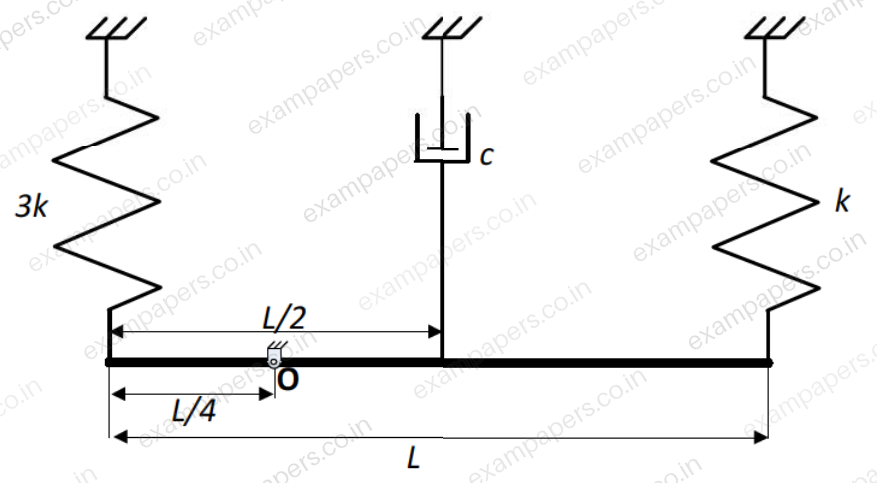
Your answerChoose one option.
Log in to check the answer
You can attempt this question now. Sign in to view the answer key, explanations and discussion.Log in to check answerQuestion 43
Open questionMENAT2 marksNeeds review
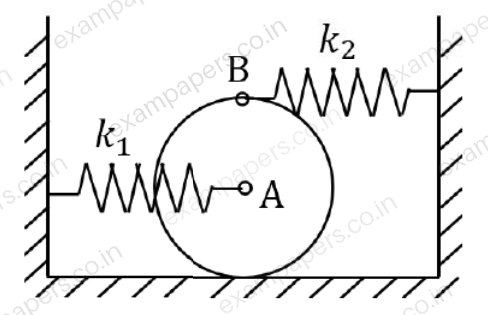
A uniform thin disk of mass 1 kg and radius 0.1 m is kept on a surface as shown in the figure. A spring of stiffness
N/m is connected to the disk center A and another spring of stiffness
N/m is connected at point B just above point A on the circumference of the disk. Initially, both the springs are unstretched. Assume pure rolling of the disk. For small disturbance from the equilibrium, the natural frequency of vibration of the system is ______ rad/s (round off to one decimal place).
Log in to check the answer
You can attempt this question now. Sign in to view the answer key, explanations and discussion.Log in to check answer