
Metallurgical Engineering
GATE MT Basic forms of corrosion and its prevention PYQs
Build your understanding with focused practice from past exam papers.
How to practice Basic forms of corrosion and its prevention
Attempt a question, record the concept and assumptions, then check the available answer. Rework mistakes after revising the relevant concepts. Topic tags can overlap; review the question context.
Questions 1–8 of 8. Imported answers require independent review unless marked reviewed.
Question 31
Open questionMTMSQ1 markNeeds review
Which of the following elements, when present in iron, enhance(s) its corrosion resistance?
Your answerSelect all correct options. You can choose more than one.
Log in to check the answer
You can attempt this question now. Sign in to view the answer key, explanations and discussion.Log in to check answerQuestion 42
Open questionMTMCQ2 marksNeeds review
The microstructures of a quenched steel tempered at three temperatures
for a fixed time are schematically illustrated. The solid circles represent cementite particles in ferrite matrix;
,
and
are average radii of cementite particles, and
,
and
are volume fractions of cementite at temperatures
,
and
, respectively. If the cementite in steel is more noble than ferrite, then which one of the three microstructures will have the highest corrosion rate when exposed to an aqueous solution of 3.5 wt. % NaCl? 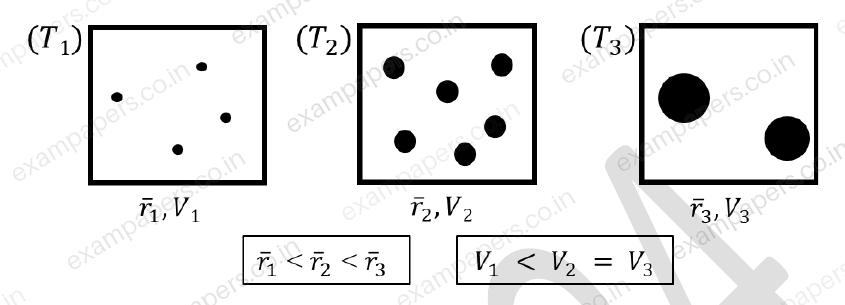
Your answerChoose one option.
Log in to check the answer
You can attempt this question now. Sign in to view the answer key, explanations and discussion.Log in to check answerQuestion 52
Open questionMTNAT2 marksNeeds review
At 25 °C, iron corrodes in a deaerated acid of pH 3 with a corrosion current density of 4 μA cm⁻². The corrosion potential (V) is: ________ (round off to 2 decimal places).
Given:
βc = 0.1 V per decade of current density
Exchange current density of hydrogen on iron surface = 10⁻⁹ A cm⁻²
R = 8.314 J mol⁻¹ K⁻¹, F = 9600 C mol⁻¹
All potentials are with reference to standard hydrogen electrode.
Log in to check the answer
You can attempt this question now. Sign in to view the answer key, explanations and discussion.Log in to check answerQuestion 6
Open questionMTMCQ1 markNeeds review
Which one of the following statements regarding selective leaching of a binary alloy is TRUE?
Your answerChoose one option.
Log in to check the answer
You can attempt this question now. Sign in to view the answer key, explanations and discussion.Log in to check answerQuestion 23
Open questionMTNAT1 markNeeds review
An iron plate with a total exposed surface area of 50 cm
undergoes atmospheric corrosion. If 200 g of weight is lost over a period of 10 years, then the corrosion rate is _____ kg·m
·year
(round off to the nearest integer).Log in to check the answer
You can attempt this question now. Sign in to view the answer key, explanations and discussion.Log in to check answerQuestion 43
Open questionMTNAT2 marksNeeds review
Iron is corroding in fresh water which has dissolved oxygen concentration of 15 mM. The anodic current density at an overpotential of 120 mV is ______ A·cm
(round off to three decimal places).Given:
Anodic Tafel slope is 0.06 V.
Diffusion coefficient of oxygen is
cm
·s
.Diffusion layer thickness is 0.06 cm.
Log in to check the answer
You can attempt this question now. Sign in to view the answer key, explanations and discussion.Log in to check answerQuestion 15
Open questionMTMCQ1 markNeeds review
The carbide that is primarily responsible for intergranular corrosion in austenitic stainless steel is ____________.
Your answerChoose one option.
Log in to check the answer
You can attempt this question now. Sign in to view the answer key, explanations and discussion.Log in to check answerQuestion 9
Open questionMTMCQ1 markNeeds review
Which of the following materials are protected by passivation (i.e., formation of a thin adherent film on the surface) from corrosion?
P. Aluminium alloys
Q. Mild steel
R. Stainless steel
S. Silver
Your answerChoose one option.
Log in to check the answer
You can attempt this question now. Sign in to view the answer key, explanations and discussion.Log in to check answer