
Metallurgical Engineering
GATE MT Comminution techniques, Size classification, Flotation, Gravity and other methods of mineral beneficiation; Agglomeration: sintering, pelleting and briquetting. PYQs
Build your understanding with focused practice from past exam papers.
How to practice Comminution techniques, Size classification, Flotation, Gravity and other methods of mineral beneficiation; Agglomeration: sintering, pelleting and briquetting.
Attempt a question, record the concept and assumptions, then check the available answer. Rework mistakes after revising the relevant concepts. Topic tags can overlap; review the question context.
Questions 1–10 of 12. Imported answers require independent review unless marked reviewed.
Question 17
Open questionMTMCQ1 markNeeds review
Wet high intensity magnetic separators (WHIMS) are used to concentrate
Your answerChoose one option.
Log in to check the answer
You can attempt this question now. Sign in to view the answer key, explanations and discussion.Log in to check answerQuestion 18
Open questionMTMCQ1 markNeeds review
Which one of the following reagents is NOT used in froth flotation process?
Your answerChoose one option.
Log in to check the answer
You can attempt this question now. Sign in to view the answer key, explanations and discussion.Log in to check answerQuestion 17
Open questionMTMCQ1 markNeeds review
The most effective concentration step for sulfide ores is
Your answerChoose one option.
Log in to check the answer
You can attempt this question now. Sign in to view the answer key, explanations and discussion.Log in to check answerQuestion 39
Open questionMTMCQ2 marksNeeds review
Elutriator is used to separate particles based on their sizes in flowing air as shown in the figure.
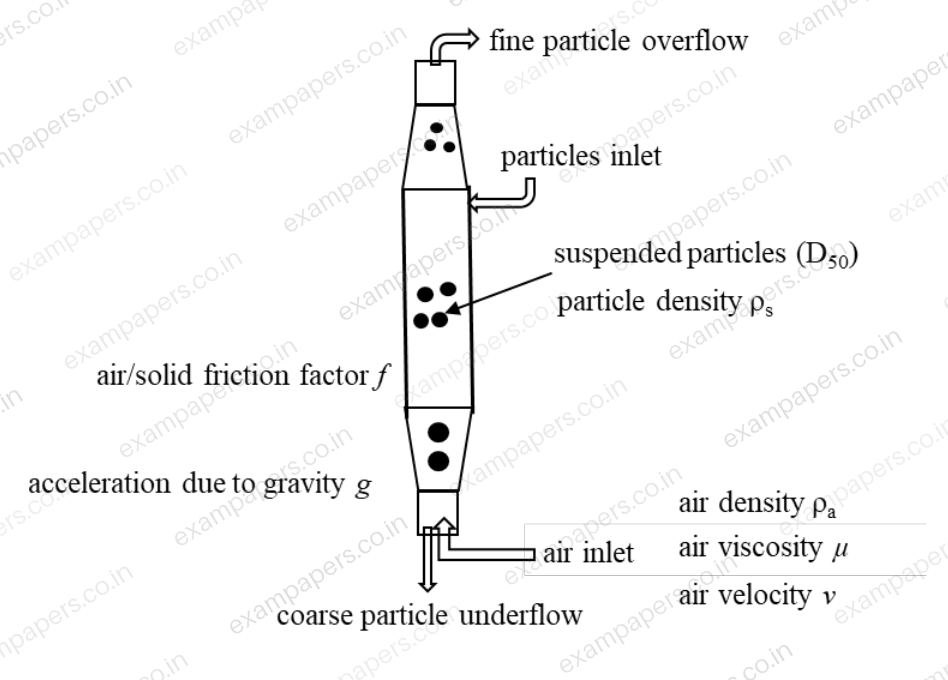
Assuming spherical particles, the diameter (D
) of the suspended particles which have 50% chance to report to overflow by turbulent air flow is expressed asYour answerChoose one option.
Log in to check the answer
You can attempt this question now. Sign in to view the answer key, explanations and discussion.Log in to check answerQuestion 59
Open questionMTNAT2 marksNeeds review
Copper ore assaying 10 wt.% Cu is fed to a concentration plant at the rate of 100 tons/h. If the grades of concentrate and tailing are 30 wt.% Cu and 1 wt.% Cu, respectively, the percentage recovery of copper in concentrate is __________ (round off to nearest integer).
Given: 1 ton = 1000 kg
Log in to check the answer
You can attempt this question now. Sign in to view the answer key, explanations and discussion.Log in to check answerQuestion 38
Open questionMTMCQ2 marksNeeds review
Match the following mineral processing operations (Column I) with the corresponding physical principles (Column II)
Column I
(P) Flotation
(Q) Jigging
(R) Tabling
(S) Comminution
Column II
(1) Difference in speed of lateral movements
(2) Hydrophobicity
(3) Difference in size reduction
(4) Difference in initial acceleration
Your answerChoose one option.
Log in to check the answer
You can attempt this question now. Sign in to view the answer key, explanations and discussion.Log in to check answerQuestion 58
Open questionMTNAT2 marksNeeds review
A sieve made of steel wire of diameter 53 μm has an aperture size of 74 μm. Its mesh number is ______ (round off to the nearest integer).
Log in to check the answer
You can attempt this question now. Sign in to view the answer key, explanations and discussion.Log in to check answerQuestion 47
Open questionMTNAT2 marksNeeds review
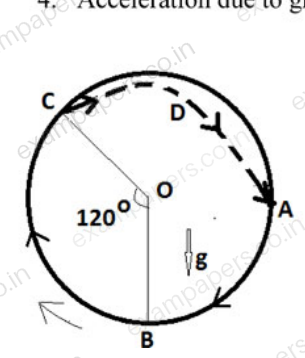
For effective communition in a ball mill, it is desired that the balls travelling along the mill wall leave the wall at point C and travel freely in air along the path CDA, as shown in the figure. If
is 120°, the rotational speed of the mill is ______ rpm (round off to one decimal place) by performing suitable force balance at point C.Assume:
There is no slip between the ball and mill wall.
O is the rotational axis of the mill and OB is parallel to the vector
.Inner diameter of ball mill is 3.26 m.
Acceleration due to gravity g is 9.8 m·s
.
Log in to check the answer
You can attempt this question now. Sign in to view the answer key, explanations and discussion.Log in to check answerQuestion 11
Open questionMTMCQ1 markNeeds review
Coarse suspended particles are to be separated from a flowing gas in a dust catcher. All factors remaining same, maximum gas-solid separation is expected from the dust catcher shown below.
Your answerChoose one option.
Log in to check the answer
You can attempt this question now. Sign in to view the answer key, explanations and discussion.Log in to check answerQuestion 53
Open questionMTNAT2 marksNeeds review
If the solid-solid interfacial energy (
) is 0.87
and solid-liquid interfacial energy (
) is 0.5
, the dihedral angle (
, in degree, rounded off to one decimal place) during sintering is ________.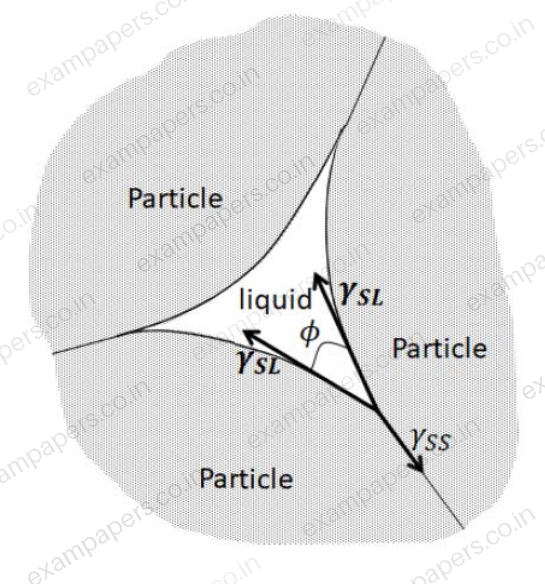
Log in to check the answer
You can attempt this question now. Sign in to view the answer key, explanations and discussion.Log in to check answer