
Metallurgical Engineering
GATE MT concept:enthalpy PYQs
Build your understanding with focused practice from past exam papers.
Questions 11–16 of 16. Imported answers require independent review unless marked reviewed.
Question 6
Open questionMTMCQ1 markNeeds review
Elements A and B have the same crystal structure. For a dilute solution of B in A, which one of the following is true?
(Given:
– Mixing enthalpy,
– Activity of B and
– Mole fraction of B)Your answerChoose one option.
Log in to check the answer
You can attempt this question now. Sign in to view the answer key, explanations and discussion.Log in to check answerQuestion 17
Open questionMTNAT1 markNeeds review
Melting point of Cu is 1358 K and its enthalpy of melting is 13400 J mol
. The value of free energy change (in J mol
) for liquid to solid transformation at 1058 K is: __________ (round off to nearest integer).Assume:
Log in to check the answer
You can attempt this question now. Sign in to view the answer key, explanations and discussion.Log in to check answerQuestion 25
Open questionMTNAT1 markNeeds review
The vacancy concentration in a crystal doubles upon increasing the temperature from 27 °C to 127 °C. The enthalpy (in kJ mol
) of vacancy formation is: ______ (round off to 2 decimal places). Given:
J mol
K
.Log in to check the answer
You can attempt this question now. Sign in to view the answer key, explanations and discussion.Log in to check answerQuestion 30
Open questionMTMCQ2 marksNeeds review
The condition for getting the binary phase diagram of A-B (shown below) is:
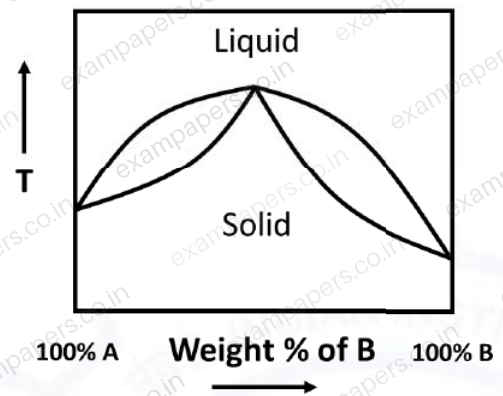
Given:
– Enthalpy of mixing of solid
– Enthalpy of mixing of liquidYour answerChoose one option.
Log in to check the answer
You can attempt this question now. Sign in to view the answer key, explanations and discussion.Log in to check answerQuestion 48
Open questionMTNAT2 marksNeeds review
If liquid copper is cooled to 1353 K, magnitude of the driving force for liquid to transform to solid is ______ J·mol
(round off to one decimal place).Given, melting temperature and enthalpy of melting of copper are 1356 K and 13 kJ·mol
respectively.Log in to check the answer
You can attempt this question now. Sign in to view the answer key, explanations and discussion.Log in to check answerQuestion 51
Open questionMTNAT2 marksNeeds review
For the reaction: 4Ag(s, pure) + O
(g) → 2Ag
O(s, pure), the standard enthalpy change,
, and the standard entropy change,
, in the temperature range from 298 K to 500 K. The temperature above which Ag
O decomposes in an atmosphere containing oxygen at a partial pressure
is ______ (in K to one decimal place). Given: Gas constant R = 8.314 J K
mol
Log in to check the answer
You can attempt this question now. Sign in to view the answer key, explanations and discussion.Log in to check answer