
Metallurgical Engineering
GATE MT Convection PYQs
Build your understanding with focused practice from past exam papers.
How to practice Convection
Attempt a question, record the concept and assumptions, then check the available answer. Rework mistakes after revising the relevant concepts. Topic tags can overlap; review the question context.
Questions 1–5 of 5. Imported answers require independent review unless marked reviewed.
Question 38
Open questionMTMCQ2 marksNeeds review
As shown in the figure, the right end of a slender, long solid cylindrical metal rod of thermal conductivity
, length
and diameter
(
) is in contact with an infinite liquid heat sink. At steady-state, the temperatures of the right end of the rod and the heat sink are
and
, respectively. If the convection heat transfer coefficient between the liquid heat sink and the right end of the rod is
, then what would be the temperature of the left end of the rod,
, at steady-state? Assume that there is no other heat loss. 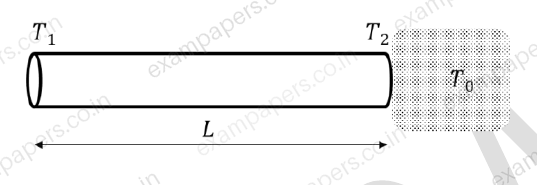
Your answerChoose one option.
Log in to check the answer
You can attempt this question now. Sign in to view the answer key, explanations and discussion.Log in to check answerQuestion 62
Open questionMTNAT2 marksNeeds review
Air at 300 K is passed at a mass flow rate of 1.5 kg·s⁻¹ through a metallic tube of inner diameter 0.08 m. Inner wall temperature of the tube is maintained at 700 K. Temperature of the air leaving the tube is 600 K. Assuming that heat transfer occurs entirely by steady state convection, length of the tube is __________ m (round off to 2 decimal places).
Given: the coefficient of convective heat transfer from tube wall to air is 500 W·m⁻²·K⁻¹. Assume specific heat capacity of air to be constant and equal to 1080 J·kg⁻¹·K⁻¹ and π = 3.14
Log in to check the answer
You can attempt this question now. Sign in to view the answer key, explanations and discussion.Log in to check answerQuestion 1
Open questionMTMCQ1 markNeeds review
For a laminar flow of a liquid metal over a flat plate, the thicknesses of the velocity and thermal boundary layers are
and
respectively. Kinematic viscosity (viscosity/density) of liquid metal is significantly lower than its thermal diffusivity [thermal conductivity / (density × specific heat)]. Based on this information, pick the correct option.(Note: The temperature of the liquid metal is different from that of the plate.)
Your answerChoose one option.
Log in to check the answer
You can attempt this question now. Sign in to view the answer key, explanations and discussion.Log in to check answerQuestion 49
Open questionMTNAT2 marksNeeds review
A spherical liquid metal droplet of diameter 1 mm is solidified in a stream of gas at 300 K. Assuming that the metal droplet remains at its melting point of 900 K and neglecting radiative losses, the time to complete the solidification is ______ (in seconds to one decimal place). Given: The enthalpy of fusion for the metal is 400 kJ kg
; the gas-droplet convective heat transfer coefficient is 200 W m
K
; Density of liquid metal is 2700 kg m
.Log in to check the answer
You can attempt this question now. Sign in to view the answer key, explanations and discussion.Log in to check answerQuestion 32
Open questionMTNAT2 marksNeeds review
A continuous cast steel slab, 1 m × 1 m × 0.1 m, at 1298 K cools in air. The initial rate of heat loss (in kW) from the top surface of slab by radiation and convection is __________ (answer up to two decimal places)
Given: (i) Ambient temperature = 298 K, (ii) emissivity of steel = 0.8, (iii) convective heat transfer coefficient = 4.6 W m
K
, (iv) Stefan-Boltzmann constant (
) =
W m
K
Log in to check the answer
You can attempt this question now. Sign in to view the answer key, explanations and discussion.Log in to check answer