
Metallurgical Engineering
GATE MT Diffusion in solids PYQs
Build your understanding with focused practice from past exam papers.
How to practice Diffusion in solids
Attempt a question, record the concept and assumptions, then check the available answer. Rework mistakes after revising the relevant concepts. Topic tags can overlap; review the question context.
Questions 1–10 of 10. Imported answers require independent review unless marked reviewed.
Question 60
Open questionMTNAT2 marksNeeds review
During carburizing of a steel, the surface concentration is kept constant at 1.4 wt.% carbon. Diffusivity of carbon for the steel at 950 °C is 6.25 × 10⁻¹¹ m²/s. At 950 °C, the time required to carburize the steel with an initial composition of 0.2 wt.% carbon to 0.859 wt.% carbon at a depth of 0.2 mm is ______________ seconds (approximate to the nearest integer).
Use the nearest value of the error function from the table given below for your calculation.
z | erf (z) |
|---|---|
0.3 | 0.3268 |
0.4 | 0.4284 |
0.5 | 0.5205 |
Log in to check the answer
You can attempt this question now. Sign in to view the answer key, explanations and discussion.Log in to check answerQuestion 43
Open questionMTMCQ2 marksNeeds review
The following are the activation energies for diffusion of carbon and iron at 773 K in polycrystalline BCC iron:
P = Activation energy for diffusion of carbon in BCC iron through the lattice
Q = Activation energy for diffusion of iron in BCC iron through the lattice
R = Activation energy for diffusion of iron in BCC iron along the grain boundary
Which one of the following statements is CORRECT?
Your answerChoose one option.
Log in to check the answer
You can attempt this question now. Sign in to view the answer key, explanations and discussion.Log in to check answerQuestion 55
Open questionMTNAT2 marksNeeds review
During carburization of a steel at 950 °C, carbon concentration is measured as 0.8 wt.% at a depth of 0.3
after one hour. The time required to get the same carbon concentration at a depth of 0.6
at the same carburization temperature is _____
. (Round off to the nearest integer).Log in to check the answer
You can attempt this question now. Sign in to view the answer key, explanations and discussion.Log in to check answerQuestion 20
Open questionMTMCQ1 markNeeds review
For self-diffusion in polycrystalline copper with a lattice diffusion coefficient D_L, grain boundary diffusion coefficient D_GB, and surface diffusion coefficient D_S, the correct relationship is
Your answerChoose one option.
Log in to check the answer
You can attempt this question now. Sign in to view the answer key, explanations and discussion.Log in to check answerQuestion 56
Open questionMTNAT2 marksNeeds review
The concentration
of a solute (in units of atoms·mm⁻³) in a solid along
direction (for
) follows the expression
where
is in mm,
and
are in units of atoms·mm⁻⁵ and atoms·mm⁻⁴, respectively. Assuming
, the magnitude of flux at
mm is _____ ×
atoms·mm⁻²·s⁻¹ (answer rounded off to the nearest integer).Given: diffusion coefficient of the solute in the solid is 3 ×
mm²·s⁻¹.Log in to check the answer
You can attempt this question now. Sign in to view the answer key, explanations and discussion.Log in to check answerQuestion 50
Open questionMTNAT2 marksNeeds review
A hypothetical binary eutectic phase diagram of A – B is shown below. An alloy with 5 wt.% B solidifies with no convection. Assuming steady state, the critical temperature gradient (in K mm⁻¹) required to maintain planar solidification front is: __________ (round off to nearest integer).
Given:
Diffusivity of B in liquid =
m² s⁻¹
Velocity of solidification front = 4 μm s⁻¹ 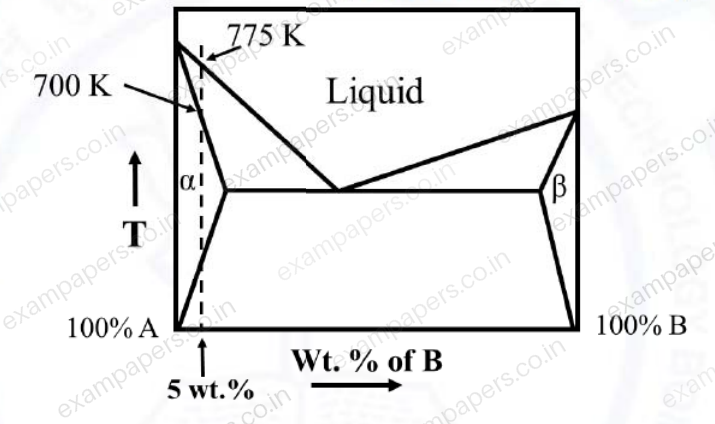
Log in to check the answer
You can attempt this question now. Sign in to view the answer key, explanations and discussion.Log in to check answerQuestion 51
Open questionMTNAT2 marksNeeds review
A thick steel plate containing 0.1 wt.% C is carburized at 950 °C. The plate’s surface carbon concentration is maintained at 1.1 wt.% C. After 9 hours, the depth (in mm) below the surface at which the carbon concentration is 0.6 wt.% C will be: __________ (round off to 2 decimal places).
Given: Diffusivity of carbon in γ-Fe at 950 °C =
m² s⁻¹
Error function table:z | 0.35 | 0.40 | 0.45 | 0.50 | 0.55 | 0.60 |
|---|---|---|---|---|---|---|
erf(z) | 0.3794 | 0.4284 | 0.4755 | 0.5205 | 0.5633 | 0.6039 |
Log in to check the answer
You can attempt this question now. Sign in to view the answer key, explanations and discussion.Log in to check answerQuestion 38
Open questionMTMCQ2 marksNeeds review
Determine the correctness or otherwise of the following Assertion [a] and the Reason [r]
Assertion [a]: The rate of homogenization in a dilute substitutional solid solution of B in A is controlled by the diffusivity of B.
Reason [r]: Atomic migration cannot occur along dislocations and grain boundaries.
Your answerChoose one option.
Log in to check the answer
You can attempt this question now. Sign in to view the answer key, explanations and discussion.Log in to check answerQuestion 13
Open questionMTMCQ1 markNeeds review
The fastest diffusing element in iron at 1100 °C is ____________.
Your answerChoose one option.
Log in to check the answer
You can attempt this question now. Sign in to view the answer key, explanations and discussion.Log in to check answerQuestion 25
Open questionMTNAT1 markNeeds review
A copper-aluminium diffusion couple develops a certain concentration profile after an isothermal treatment at 600°C for 10 hours. The time required to achieve the same concentration profile at 500°C is ________ (in hours to 1 decimal place)
Given: The interdiffusion coefficient for copper in aluminium at 500°C and 600°C are
and
.Log in to check the answer
You can attempt this question now. Sign in to view the answer key, explanations and discussion.Log in to check answer