
Metallurgical Engineering
GATE MT Fatigue PYQs
Build your understanding with focused practice from past exam papers.
How to practice Fatigue
Attempt a question, record the concept and assumptions, then check the available answer. Rework mistakes after revising the relevant concepts. Topic tags can overlap; review the question context.
Questions 1–10 of 25. Imported answers require independent review unless marked reviewed.
Question 17
Open questionMTMCQ1 markNeeds review
Deformation mechanism map of a given material is used for determining which one of the following properties?
Your answerChoose one option.
Log in to check the answer
You can attempt this question now. Sign in to view the answer key, explanations and discussion.Log in to check answerQuestion 37
Open questionMTMCQ2 marksNeeds review
Match the concepts listed in Column I with the associated terms listed in Column II
Column I
(P) Paris Law
(Q) Schmid Factor
(R) Larson-Miller Parameter
(S) Portevin - Le Chatelier Effect
Column II
(1) Creep
(2) Fatigue
(3) Dynamic Strain Aging
(4) Critical Resolved Shear Stress
Your answerChoose one option.
Log in to check the answer
You can attempt this question now. Sign in to view the answer key, explanations and discussion.Log in to check answerQuestion 40
Open questionMTMCQ2 marksNeeds review
Match the phenomena in Column I with the typical observations in Column II.
Column I
P. Dynamic strain aging
Q. Recrystalisation
R. Bauschinger effect
S. Superplasticity
Column II
Grain boundary sliding
Decrease in yield stress with a reversal of loading direction
Decrease in dislocation density
Serrations in stress-strain curve
Your answerChoose one option.
Log in to check the answer
You can attempt this question now. Sign in to view the answer key, explanations and discussion.Log in to check answerQuestion 60
Open questionMTNAT2 marksNeeds review
In polycrystalline Ni, Nabarro-Herring diffusion creep was found to be the rate controlling creep mechanism at a certain temperature.
At that temperature, if the steady state strain rate is 10
s
at a stress of 10 MPa, the steady state strain rate of 10
s
will be obtained at a stress value of _____ MPa (in integer).Assume that the same creep mechanism is rate controlling during the creep deformation.
Log in to check the answer
You can attempt this question now. Sign in to view the answer key, explanations and discussion.Log in to check answerQuestion 25
Open questionMTMCQ1 markNeeds review
Match the concepts listed in Column I with the phenomena listed in Column II.
Column I | Column II
P. Peierls-Nabarro stress | 1. Yield point phenomenon
Q. Cottrell’s atmosphere | 2. Fatigue
R. Paris law | 3. Dislocation glide
S. Considère’s criterion | 4. Onset of necking
Your answerChoose one option.
Log in to check the answer
You can attempt this question now. Sign in to view the answer key, explanations and discussion.Log in to check answerQuestion 48
Open questionMTMSQ2 marksNeeds review
A creep test of a pure polycrystalline metal is performed in tension and the creep strain rate is observed to decrease during the primary stage. The creep mechanism is later determined to be dislocation-climb-controlled. The observed decrease in creep strain rate is/are due to
Your answerSelect all correct options. You can choose more than one.
Log in to check the answer
You can attempt this question now. Sign in to view the answer key, explanations and discussion.Log in to check answerQuestion 54
Open questionMTNAT2 marksNeeds review
A steel bar is subjected to fatigue loading with a tensile mean stress. Given that the ultimate tensile strength is 1000
and the fatigue limit under fully reversed loading is 250
, the fatigue limit for a mean stress of 100
, considering Goodman relationship is _____
.
(Round off to the nearest integer)Log in to check the answer
You can attempt this question now. Sign in to view the answer key, explanations and discussion.Log in to check answerQuestion 63
Open questionMTNAT2 marksNeeds review
A large rectangular component is undergoing fully-reversed cyclic loading, and the component is known to grow the dominant fatigue crack from the outer surface. If the stress amplitude (
) is 100
and the critical stress intensity factor
of the material is 50
then the crack length at which the component will fail catastrophically is _____
.
(Round off to one decimal place)Given: The geometric factor
for this loading condition is 1.12.Log in to check the answer
You can attempt this question now. Sign in to view the answer key, explanations and discussion.Log in to check answerQuestion 22
Open questionMTMCQ1 markNeeds review
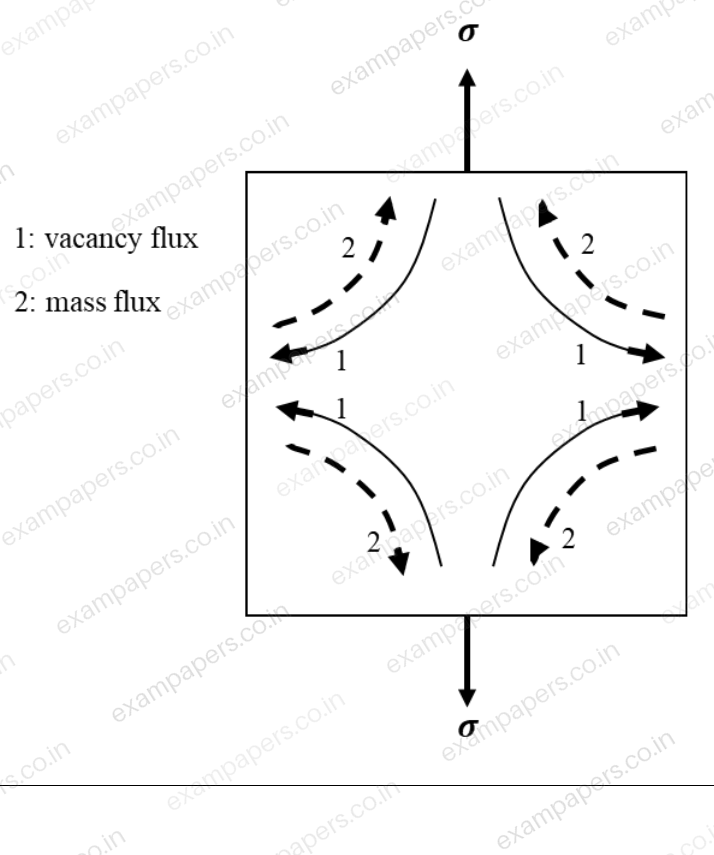
The mechanism of creep for a single crystal as depicted in the schematic is
Your answerChoose one option.
Log in to check the answer
You can attempt this question now. Sign in to view the answer key, explanations and discussion.Log in to check answerQuestion 27
Open questionMTMSQ1 markNeeds review
Which of the following is/are responsible for reducing the high cycle fatigue life of a component?
Your answerSelect all correct options. You can choose more than one.
Log in to check the answer
You can attempt this question now. Sign in to view the answer key, explanations and discussion.Log in to check answer