
Metallurgical Engineering
GATE MT format:mcq PYQs
Build your understanding with focused practice from past exam papers.
Questions 91–100 of 379. Imported answers require independent review unless marked reviewed.
Question 23
Open questionMTMCQ1 markNeeds review
Which one of the following crystal structure changes occurs during the transformation of mild steel from austenite to martensite?
Your answerChoose one option.
Log in to check the answer
You can attempt this question now. Sign in to view the answer key, explanations and discussion.Log in to check answerQuestion 24
Open questionMTMCQ1 markNeeds review
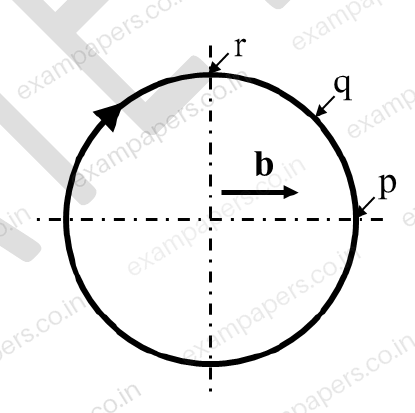
The figure shows a dislocation loop (shown by the solid circle), whose Burgers vector is
(shown by the horizontal arrow inside the dislocation loop). Identify the nature of the dislocation segment at locations p, q and r.The dash-dot lines show the horizontal and vertical diameters of the loop, and the arrow along the dislocation loop indicates the line vector.
Your answerChoose one option.
Log in to check the answer
You can attempt this question now. Sign in to view the answer key, explanations and discussion.Log in to check answerQuestion 25
Open questionMTMCQ1 markNeeds review
Match the concepts listed in Column I with the phenomena listed in Column II.
Column I | Column II
P. Peierls-Nabarro stress | 1. Yield point phenomenon
Q. Cottrell’s atmosphere | 2. Fatigue
R. Paris law | 3. Dislocation glide
S. Considère’s criterion | 4. Onset of necking
Your answerChoose one option.
Log in to check the answer
You can attempt this question now. Sign in to view the answer key, explanations and discussion.Log in to check answerQuestion 26
Open questionMTMCQ1 markNeeds review
Match the defects listed in Column I with the associated manufacturing processes listed in Column II.
Column I | Column II
P. Misrun | 1. Extrusion
Q. Earing | 2. Rolling
R. Alligatoring | 3. Casting
S. Chevron cracking | 4. Deep drawing
Your answerChoose one option.
Log in to check the answer
You can attempt this question now. Sign in to view the answer key, explanations and discussion.Log in to check answerQuestion 27
Open questionMTMCQ1 markNeeds review
Which one of the following processes is NOT involved in the sintering of a green compact of ceramic powders? Assume that sintering is performed without application of external pressure.
Your answerChoose one option.
Log in to check the answer
You can attempt this question now. Sign in to view the answer key, explanations and discussion.Log in to check answerQuestion 36
Open questionMTMCQ2 marksNeeds review
If
, where
are not identically zero, then the values of
areYour answerChoose one option.
Log in to check the answer
You can attempt this question now. Sign in to view the answer key, explanations and discussion.Log in to check answerQuestion 37
Open questionMTMCQ2 marksNeeds review
If
,
, thenYour answerChoose one option.
Log in to check the answer
You can attempt this question now. Sign in to view the answer key, explanations and discussion.Log in to check answerQuestion 38
Open questionMTMCQ2 marksNeeds review
As shown in the figure, the right end of a slender, long solid cylindrical metal rod of thermal conductivity
, length
and diameter
(
) is in contact with an infinite liquid heat sink. At steady-state, the temperatures of the right end of the rod and the heat sink are
and
, respectively. If the convection heat transfer coefficient between the liquid heat sink and the right end of the rod is
, then what would be the temperature of the left end of the rod,
, at steady-state? Assume that there is no other heat loss. 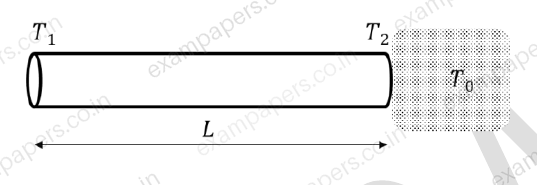
Your answerChoose one option.
Log in to check the answer
You can attempt this question now. Sign in to view the answer key, explanations and discussion.Log in to check answerQuestion 39
Open questionMTMCQ2 marksNeeds review
Match the dimensionless numbers listed in Column I with their applications to transport phenomena listed in Column II. Column I: P. Reynolds number; Q. Schmidt number; R. Prandtl number; S. Biot number. Column II: 1. Momentum and mass transfer; 2. Momentum and heat transfer; 3. Convective and conductive heat transfer; 4. Laminar to turbulent flow.
Your answerChoose one option.
Log in to check the answer
You can attempt this question now. Sign in to view the answer key, explanations and discussion.Log in to check answerQuestion 40
Open questionMTMCQ2 marksNeeds review
In a cubic lattice, what is the ratio of interplanar spacings of the (100), (110) and (111) planes? (Round off to two decimal places)
Your answerChoose one option.
Log in to check the answer
You can attempt this question now. Sign in to view the answer key, explanations and discussion.Log in to check answer